

Universal, Multipartite, and Shape-Dependent Entanglement
Entanglement in quantum field theory is not one number. A raw subregion entropy records local ultraviolet structure; a universal coefficient records what survives an allowed change of regulator; mutual information measures total correlation; negativity tests a partial transpose; reflected entropy studies a canonical purification; and an entropy cone constrains a whole vector of subsystem entropies. The central skill of this chapter is to choose the construction that answers the physical question and to carry its hypotheses all the way to the conclusion.
Helpful background. Review UV divergences and the area law, mutual information, anomaly coefficients, and topological entanglement diagnostics as needed.
Geometry, state, and measure
Section titled “Geometry, state, and measure”Before writing an entropy symbol, fix four pieces of data.
- Subsystem. Name the region and its algebra. A lattice factor, a split inclusion, and a sharp type-III local algebra do not supply the same density matrix.
- State. Distinguish a vacuum, thermal state, excited state, or restricted state. A conformal map that works for the vacuum need not work for an excitation.
- Ultraviolet prescription. State the cutoff, subtraction, counterterm class, and limiting family. A constant is universal only relative to the changes that are allowed.
- Information construction. Decide whether the question concerns entropy, total correlation, mixed-state entanglement, a canonical purification, spectral data, or multipartite compatibility.
The chapter map begins with these data and then separates four questions that are often conflated.
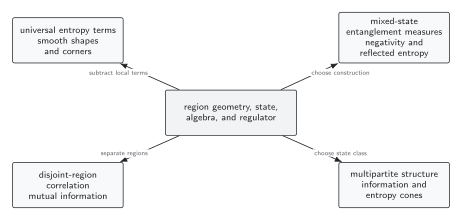
Matched subtraction can expose universal geometric data; positive separation leads to mutual information; a partial transpose or canonical purification defines a mixed-state measure; and a declared state class defines an entropy cone. These branches answer different questions. Schematic.
Read the arrows as operations, not as implications. Knowing a universal corner coefficient does not determine negativity. Knowing mutual information does not certify that the correlation is quantum. Satisfying a holographic entropy inequality does not prove that a state has a gravitational dual.
What the chapter establishes
Section titled “What the chapter establishes”The geometric route starts with universal terms, develops smooth shape variations, resolves corners and cusps, and checks exact interval, sphere, and cylinder geometries. The correlation route moves from disjoint mutual information to negativity and reflected entropy. The final route treats entropy cones, entanglement spectra, topological subtraction, thermal and excited states, and measure selection.
The comparison below is the chapter’s common reference. “Regulator independent” never means “assumption free”: the state, algebra, geometry, and limiting procedure still belong to the definition.
| Construction | State class | Region geometry | Regulator dependence | Physical meaning | Computability | Main ambiguity |
|---|---|---|---|---|---|---|
| Raw subregion entropy | Any regulated state | One chosen region and algebra | Power divergences and many finite terms depend on the prescription | Entropy of the regulated restriction | Replica methods, covariance matrices, tensor networks, or numerics | No intrinsic sharp-region density matrix in a type-III algebra |
| Universal log, sphere, or corner term | Usually vacuum CFT or a specified gapped phase | Fixed smooth shape, angle, or subtraction geometry | Invariant only under the declared counterterm and regulator class | Anomaly, stress-tensor, defect, or long-range data | Replica geometry, conformal maps, shape response, or continuum fits | A cutoff-independent-looking constant can still be scheme dependent |
| Mutual information | Any state on two declared algebras | Preferably regions at positive separation | Local boundary divergences cancel in a matched construction | Total classical and quantum correlation | Entropy differences, relative entropy, replica correlators, or bounds | It does not isolate mixed-state entanglement |
| Logarithmic negativity | Bipartite mixed or pure state with a transpose convention | Adjacent and disjoint regions have different ultraviolet behavior | Requires a type-I regulator, split, or algebraic replacement | Non-PPT entanglement and an entanglement monotone in its domain | Trace norm, even-replica continuation, or covariance methods | Fermionic transpose choices and zero-negativity bound entanglement |
| Reflected entropy | Mixed state in a fixed algebraic realization | Bipartite regions, with support and split data stated | The continuum split or cutoff limit must be controlled | Total correlation in the canonical doubled purification | Square-root purification, replicas, or Gaussian covariance data | The auxiliary copies are not a physical preparation |
| Entropy vector and cone | Generic quantum, stabilizer, holographic, or another declared class | All nonempty unions of the same parties | Each component needs one common subsystem prescription | Compatibility with homogeneous entropy inequalities | Entropy evaluation followed by linear or convex-cone tests | Special-class inequalities are not generic QFT laws |
| Entanglement spectrum | Regulated state with symmetry sectors declared | One cut, boundary condition, and physical size | High levels and additive modular-energy shifts are cutoff sensitive | Spectrum of a regulated reduced state; possible low-energy diagnostics | Correlation matrices, diagonalization, or tensor-network transfer data | Degeneracy alone need not diagnose a phase |
| Topological subtraction | Gapped 2+1-dimensional ground state under standard subtraction assumptions | Matched overlapping regions far from physical boundaries | Local boundary terms cancel; finite-size corrections remain | A long-range constant; γ = log D for intrinsic topological order in the standard domain | Balanced entropy combinations and size extrapolation | Interfaces, corners, gaplessness, or small regions can mimic a constant |
| Excess or thermal entropy | Matched vacuum, thermal, excited, or eigenstate family | Fixed region, volume, and ensemble | Ultraviolet cancellation requires identical short-distance structure | State-dependent entropy, including thermal and classical contributions | Conformal maps, relative entropy, free fields, or many-body numerics | A volume law is not automatically bipartite quantum entanglement |
The table also explains why no single “best entanglement measure” exists. A measure is strong when its invariances and operation class match the question, and misleading when they do not. Representative primary constructions include the CFT interval formulas Calabrese and Cardy 2004, §§2–3, the disjoint-region expansion Cardy 2013, §§2–3, the entanglement-spectrum diagnostic Li and Haldane 2008, pp. 010504-1–010504-4, and topological subtraction Kitaev and Preskill 2006, pp. 110404-1–110404-4.
A guided route
Section titled “A guided route”For geometry and universality, read the first four pages in order. Track which coefficient is being extracted, which local terms are subtracted, and whether the deformation is smooth or singular. The interval and sphere examples then show how exact conformal maps encode both the power and the limits of the result.
For correlation and mixed-state entanglement, begin with mutual information and keep one finite-dimensional compass in mind. With natural logarithms, a Bell pair has
A perfectly correlated classical bit has but , while a product state gives zero for all three. Thus equalities in special states do not make the constructions interchangeable.
For multipartite, spectral, and long-range questions, first make every subsystem choice consistent. Tripartite information can have either sign in ordinary quantum states; a finite entanglement spectrum belongs to a regulator; and topological subtraction requires a gapped scaling regime. Read the final measure-selection page whenever the desired conclusion is operational rather than purely geometric.
Universality has a domain
Section titled “Universality has a domain”The second map separates a potentially universal remainder from the choices that still delimit it.

A matched construction can remove local cutoff terms, but it does not remove the need to state geometry, counterterm class, algebra, state, replica continuation, partial transpose, purification, ensemble, or entropy-cone class. Schematic.
Three failure tests recur throughout the chapter.
- Vary an allowed scheme choice. If the proposed coefficient shifts under an allowed local counterterm, it was not universal in that comparison.
- Approach the edge of the domain. Send a smooth deformation toward a cusp, separated regions toward contact, or a gapped subtraction toward . A new singular term or failed scaling law marks a change of problem.
- Replace the construction. Exchange even for odd negativity replicas, change a fermionic transpose, choose another purification, or test a holographic cone as though it were the generic quantum cone. A changed answer is expected because the observable has changed.
The primary literature makes these boundaries concrete: smooth CFT shape response is controlled by the nonlocal second variation Faulkner, Leigh, and Parrikar 2016, §§2–5; negativity requires the even-replica continuation Calabrese, Cardy, and Tonni 2013, §§3–4; reflected entropy starts from the canonical square-root purification Dutta and Faulkner 2021, §§2–3; and holographic monogamy belongs to the holographic entropy cone Bao et al. 2015, §§2–4.
Check your preparation
Section titled “Check your preparation”1. Why can the coefficient of a logarithm be universal when the entropy itself diverges?
Answer
Local ultraviolet physics produces regulator-dependent power divergences. In a fixed dimension and geometry, an allowed local counterterm may be unable to change a particular logarithmic coefficient, so that coefficient can survive regulator changes even though the full entropy does not. One must still state the state, algebra, shape, and counterterm class.
2. Which of mutual information, negativity, and reflected entropy vanishes for a perfectly correlated classical bit?
Answer
Negativity vanishes because the state is separable and its partial transpose is positive. Mutual information and reflected entropy are both because both can detect total correlation, including classical correlation. This example prevents the three measures from being interpreted as interchangeable entanglement scales.
3. Does observing prove that a state is holographic?
Answer
No. The inequality is necessary for the standard holographic entropy cone, but many nonholographic states also satisfy it. Conversely, generic quantum states can have either sign, so a positive value rules out that holographic inequality without violating a generic quantum law.
4. What must be scaled in a topological-entanglement calculation?
Answer
Use the same regulator and matched subtraction geometry at several region sizes. Require the region widths, junction-smoothing scales, and distances to physical boundaries to be large compared with the correlation length, control corners, and fit the residual finite-size dependence. A stable constant without these controls is not yet a topological diagnosis.
References
Section titled “References”- Bao, Ning, Sepehr Nezami, Hirosi Ooguri, Bogdan Stoica, James Sully, and Michael Walter. “The Holographic Entropy Cone.” Journal of High Energy Physics 09 (2015): 130. DOI. Open PDF.
- Calabrese, Pasquale, and John Cardy. “Entanglement Entropy and Quantum Field Theory.” Journal of Statistical Mechanics (2004): P06002. DOI. Open PDF.
- Calabrese, Pasquale, John Cardy, and Erik Tonni. “Entanglement Negativity in Extended Systems: A Field Theoretical Approach.” Journal of Statistical Mechanics (2013): P02008. DOI. Open PDF.
- Cardy, John. “Some Results on the Mutual Information of Disjoint Regions in Higher Dimensions.” Journal of Physics A 46 (2013): 285402. DOI. Open PDF.
- Dutta, Souvik, and Thomas Faulkner. “A Canonical Purification for the Entanglement Wedge Cross-Section.” Journal of High Energy Physics 03 (2021): 178. DOI. Open PDF.
- Faulkner, Thomas, Robert G. Leigh, and Onkar Parrikar. “Shape Dependence of Entanglement Entropy in Conformal Field Theories.” Journal of High Energy Physics 04 (2016): 088. DOI. Open PDF.
- Kitaev, Alexei, and John Preskill. “Topological Entanglement Entropy.” Physical Review Letters 96 (2006): 110404. DOI. Open PDF.
- Li, Hui, and F. Duncan M. Haldane. “Entanglement Spectrum as a Generalization of Entanglement Entropy: Identification of Topological Order in Non-Abelian Fractional Quantum Hall Effect States.” Physical Review Letters 101 (2008): 010504. DOI. Open PDF.
Original QFT.org content:CC BY 4.0, unless an item supplies different terms. Third-party material retains its own terms.