

Recovery Thresholds, Access Structures, and Side Information
An access structure assigns a recovery quality to each allowed union of output regions. A set is authorized when it supports a decoder for the declared logical algebra, forbidden when it is approximately decoupled, and intermediate when it retains partial or task-dependent information. In QFT these categories are tolerance-, energy-, algebra-, and time-dependent; a sharp perfect-code threshold is a special case.
Required background. Decoupling and Subsystem Information Loss supplies the forbidden-set criterion. Helpful background. Recovery Maps and Approximate Markovianity supplies decoder bounds.
Authorized, forbidden, and intermediate sets
Section titled “Authorized, forbidden, and intermediate sets”Let be a family of accessible output algebras. For each , define
on logical algebra , with metric and energy domain fixed. Then
- is -authorized if ;
- is -forbidden if the channel to is within of a comparison channel that forgets the protected logical information;
- otherwise is intermediate for this task.
Monotonicity under access inclusion holds only when the larger observer may ignore extra degrees of freedom and has at least the same operation class. Causal timing, gauge constraints, or restricted controls can prevent a naive set-inclusion argument.
No-cloning and overlap constraints
Section titled “No-cloning and overlap constraints”Two disjoint observers cannot both recover an arbitrary unknown logical state with perfect fidelity. Hence two authorized sets for a perfect quantum secret-sharing code must intersect in a way consistent with the encoding and resource model. Approximate codes replace the contradiction by quantitative tradeoffs: two high-fidelity recoveries would induce an approximate cloning channel.
Classical subalgebras are different. Disjoint regions may both recover a commuting charge label without violating no-cloning. An access structure should therefore be attached to the protected algebra, not merely to a code-space dimension. The exact threshold construction for quantum secret sharing is developed by Cleve, Gottesman, and Lo 1999, pp. 648–651.
Side information and conditional access
Section titled “Side information and conditional access”Let denote side information supplied to a decoder. Define with the channel on . A set can be forbidden without and authorized with it. Examples include:
- a classical symmetry-sector label;
- a phase reference that permits sector-coherent operations;
- pre-shared entanglement;
- an earlier output register correlated with the input;
- a measurement record from monitored dynamics.
The side information must be counted as a resource and placed consistently in the complementary channel. Otherwise an apparent threshold can be manufactured by moving information between columns.
Geometry, time, and crossover widths
Section titled “Geometry, time, and crossover widths”In a spatially local dynamics, define a nested family and plot . A finite system usually shows a crossover rather than a step. Useful reported quantities are
with thresholds replaced by values appropriate to the chosen metric. Both depend on decoder class and finite-size rounding. The continuum claim requires convergence in physical units and a causal construction of the decoder.
Algebraic QFT formulation
Section titled “Algebraic QFT formulation”For local von Neumann algebras , authorized recovery means a normal completely positive map reconstructs the logical algebra from within the declared state/energy domain. Forbidden means restricted states on that algebra are indistinguishable with respect to the logical input. Continuity of complementary channels supplies the finite-dimensional quantitative bridge to recovery Kretschmann, Schlingemann, and Werner 2008, Theorem 1. Centers and superselection sectors can yield a classical authorized part and quantum forbidden part.
Do not infer access solely from geometric volume. Shape, causal domain, disconnected components, boundary algebras, and energy cost can change it.
Scientific evidence cutoff: 10 August 2026. The access-structure comparisons and literature-sensitive qualifications on this page are current through that date.
Exercises
Section titled “Exercises”Why may two spacelike separated regions both recover a logical charge but not an arbitrary logical qubit?
Solution
A charge label belongs to a commuting classical algebra and may be redundantly recorded. An arbitrary qubit includes noncommuting observables; perfect recovery by two disjoint regions would clone all states. The access structure must specify which logical algebra is protected.
Continue to Information Velocities and Causal Bounds for moving recovery thresholds and to Finite Size, Symmetry Sectors, and Scrambling False Positives for rounding and recurrence controls.
Diagnostic and failure maps
Section titled “Diagnostic and failure maps”The first diagram separates influence diagnostics from the decoupling and recovery test; inspect the declared output access, norm, and decoder class. The second collects mechanisms that can imitate scrambling and the controls that distinguish them.
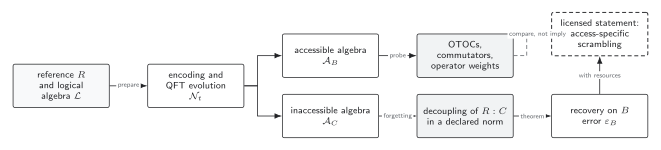
Scrambling becomes operational only after the input algebra, output access structure, side information, norm, energy restriction, and decoder class are declared. OTOCs and operator weights diagnose influence; decoupling and a recovery theorem license a statement about information access. The diagram is schematic and not to scale.
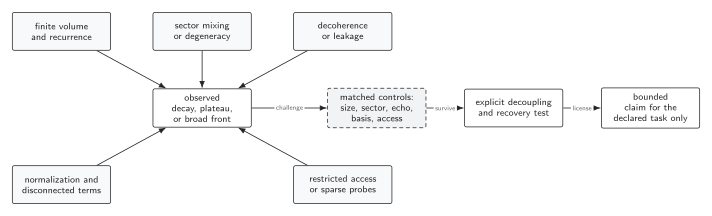
Several mechanisms can suppress a correlator or produce an entropy plateau without delocalizing recoverable quantum information. Sector resolution, recurrence windows, normalization checks, access variation, and an explicit recovery test distinguish these alternatives. The diagram is schematic.
References
Section titled “References”- Cleve, Richard, Daniel Gottesman, and Hoi-Kwong Lo. “How to Share a Quantum Secret.” Physical Review Letters 83 (1999): 648–651. DOI. Open PDF.
- Kretschmann, Dennis, Dirk Schlingemann, and Reinhard F. Werner. “A Continuity Theorem for Stinespring’s Dilation.” Journal of Functional Analysis 255 (2008): 1889–1904. DOI. Open PDF.
Original QFT.org content:CC BY 4.0, unless an item supplies different terms. Third-party material retains its own terms.