

Reproducible Reporting Standard for QFT Information
A reproducible QFT information result includes enough structured material for an independent researcher to reconstruct the target, obtain or regenerate the inputs, run the analysis, verify intermediate identities, and recover the bounded conclusion. A polished plot and final notebook are insufficient if calibration, rejected records, environment, random seeds, or continuum-fit alternatives are absent.
Required background. Claim–Evidence Records, Replication, and Retraction Handling supplies evidence history.
Helpful background. Continuum Extrapolation, Bias, and Uncertainty supplies the complete uncertainty record.
Minimum reproducibility packet
Section titled “Minimum reproducibility packet”Scientific target. State the observable or information functional, algebra or region, state family, units, metric and Fourier conventions, regulator, and evidence cutoff.
Inputs. Provide raw or minimally processed data, selection and exclusion rules, calibration observations, synthetic-data generator when used, licenses or access conditions, and cryptographic hashes.
Analysis. Freeze source code, dependency lockfile or container specification, random seeds, commands, configuration, and hardware-sensitive precision choices. Explain every manual intervention.
Intermediate checks. Include dimensional analysis, normalization identities, physicality constraints, exact small-system values, convergence tables, residuals, and negative controls.
Uncertainty. Preserve bootstrap or posterior draws when feasible, covariance matrices, nuisance priors, deterministic bounds, continuum fit families, and coverage tests.
Outputs. Link each table and figure to the generating inputs and code. Supply semantic text or tables for visual relationships and accessible labels.
Claim. State the strongest conclusion, domain, alternatives excluded, alternatives remaining, and every assumption required to transfer the result to continuum QFT.
Two worked packages
Section titled “Two worked packages”An entropy package contains mode definitions, region endpoints, raw measurement or configuration records, calibration, estimator order , nonlinear-bias treatment, covariance, cutoff/volume/truncation grid, fit alternatives, exact Gaussian benchmark, and the final regulated or continuum claim.
A detector-channel package contains trajectory, switching, spatial profile, probe preparations, detector transfer calibration, raw outcomes, likelihood, identifiability singular values, nuisance covariance, held-out probes, energy domain, model-discrepancy tests, and the parameter or effective-response conclusion.
For both, a single command or short documented sequence should regenerate intermediate tables before final assets. The independent researcher should not need to infer a hidden directory, download an unversioned file, or click through an interactive interface to obtain numerical values.
Reproduction levels
Section titled “Reproduction levels”| Level | New element | What it tests |
|---|---|---|
| rerun | same code and data | environment and deterministic execution |
| independent implementation | new code, same data | equations and algorithm interpretation |
| repeated acquisition | new data, same protocol | sampling, drift, and instrument stability |
| independent method | different estimator or observable | method-specific bias |
| independent platform/regulator | different hardware or discretization | broader physical and continuum transfer |
Do not collapse these into one word. Report exactly which stages are independent.
Removal test
Section titled “Removal test”Remove each field in turn and ask what becomes impossible. Without the mode map, the subsystem is undefined. Without calibration covariance, uncertainty is incomplete. Without raw or sufficient-statistic records, alternative estimators cannot be tested. Without code version and environment, results may not rerun. Without fit alternatives, the continuum claim cannot be stress tested. Without a dated claim, later corrections cannot be interpreted.
The FAIR principles guide durable metadata and reuse Wilkinson et al. 2016, Principles F1–R1. FAIR does not mean unrestricted access: lawful restrictions can be stated while metadata, checksums, and an access procedure remain available.
Exercises
Section titled “Exercises”Notebook only. A notebook reruns on the author’s laptop but has no lockfile or raw-data provenance. What has been demonstrated?
Solution
Only local rerunnability in one undocumented environment. Independent reproduction still needs inputs, versions, environment, commands, and the map from raw records to notebook cells.
Rights-limited data. Can a result be reproducible when raw data cannot be public?
Solution
Potentially. Publish complete metadata, hashes, schema, calibration and analysis code, synthetic or redacted test data, and a lawful access procedure. State which verification steps remain unavailable without restricted data.
Inference and failure-control maps
Section titled “Inference and failure-control maps”The first diagram traces the complete path from raw records to a bounded information claim; inspect the assumption attached to every arrow. The second maps shared and method-specific failure channels to held-out tests, regulator variation, replication, and correction.
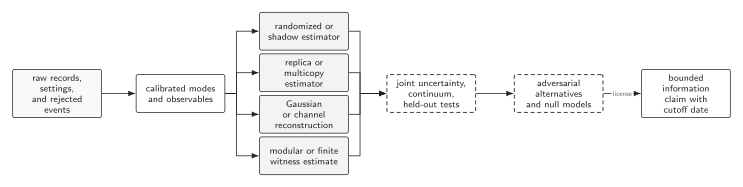
Entropy, tomography, witness, and recovery methods enter at the estimator stage, but all share calibration, uncertainty, continuum, and alternative-model tests. The final statement is no stronger than the least validated arrow. The diagram is schematic and not to scale.
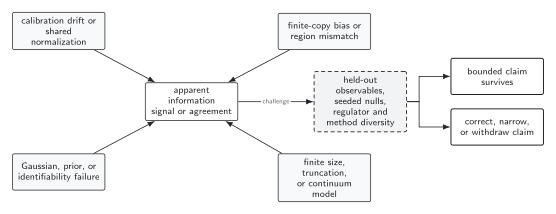
Different estimators can share the same calibration or normalization bias, so numerical agreement is not automatically independent replication. Adversarial nulls, held-out observables, regulator variation, and genuinely independent implementations set the claim ceiling and trigger correction when needed. The diagram is schematic.
References
Section titled “References”- Wilkinson, Mark D., Michel Dumontier, IJsbrand Jan Aalbersberg, et al. “The FAIR Guiding Principles for Scientific Data Management and Stewardship.” Scientific Data 3 (2016): 160018. DOI.
Original QFT.org content:CC BY 4.0, unless an item supplies different terms. Third-party material retains its own terms.