

Regulated Entropy and Replica Methods
Entanglement entropy in QFT is calculated through regulated density matrices, correlation spectra, or replicated path integrals. This chapter makes the equivalence and the limits of those methods explicit. Its central rule is simple: define the regulated subsystem and integer moments first; only then discuss analytic continuation, subtraction, or a continuum claim.
Helpful background. Restricted states and factorization failure distinguish a continuum restriction from a regulated density matrix; Euclidean correlators and Gaussian fields supply the path-integral and free-field inputs; heat kernels and spectral determinants supply spectral tools; direct sums and tensor products fix the regulated factorization; continuum extrapolation fixes physical matching; and conformal boundaries and defects supply the specialist defect language.
The regulated entropy problem
Section titled “The regulated entropy problem”Choose a regulator , a region , a state, boundary and center data, and an order of ultraviolet and infrared limits. When these choices produce a type-I factorization, the basic objects are
A Gaussian calculation obtains from the restricted covariance spectrum, as in Peschel 2003, pp. L205–L208. A replica calculation obtains the same integer moments from , as in Calabrese and Cardy 2004, §§ 2–3. The von Neumann entropy
requires a controlled function near , not merely a handful of integer values. The diagram shows which parts are exact at fixed regulator and where an additional inference enters.
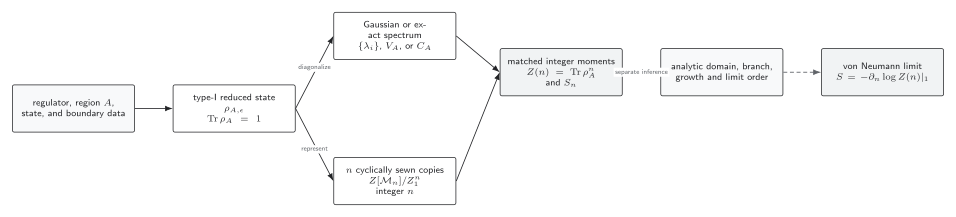
The spectral and replica routes must agree on matched integer moments at fixed regulator. Continuation from those moments to is logically separate and must state its analytic domain, branch, growth conditions, and order of limits. Schematic.
Readers should already understand why a sharp continuum region need not factorize and how to choose an algebraic, split, or regulated subsystem. This chapter does not assign a bare density matrix or von Neumann entropy to an intrinsic type-III local algebra. It also does not replace the numerical volumes’ general lattice and Monte Carlo algorithms or the conformal volume’s treatment of defect-CFT data.
Methods and licensed conclusions
Section titled “Methods and licensed conclusions”| Method | Required input | Direct output | Main validity check |
|---|---|---|---|
| Density-matrix or exact diagonalization | Finite factorization, normalized state, and declared subsystem | Spectrum, Sn, and S at fixed regulator | Trace one, positivity, pure-state complement spectrum, and exact limits |
| Gaussian correlation matrix | Gaussian state and canonically normalized restricted covariance | Entropy from bosonic symplectic or fermionic occupation eigenvalues | Uncertainty cone or 0 ≤ CA ≤ 1, plus a non-Gaussianity check |
| Replica path integral | Integer n, Euclidean state preparation, cyclic sewing, and Z1n normalization | Tr ρAn and integer Rényi entropy | Correct n = 1 limit, complement symmetry, and a spectral cross-check |
| Analytic continuation | Analytic domain, branch, growth or spectral control, and integer data covariance | Noninteger Rényi data or the derivative at n = 1 | Alternative admissible continuations and nearby-singularity sensitivity |
| Continuum extrapolation | Fixed physical geometry, multiple cutoffs, infrared control, and a finite target | Universal coefficient, difference, derivative, or continuum combination | Fit-window, discretization, orientation, and finite-volume stability |
The raw entropy itself is usually cutoff dependent, as the free-field area-law calculation of Srednicki 1993, pp. 666–669 illustrates. This does not make it useless: it is a well-defined property of the regulated model and a source of universal terms when the appropriate local divergences and scheme choices are separated. It does mean that two bare entropies cannot be compared across regulators by matching a symbol called alone.
A guided route through the chapter
Section titled “A guided route through the chapter”Begin with Entropy of a Regulated Subregion to define the state, subsystem, cutoff, and limit order. Then read Replica Trick and Branched Geometries for the integer moments and Rényi Entropies and Replica Analytic Continuation for the additional hypotheses behind . Twist Operators, Replica Defects, and Sewing Data repackages cyclic sewing as a defect insertion, while Analytic Continuation: Uniqueness and Failure Modes shows how sparse integer data, branches, and saddle exchange can defeat an extrapolation.
For direct free-theory calculations, use Gaussian States and Correlation-Matrix Entropy and Entanglement Entropy of Free Fields. Zero Modes, Boundaries, and Infrared Sensitivity should be read before taking a massless or infinite-volume limit.
The final arc separates short-distance structure from a continuum result. Ultraviolet Divergences and the Area Law develops the local surface expansion; Entropy Counterterms and Renormalization Ambiguities identifies the allowed scheme shifts. Numerical Replica and Thermodynamic-Integration Estimators treats fixed-cutoff estimators, and From Lattice Entropy to a Continuum Claim treats physical matching and extrapolation. End with Verifying Replica and Entropy Calculations for independent checks and seeded-error tests.
From a calculation to a claim
Section titled “From a calculation to a claim”Every transition in an entropy calculation has a characteristic failure. The upper row in the next figure gives the minimal sequence of checks. The dashed boxes identify what an omitted check permits one to claim incorrectly.
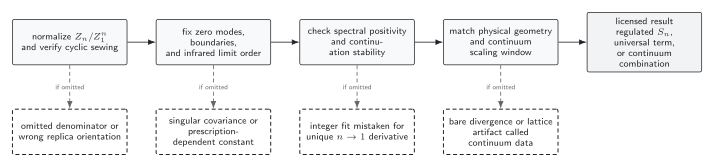
Normalization and sewing establish the intended integer moment; zero-mode and boundary control establish the infrared state; spectral and continuation checks control ; geometry matching and a scaling window establish the continuum target. Omitting any stage licenses only a weaker conclusion. Schematic.
These checks should be kept independent where possible. A replica code and a correlation-matrix code test different constructions. Two replica codes built on the same sewing routine do not test the routine’s orientation. Likewise, several fit families applied to the same sparse integer moments do not establish a uniqueness theorem.
Check your understanding
Section titled “Check your understanding”- Explain why computes an integer moment but does not by itself define a unique derivative at .
- For a periodic massless scalar, state which infrared datum must be added before its finite-volume entropy is defined.
- Name a regulator change that may alter the area coefficient and a test that a purported universal term should survive.
- Separate the error budget of a numerical replica result into fixed-cutoff estimator errors, continuation errors, and continuum-limit errors.
- Describe one cross-check that does not share the replica construction’s normalization or sewing data.
A complete answer identifies the target at fixed regulator, the hypotheses used at every continuation or limit, and the strongest claim that remains invariant under the relevant adversarial changes.
References
Section titled “References”- Calabrese, Pasquale, and John Cardy. “Entanglement Entropy and Quantum Field Theory.” Journal of Statistical Mechanics: Theory and Experiment 2004 (2004): P06002. arXiv; DOI.
- Peschel, Ingo. “Calculation of Reduced Density Matrices from Correlation Functions.” Journal of Physics A: Mathematical and General 36 (2003): L205–L208. arXiv; DOI.
- Srednicki, Mark. “Entropy and Area.” Physical Review Letters 71 (1993): 666–669. arXiv; DOI.
Original QFT.org content:CC BY 4.0, unless an item supplies different terms. Third-party material retains its own terms.