

Quantum Error Correction in Continuum Fields
Quantum error correction in QFT asks whether a declared logical operator algebra can be preserved against a declared noise channel on a declared state or energy domain. The answer must include an encoder, the correctable algebra, the noise and its complement, a recovery map, an error metric, locality and symmetry restrictions, and the regulator-to-continuum limit. Finite-dimensional code language remains useful, but tensor factors, unrestricted channel norms, and sharply localized logical operators do not transfer automatically to continuum local algebras.
Helpful background. Recovery Maps and Approximate Markovianity supplies recovery inequalities. Completely Positive Maps and Causal Quantum Channels supplies the operational channel model, and Direct Sums, Tensor Products, and Index Structure supplies regulated code spaces. Von Neumann Factors and Type-III Local Algebras and Superselection Rules and Accessible Entanglement identify continuum and symmetry obstructions. Edge Modes, Subregions, and Factorization and MERA, cMERA, and Renormalization Geometry provide two common regulated interfaces. None is required merely to enter the overview.
A complete field-code task
Section titled “A complete field-code task”Let encode the logical system into a regulated physical algebra. A complete task is
where is the protected logical algebra; is the logical state domain, defined for example by an encoded physical-energy bound; includes the physical algebra and its region assignment; and are a noise channel and a chosen complementary channel; and is the allowed recovery family, including decoder support, ancillas, communication, time, and charged resources. The distance , tolerance , and constraints fix the metric, energy, locality, causality, and covariance requirements. Finally, specifies matching maps, the topology of convergence, fixed physical regions, and the order of limits.
Using the physical-output convention, exact full-subspace correction is the special case
for every . Operator-algebra QEC asks only that the Heisenberg action on be restored; gauge degrees of freedom may change. Approximate QEC replaces equality by a uniform bound on the declared domain and recovery family.
The continuum claim is not obtained by dropping . One must identify limiting physical algebras, keep erasure regions at fixed physical size, control energy and recovery errors uniformly, and show that the encoders and recoveries converge in the topology relevant to the task.
Choose a route
Section titled “Choose a route”| Goal | Route | Stop when you can… |
|---|---|---|
| State the task | Error Models and Recovery Conditions → Operator-Algebra Quantum Error Correction | distinguish full-subspace recovery from correction of a logical algebra |
| Quantify approximation | Approximate Recovery and Information–Disturbance → Energy-Constrained Error Metrics | match environmental leakage to recovery error in a nontrivial field norm |
| Treat spatial loss | Erasure Correctability for Field Subregions → Complementary Recovery and Cleaning | specify the region algebra, center, complement, and logical representatives |
| Impose spacetime constraints | erasure correctability → Locality, Code Distance, and Causality | distinguish site distance from fixed physical protection and decoding time |
| Enforce covariance | Symmetry and Covariance Constraints on QEC | state the exact no-go hypotheses and the asymmetry resource that relaxes them |
| Treat gauge systems | operator-algebra QEC → Subsystem, Gauge, and Constraint Codes | separate physical gauge redundancy from code gauge degrees of freedom |
| Seek a continuum code | Continuum and Type-III Obstacles → Validating a Continuum Code Limit | prove algebra matching and a cutoff-uniform recovery estimate |
| Interpret scale transformations | Renormalization as Encoding: Uses and Caveats → Tensor Networks as Approximate Encodings | identify the retained logical algebra rather than calling every coarse graining a code |
| Use several reconstructions | Redundant Reconstruction and Logical Equivalence | show representatives agree on the code without creating independent copies |
From an error model to a licensed guarantee
Section titled “From an error model to a licensed guarantee”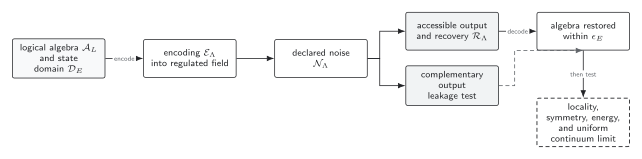
Correctability relates one logical algebra, one noise channel and complement, one state or energy domain, and one recovery class. Environmental forgetting supports recovery only in the matching metric; locality, symmetry, and continuum convergence are additional tests. The diagram is schematic and not to scale.
In the same physical-output convention, let represent , so that . Exact algebra correction asks for
The finite-subspace criterion originates with Knill and Laflamme Knill and Laflamme 1997, §§II–III; its Heisenberg algebra generalization is due to Bény, Kempf, and Kribs Bény, Kempf, and Kribs 2007, pp. 1–3. The complementary channel must forget precisely the noncommuting logical information that is to be recoverable, with quantitative stability controlled by continuity of Stinespring representations Kretschmann, Schlingemann, and Werner 2008, Theorem 3. Classical center information can remain available to both outputs without violating no cloning.
Compare code claims
Section titled “Compare code claims”| Proposal | Logical algebra | Noise and domain | Recovery metric | Locality and symmetry | Regulator or limit | Maximum justified guarantee |
|---|---|---|---|---|---|---|
| Finite oscillator code | Matrix algebra on bounded-energy logical states | Loss, erasure, or dephasing on states with mean energy no greater than E | Energy-constrained channel distance | Declared mode controls | Convergent Fock truncation | Approximate recovery below the reported error |
| Spatial erasure code | Subalgebra represented outside region A | Erasure of the algebra assigned to A | Algebra or code-state norm | Recovery support and causal time | Fixed physical A as spacing a → 0 | Cleaning or recovery for the chosen algebra |
| Covariant code | Charge-carrying logical algebra | Symmetry-respecting noise | Worst-case or entanglement fidelity | Covariant encoder and recovery; reference frames charged | Controlled energy and size scaling | Bound consistent with the covariance tradeoff |
| Gauge or subsystem code | Logical commutant modulo the code-gauge algebra | Physical gauge-preserving channel | Operator-algebra error | Gauss constraints and center convention | Matched physical algebra | Correctability of logical, not gauge, observables |
| RG or tensor-network code | Explicitly retained low-energy algebra | Discarded modes or network legs | Observable reconstruction error | Network causal cones and symmetry | Bond and cutoff refinement | Approximate encoding within tested observables |
| Continuum algebraic code | Von Neumann logical algebra | Normal channel on a stated representation | Energy or algebra topology | Spacetime-local recovery restrictions | Uniform limiting maps | A theorem only under its full analytic hypotheses |
Continuum failure modes
Section titled “Continuum failure modes”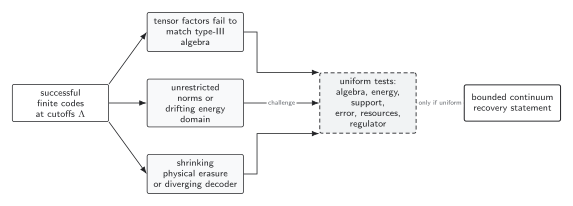
A sequence of successful finite codes does not establish a continuum code unless its logical algebra, physical erasure region, energy domain, recovery error, and locality bounds converge uniformly. Type-III structure and regulator-dependent tensor factors require an algebraic target. The diagram is schematic.
The fourteen pages
Section titled “The fourteen pages”- Error Models, Codes, and Recovery Conditions fixes the complete QEC tuple and exact test.
- Operator-Algebra Quantum Error Correction protects an algebra without demanding recovery of every gauge degree of freedom.
- Approximate Recovery and Information–Disturbance relates complementary leakage to achievable correction.
- Energy-Constrained Errors and Infinite-Dimensional Norms makes infinite-dimensional error bounds nontrivial.
- Erasure, Subregions, and Correctability turns a region loss into an algebraic noise channel.
- Complementary Recovery and Cleaning Relations moves logical representatives away from a correctable erasure.
- Locality, Code Distance, and Causal Constraints adds fixed physical support and decoding-time bounds.
- Symmetry, Covariance, and QEC Constraints states exact and approximate covariance tradeoffs.
- Subsystem and Gauge-Code Structures in QFT separates logical, code-gauge, constraint, and center algebras.
- Continuum Codes and Type-III Obstacles identifies failed finite-dimensional assumptions.
- Regularization, Continuum Limits, and Code Validation supplies a uniform convergence protocol.
- Renormalization and Coarse Graining as Encoding bounds the QEC analogy for coarse graining.
- Tensor Networks as Encoding Maps: Scope and Limits tests a regulated network as an encoder.
- Reconstruction from Redundant Encodings explains multiple representatives without cloning.
Boundaries and conventions
Section titled “Boundaries and conventions”Channels act on density operators in Schrödinger picture unless a displayed dagger indicates Heisenberg picture. A page states whether trace distance contains the factor , which fidelity convention is used, and whether a channel norm is energy constrained. Erasure means replacement of or loss of access to a declared algebra, not destruction of a geometric set without an algebra assignment.
Gauge and symmetry structure is developed in Volume 3, tensor-network implementation in Volume 8, and topological-matter applications in Volume 12. Holographic QEC, entanglement-wedge reconstruction, and islands belong to Volume 15; they do not define generic field codes. Volume 16 supplies theorem-first infinite-dimensional generality. A finite-code verification must state its truncation, noise model, decoder, and acceptance criteria; it is not by itself a threshold calculation.
Review the chapter
Section titled “Review the chapter”Exact criterion. A code corrects erasure of . What must the complementary output fail to learn?
Verification criteria
It must fail to distinguish the noncommuting logical information in the correctable algebra on the stated code domain. Classical center labels may remain. The claim must name the algebra, erasure channel, complementary channel, and equality or error metric.
Continuum test. A lattice code distance grows as . Why is that not yet improving physical protection?
Verification criteria
The counted sites may cover a fixed or even shrinking physical distance. One must hold the physical erasure region and energy domain fixed, translate logical algebras, and show recovery error and decoder locality converge uniformly as .
Redundancy. How can two regions reconstruct one logical operator without cloning?
Verification criteria
The two physical representatives have the same action after projection to the code. They are not two independent logical systems and can differ outside the code; noncommuting logical algebras cannot both be independently available in disjoint commuting regions under the same assumptions.
References
Section titled “References”- Bény, Cédric, Achim Kempf, and David W. Kribs. “Generalization of Quantum Error Correction via the Heisenberg Picture.” Physical Review Letters 98 (2007): 100502. DOI. Open PDF.
- Knill, Emanuel, and Raymond Laflamme. “Theory of Quantum Error-Correcting Codes.” Physical Review A 55 (1997): 900–911. DOI. Open PDF.
- Kretschmann, Dennis, Dirk Schlingemann, and Reinhard F. Werner. “The Information-Disturbance Tradeoff and the Continuity of Stinespring’s Representation.” IEEE Transactions on Information Theory 54 (2008): 1708–1717. DOI. Open PDF.
Original QFT.org content:CC BY 4.0, unless an item supplies different terms. Third-party material retains its own terms.