

Additivity, Haag Duality, and Information Completeness
Additivity says how algebras of smaller regions generate that of a larger region; Haag duality says whether the algebra of a causal complement exhausts the commutant. Together they determine whether the net has omitted observables, but neither is automatic in disconnected, gauge, charged, or topologically nontrivial settings.
Required background. Use the net of local observables. Helpful background. Type-III factors clarify that duality concerns commutants, not traces.
Additivity and duality are different tests
Section titled “Additivity and duality are different tests”For a cover , additivity requires
where denotes the generated von Neumann algebra. Weak, strong, and causal additivity use different admissible covers or causal completions, so the version must be named.
Locality gives only
Haag duality is equality. If the inclusion is strict, the dual net contains operators compatible with every observable in the causal complement but absent from the original assignment. The discrepancy can encode charged intertwiners, Wilson or disorder operators, boundary data, or topology.
The Haag–Kastler axioms establish the basic net relations but do not make duality universal Haag and Kastler 1964, pp. 848–861.
The structural map places Additivity, Haag Duality, and Information Completeness among sharp local algebras, split inclusions, and regulated or operational substitutes.
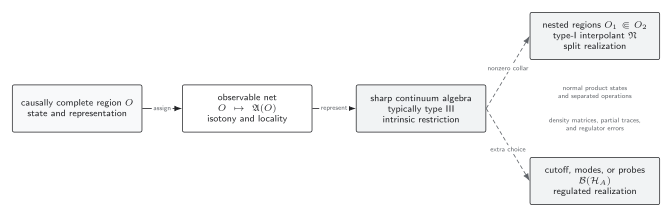
A causally complete region determines a sharp local algebra, usually type III. A nonzero split collar or an explicit cutoff, mode selection, or probe model can instead supply a type-I realization; these alternatives enable ordinary density matrices but retain different physical approximations. Schematic, not to scale.
Information completeness
Section titled “Information completeness”Suppose two normal states agree on . They are indistinguishable by the admitted local measurements. If , an observable in the difference may distinguish their extensions. Calling the original algebra “information-complete” therefore depends on the physical observable choice, not merely on causal support.
For a simply connected region in a neutral free field, duality often holds in the vacuum representation. For disconnected regions or gauge theories, it can fail. A gauge region may have electric-flux or edge data that commute with strictly complementary local observables yet are not generated by the naive interior algebra. An information-theoretic conclusion therefore requires an explicit gauge algebra and center choice; entropy, separability, and reconstruction depend on that choice.
A comparison procedure
Section titled “A comparison procedure”To test a region :
- compute or characterize ;
- take its commutant in the stated representation;
- compare generators of and ;
- identify any missing operators and their localization or sector meaning;
- repeat for disconnected and multiply connected regions.
The comparison is representation-sensitive. Charged representations can alter duality properties even when the abstract observable net is unchanged.
Failure of naive reconstruction
Section titled “Failure of naive reconstruction”If one assumes equality from locality alone, a reconstruction map may omit a boundary or topological operator. The failure is exposed by choosing a state pair that agrees on but differs on an element of . The strongest surviving claim is reconstruction relative to the explicitly chosen algebra, not reconstruction of every operator compatible with the causal complement.
Before applying this result, use the validity map to keep the algebra, state, operation class, resources, and approximation fixed.
For a side-by-side statement of the chapter’s subsystem choices, use the subsystem comparison table.
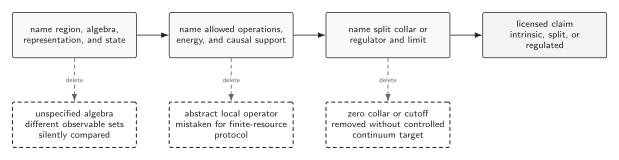
Every local-information claim must specify the represented algebra and state, the allowed operations and resource support, and any split collar or regulator. The dashed lower boxes show what fails when the algebra, protocol, or limiting prescription is left implicit. Schematic.
References
Section titled “References”- Haag, Rudolf, and Daniel Kastler. “An Algebraic Approach to Quantum Field Theory.” Journal of Mathematical Physics 5 (1964): 848–861. DOI.
Further reading
Section titled “Further reading”- Doplicher, Sergio, Rudolf Haag, and John E. Roberts. “Local Observables and Particle Statistics I.” Communications in Mathematical Physics 23 (1971): 199–230. DOI.
Original QFT.org content:CC BY 4.0, unless an item supplies different terms. Third-party material retains its own terms.