

Erasure, Subregions, and Correctability
Erasure of a QFT subregion is correctable when the declared logical algebra can be reconstructed from the complementary physical algebra after access to the region is discarded. The claim depends on how the region algebra and its center are defined, which regulator or split inclusion is used, and whether recovery must be local and energy bounded. A geometric set alone is not an erasure channel.
Required background. Error Models, Codes, and Recovery Conditions supplies the channel criterion.
Helpful background. Choosing a Continuum Subsystem: Algebra, Split, or Regulator supplies the region-to-algebra assignment.
Erasure as a channel on an algebra
Section titled “Erasure as a channel on an algebra”In a finite tensor regulator , erasure of may be modeled by
with output on , or by replacing with a fixed flag state. Its complement receives the erased subsystem. A code corrects the erasure exactly when the reduced state on is independent of the logical state, including correlations with a reference.
For a logical algebra , the condition is weaker: the erased output may retain information in but not the protected noncommuting algebra, as formalized by the Heisenberg algebra criterion Bény, Kempf, and Kribs 2007, pp. 1–3. Equivalently, every physical representative of a correctable logical observable has a representative on the complement satisfying, on the physical code projector ,
where denotes any physical representative of the logical observable. This is an equality of actions on the code, not an operator identity on the full Hilbert space.
Region algebras in the continuum
Section titled “Region algebras in the continuum”In continuum QFT, assign a local von Neumann algebra and a complementary accessible algebra, often . Haag duality, boundary conditions, gauge centers, and global constraints determine whether the complement is exactly the commutant. There is generally no trace over a canonical factor .
The algebraic erasure asks whether a normal channel that forgets can be reversed on the encoded logical algebra. With a split buffer, one may insert a type-I factor between nested regions and compare regulated tensor-factor calculations, but the split distance and energy cost remain part of the approximation.
Changing an electric to magnetic center convention in a gauge regulator changes the observables assigned to the cut and can change the correctable logical set; Casini, Huerta, and Rosabal give an explicit algebraic analysis of these choices Casini, Huerta, and Rosabal 2014, §§2–4. Report the convention and test the result under physically relevant alternatives.
A regulated spatial test
Section titled “A regulated spatial test”Encode a logical mode into a lattice field and erase a contiguous set of sites representing a fixed physical interval . Perform two checks:
- compute environment distinguishability or the algebraic error products;
- construct logical representatives on and an explicit recovery.
Refine the lattice while keeping the endpoints and smearing profiles fixed. If the number of erased sites stays fixed, the physical erasure shrinks and apparent distance growth is meaningless. If the logical wave packets sharpen with , their energy may diverge and leave the claimed domain.
Approximate and causal recovery
Section titled “Approximate and causal recovery”Approximate correctability is stated in a norm on the code or energy domain. A mathematically global recovery on all of can exist while no decoder confined to a laboratory neighborhood succeeds within the desired time. Add recovery support, control bounds, and causal duration as independent constraints.
Exercises
Section titled “Exercises”Reference test. Why must the erasure criterion include logical states entangled with a reference?
Solution
It tests preservation of coherences and the complete logical channel. Independence of the erased marginal for a chosen basis can coexist with leakage of relative phase or other superpositions.
Shrinking erasure. A code corrects ten lattice sites for every spacing . What additional scaling is needed?
Solution
Ten sites cover physical length , which tends to zero. A continuum protection claim fixes a physical region and therefore erases a number of sites growing like its size divided by , while keeping code energy and recovery error controlled.
Recovery and continuum maps
Section titled “Recovery and continuum maps”The first diagram follows the task from logical algebra through noise, environmental leakage, and constrained recovery; inspect which metric and recovery family support the guarantee. The second identifies the additional uniformity tests required before finite-regulator correctability becomes a continuum field-code statement.
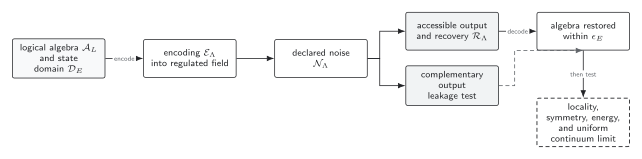
Correctability relates one logical algebra, one noise channel and complement, one state or energy domain, and one recovery class. Environmental forgetting supports recovery only in the matching metric; locality, symmetry, and continuum convergence are additional tests. The diagram is schematic and not to scale.
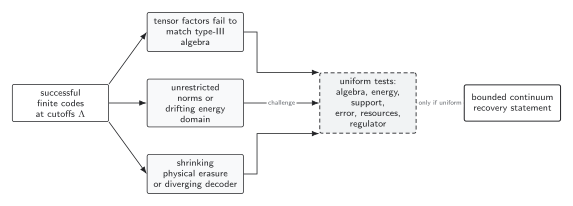
A sequence of successful finite codes does not establish a continuum code unless its logical algebra, physical erasure region, energy domain, recovery error, and locality bounds converge uniformly. Type-III structure and regulator-dependent tensor factors require an algebraic target. The diagram is schematic.
References
Section titled “References”- Bény, Cédric, Achim Kempf, and David W. Kribs. “Generalization of Quantum Error Correction via the Heisenberg Picture.” Physical Review Letters 98 (2007): 100502. DOI. Open PDF.
- Casini, Horacio, Marina Huerta, and José Alejandro Rosabal. “Remarks on Entanglement Entropy for Gauge Fields.” Physical Review D 89 (2014): 085012. DOI. Open PDF.
Original QFT.org content:CC BY 4.0, unless an item supplies different terms. Third-party material retains its own terms.