

Scrambling, Decoupling, and Recoverability
Scrambling is an operational statement about where initially localized quantum information can still be recovered after time evolution. The useful question is therefore not whether one correlator decays, but which input algebra was encoded, which output regions are accessible, which side information is available, which error metric and energy domain define success, and whether the apparent loss survives symmetry resolution, regulator refinement, and finite-size controls. This chapter connects operator influence to decoupling and recovery while keeping those logically distinct.
Helpful background. Operator Entanglement and Channel–State Maps supplies the Choi-state representation used below. Operator Spreading and Scrambling develops the physical growth of operator support, and Out-of-Time-Order Correlators and Contour Regularization fixes the thermal contours. They are preparation routes, not prerequisites for entering this overview.
Scrambling as an access-and-recovery problem
Section titled “Scrambling as an access-and-recovery problem”Let an input subsystem be maximally entangled with a reference , let the physical evolution define a channel , and suppose an observer can access but not . Three questions must be separated:
- Influence: have initially local operators developed support in or ?
- Decoupling: is nearly product with the inaccessible output, in a declared state or channel norm?
- Recovery: does there exist an allowed decoder on the accessible algebra whose error is below the stated tolerance?
For a finite regulated system, a convenient state diagnostic is
evaluated in the channel state. Small implies that contains little correlation with the encoded reference, but the operational statement still needs a recovery theorem and a metric. In continuum QFT, the same logic is formulated with restricted states on local algebras, relative entropy, or energy-constrained channel distances; a formal maximally entangled state over all field modes is not available.
The decoupling method makes the information-theoretic direction precise in finite dimensions: when the complementary output forgets the reference, a suitable decoder can recover the encoded state Hayden, Horodecki, Winter, and Yard 2008, §§II–IV. The channel-state treatment of OTOCs and multipartite information gives related but assumption-dependent diagnostics Hosur, Qi, Roberts, and Yoshida 2016, §§2–4.
Choose a route
Section titled “Choose a route”| Goal | Route | Stop when you can… |
|---|---|---|
| Define the task | Information Scrambling and Recovery Diagnostics → Decoupling and Subsystem Information Loss | state the reference, access split, norm, energy domain, and recovery question |
| Interpret correlators | task definition → OTOCs, Commutators, and Information Measures → Operator Growth versus Recoverability | distinguish causal influence from loss to an inaccessible complement |
| Use multipartite information | decoupling → Tripartite Information and Multipartite Scrambling | identify the channel state, region partition, regulator cancellation, and nonconverse |
| Ask a communication question | decoupling → Channel Capacities During Scrambling → Recovery Thresholds, Access Structures, and Side Information | specify a coding task rather than relabel mutual information as capacity |
| Compare propagation speeds | OTOCs → Information Velocities and Causal Bounds | define each arrival threshold and prove it remains inside the causal cone |
| Assess evidence | Finite Size, Symmetry Sectors, and Scrambling False Positives → Scrambling Evidence and Claim-Status Matrix | reject a claim that lacks matched null models, recovery evidence, or continuum control |
The diagnostic-to-recovery map
Section titled “The diagnostic-to-recovery map”The figure separates measurements of operator influence from statements about accessible quantum information. Follow the solid arrows only after their hypotheses are supplied; dashed arrows mark comparisons that are not implications.
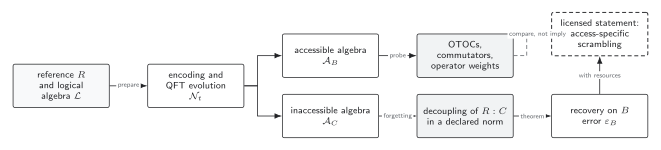
Scrambling becomes operational only after the input algebra, output access structure, side information, norm, energy restriction, and decoder class are declared. OTOCs and operator weights diagnose influence; decoupling and a recovery theorem license a statement about information access. The diagram is schematic and not to scale.
The same map in linear form is
The last arrow is metric- and domain-dependent. It does not assert that the decoder is local, computationally efficient, or experimentally available.
Compare the diagnostics
Section titled “Compare the diagnostics”| Diagnostic | Task and subsystem | Normalization and domain | Recovery content | Causal, finite-size, and symmetry controls | Maximum licensed claim |
|---|---|---|---|---|---|
| Squared commutator or OTOC | Influence between a declared input operator and output observable | State, contour, operator norm, and disconnected subtraction | No decoder statement without an additional channel identity or test | Microcausality or regulator tails; sectors, recurrences, and volume | Operator influence in the tested family |
| Operator-weight distribution | Support of one operator in a complete regulated basis | Basis, inner product, truncation, and operator normalization | No recovery statement unless the basis controls the complementary channel | Front broadening, finite basis, conserved projections, and sectors | Basis-relative operator growth |
| Tripartite information of a channel state | One input subsystem and a bipartition of the full output | Entropy order, channel-state normalization, regulator, and partition | Tests joint storage, but is not a worst-case decoder bound | Ultraviolet cancellation, fourth-party purifier, finite size, and sectors | Multipartite delocalization for that channel partition |
| Decoupling error | Reference system and the output that should forget the input | Trace, relative-entropy, or energy-constrained channel domain | Supports recovery from the complementary accessible output under a matching theorem | Causal access, side information, regulator uniformity, and charge labels | Approximate privacy from the tested output |
| Recovery error | Accessible algebra and an allowed decoder family | Worst-case state or channel metric, tolerance, and energy cap | Direct task-specific reversal statement | Decoder support, duration, finite-size scaling, and symmetry resources | Recoverability for the declared code and access set |
| Channel capacity | Repeated channel uses with declared communication resources | Energy cost, memory model, coding error, and regularization | Asymptotic rate, not one-shot recovery fidelity | Causal use model, correlated environments, finite block length, and sectors | Rate for the declared coding task |
No row can silently substitute for another. In particular, OTOC decay may arise from decoherence, normalization, or an incomplete operator family, whereas recovery can remain possible using correlations invisible to that OTOC.
False-positive structure
Section titled “False-positive structure”The second figure shows why at least one matched alternative explanation is needed before a scrambling claim is accepted.
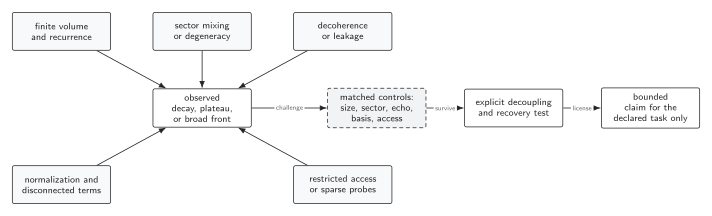
Several mechanisms can suppress a correlator or produce an entropy plateau without delocalizing recoverable quantum information. Sector resolution, recurrence windows, normalization checks, access variation, and an explicit recovery test distinguish these alternatives. The diagram is schematic.
The ten pages
Section titled “The ten pages”- Information Scrambling and Recovery Diagnostics defines the complete operational tuple.
- Decoupling and Subsystem Information Loss states finite-dimensional and energy-restricted decoupling criteria.
- OTOCs, Commutators, and Information Measures identifies what regulated correlators do and do not establish.
- Tripartite Information and Multipartite Scrambling develops the channel-state diagnostic and its nonconverse.
- Operator Growth versus Recoverability compares support growth with complementary-channel leakage.
- Channel Capacities During Scrambling separates one-shot access from asymptotic communication rates.
- Recovery Thresholds, Access Structures, and Side Information turns spatial partitions into authorized and forbidden sets.
- Information Velocities and Causal Bounds compares threshold-dependent fronts under the relativistic ceiling.
- Finite Size, Symmetry Sectors, and Scrambling False Positives supplies an adversarial control suite.
- Scrambling Evidence and Claim-Status Matrix matches the strength of a conclusion to the evidence actually obtained.
Conventions and stopping boundaries
Section titled “Conventions and stopping boundaries”The chapter inherits the site’s mostly-minus Lorentzian metric and natural logarithms. Every OTOC states operator normalization, ordering, thermal regularization, and connected subtraction. Every channel states Schrödinger or Heisenberg picture, its input and output algebras, complementary output, permitted ancillas, and energy restriction. Trace distance uses the full unless a factor is shown; fidelity conventions are stated where used.
Physical chaos, spectral statistics, Lyapunov growth, and operator fronts are developed in Volume 11; this chapter uses them as inputs to information tasks. Holographic black-hole protocols are applications in Volume 15, not definitions of generic QFT scrambling. Teleportation-based verification provides one finite-device example of separating coherent scrambling from ordinary error Landsman et al. 2019, pp. 61–65. A reproducible verification must state its finite-mode truncation, error model, and acceptance tests.
Review the chapter
Section titled “Review the chapter”Task formulation. An OTOC has decayed in a finite lattice regulator. List the additional data needed for a recovery claim.
Verification criteria
A complete answer names the encoded input and reference, accessible and inaccessible output algebras, state and energy window, OTOC normalization and contour, side information, decoder class, recovery metric, finite-size and symmetry-sector controls, and regulator/continuum test. OTOC decay alone supplies none of the decoder data.
Nonconverse. Give a process with large operator support but recoverable information.
Verification criteria
Any unitary that spreads a logical operator across many degrees of freedom while preserving access to the full output works: applying the inverse unitary recovers perfectly. A symmetry-protected logical sector or a known encoding circuit gives a stronger example. Large support shows that a restricted local observer has difficulty; it does not show destruction.
Continuum transfer. Explain why a Haar-random theorem on a -dimensional Hilbert space cannot be inserted directly into a QFT.
Verification criteria
The continuum Hilbert space is infinite dimensional, local algebras need not be type I, a uniform Haar measure on all field modes is unavailable, and energy-unbounded norms can be maximal. A valid transfer first fixes a regulator or energy subspace, proves the bound there, controls the error uniformly, and identifies the continuum algebraic statement that survives.
References
Section titled “References”- Hayden, Patrick, Michał Horodecki, Andreas Winter, and Jon Yard. “A Decoupling Approach to the Quantum Capacity.” Open Systems & Information Dynamics 15 (2008): 7–19. DOI. Open PDF.
- Hosur, Pavan, Xiao-Liang Qi, Daniel A. Roberts, and Beni Yoshida. “Chaos in Quantum Channels.” Journal of High Energy Physics 02 (2016): 004. DOI. Open PDF.
- Landsman, Kevin A., Caroline Figgatt, Thomas Schuster, Norbert M. Linke, Beni Yoshida, Norman Y. Yao, and Christopher Monroe. “Verified Quantum Information Scrambling.” Nature 567 (2019): 61–65. DOI. Open PDF.
Original QFT.org content:CC BY 4.0, unless an item supplies different terms. Third-party material retains its own terms.