

Mutual Information and Correlation Spreading
Mutual information measures every correlation retained by a chosen pair of regions, whereas a connected two-point function tests one declared pair of observables. This page compares the two after an exact local Gaussian phase kick in a regulated free-fermion chain. The calculation exposes a propagating kick–control contrast, but also a nonzero critical-state background and strong estimator dependence. Its contours are neither hard support edges nor signaling tests.
Required background. Entanglement growth supplies Gaussian reduced-state evolution and finite-size controls. Mutual information in QFT supplies the algebraic definition, ultraviolet conditions, and correlation inequality used here.
Helpful background. Front extraction supplies the frozen threshold, fit-window, held-out, and baseline protocol.
Time-dependent mutual information between separated intervals
Section titled “Time-dependent mutual information between separated intervals”For a type-I regulated pair of regions and , with natural logarithms throughout,
The relative-entropy expression is the primary definition for continuum algebras Araki 1976, § 1, Eqs. (1.1)–(1.2), pp. 809–811. The three-entropy expression used below is legitimate because the lattice fixes a spatial tensor product and a finite ultraviolet regulator. A continuum limit would require separated algebras, compatible regulator removal, and a new convergence analysis; this finite-chain calculation does not take that limit.
For bounded and , define
Applying Hölder’s inequality and quantum Pinsker to gives
Thus a nonzero bounded correlator certifies nonzero total correlation. The converse fails: a zero selected correlator can simply be blind. For example, the Bell state has but . Conversely, a classically correlated bit has and while remaining separable. Mutual information measures total correlation, not entanglement alone. Wolf et al. 2008, Eq. (5) give the same norm-controlled connection.
An exact Gaussian local kick
Section titled “An exact Gaussian local kick”Consider an open chain of fermionic sites,
initially in its exact half-filled ground state. At site , apply the local number-phase unitary
This unitary is generated by a quadratic operator, so it preserves Gaussianity. It is also a genuine local encoding, unlike a normalized annihilation and postselection protocol, whose conditioning can change a critical state nonlocally at the preparation time.
The source interval and right-moving target intervals are
They are disjoint twelve-site fermionic regions; even the nearest pair has six intervening sites, or seven bonds between its facing edges. With , the kick and time evolution are
where and is the one-particle hopping matrix. The calculation uses exact spectral evolution rather than time stepping. Eisler 2021, § 2, Eqs. (1)–(8), pp. 3–4 gives the corresponding free-chain covariance and entropy machinery.
This is explicitly a fermionic-site algebra calculation. A Jordan–Wigner string crosses the gap between two disjoint spin blocks, so their XX-spin reduced state is not silently identified with the two-interval fermionic reduced state Fagotti and Calabrese 2010, § 2, Eqs. (11)–(19), pp. 5–6.
Mutual information from the restricted covariance
Section titled “Mutual information from the restricted covariance”For any chosen site set , let be the corresponding principal submatrix. Its eigenvalues determine the entropy
Restricting separately to , , and the noncontiguous union therefore gives . This construction follows Peschel 2003, Eqs. (2), (5)–(12), pp. L205–L207.
The comparison observable is the normalized block charge
For disjoint and in a number-conserving Gaussian state, Wick’s theorem gives
The un-kicked ground state is stationary and supplies the matched control. Store the four quantities separately:
Only and are mutual informations. The difference is signed, can be negative, and obeys no general positivity or monotonicity theorem. Likewise, the norm inequality applies separately to each raw pair and ; subtracting those inequalities would be invalid.
At , the kick is supported entirely within . Local-unitary invariance therefore gives for every . Because the phase kick also commutes with every occupation , . These are exact controls, not fitted observations.
Frozen mutual-information and density-correlation fronts
Section titled “Frozen mutual-information and density-correlation fronts”Profiles are retained at . For either signed excess , define a same-time relative contour by
The algorithm takes the outermost right-moving crossing and interpolates linearly in between adjacent sites. Mutual information and block charge are normalized to their own same-time maxima. Equal therefore compares contour geometry, not absolute sensitivity.
The primary fit is frozen on and scored without refitting on . Three candidate trajectories are retained:
The term is a finite-window lattice-edge candidate, not an assumed universal exponent. The figure asks two linked questions: in panel (a), compare the nonzero critical ground-state baseline with the localized kick–control contrast; in panel (b), check whether predictions frozen before reach the untouched late-time contours for both diagnostics.
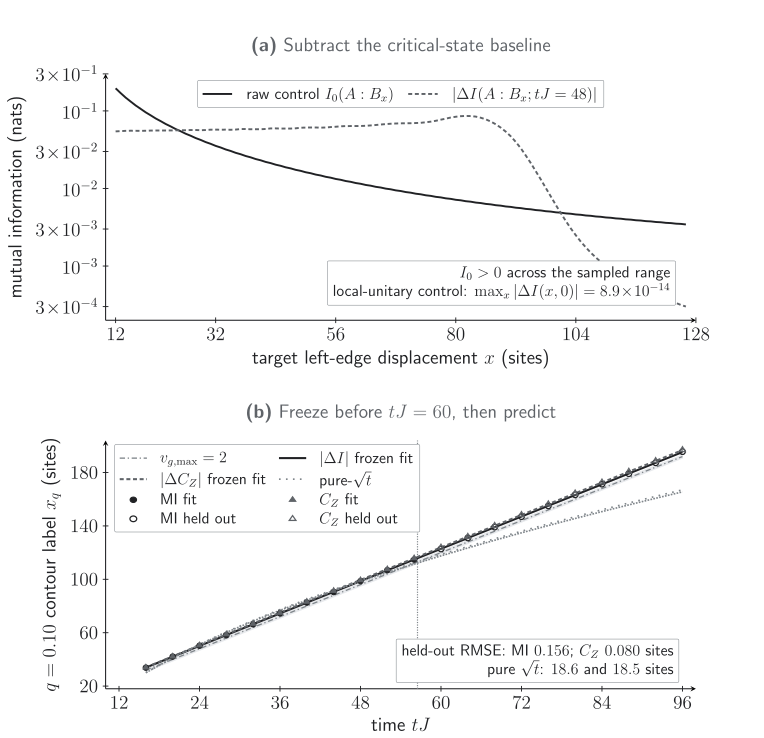
Exact finite-chain local-kick benchmark. Panel (a) shows the stationary raw mutual-information background and the localized magnitude ; the exact local-unitary control has at numerical zero. Panel (b) shows the separately normalized contours. Filled markers were fitted over and open markers were untouched over . The frozen fits give with held-out RMSE sites for and with RMSE sites for . Pure- fits miss the held-out contours by and sites. The dashed ray is only the infinite-chain maximum band-group-velocity comparator. The image is quantitative at the declared lattice regulator; it is not an exact support, signaling, or continuum cone.
The rigid ballistic fits have held-out RMSEs sites for mutual information and sites for block charge. The subleading term improves prediction on this window, but it does not identify an asymptotic broadening law. More importantly, both selected contours translate ballistically and decisively reject a purely diffusive trajectory on untouched times.
Pre-existing correlations as the adversary
Section titled “Pre-existing correlations as the adversary”The half-filled ground state is critical, so its raw mutual information does not begin from zero. In the control, is approximately , , , and nats at . A raw threshold would therefore report correlation at every one of those separations at .
This behavior is not a finite-chain accident. For two intervals of lengths and separated by a gap in the massless Dirac vacuum, the exact continuum result implies
It is positive at every finite Casini and Huerta 2009, § 3.1.5, Eqs. (176)–(179), pp. 23–24. The formula is quoted only for that continuum vacuum; it is not used as a finite-chain fit.
Matched subtraction removes this stationary background because the kick and control share the Hamiltonian, initial ground state, lattice, regions, and ultraviolet regulator. It does not turn into a new information measure. Contours use only as a declared estimator and retain its sign in the complete record. General correlation-growth bounds likewise contain a term inherited from the initial state; an exponentially clean correlation cone requires an appropriate clustering hypothesis Kastner 2015, § 5, Eqs. (16)–(24), pp. 7–8; § 6.1, Eqs. (28)–(29), pp. 9–10.
Observable, threshold, and geometry controls
Section titled “Observable, threshold, and geometry controls”The two diagnostics do not have comparable amplitudes. From to , the sampled peak falls from about to nats, whereas the peak falls from to . A chosen density correlator can therefore be much less sensitive than total correlation even when its normalized contour is sharp.
Changing the analysis also moves the inferred slope. Across advancing training windows, the broadened-fit velocity ranges from to for mutual information and from to for block charge. The contour is visibly more vulnerable to lattice oscillations and low-amplitude tail sensitivity than the primary contour. These are deterministic estimator-sensitivity ranges, not confidence intervals.
The control is compared with only through , before the leading packet can return from an open boundary. At , the cross-size contour RMSEs are sites for mutual information and sites for block charge; the maximum shifts are and sites. This supports the reported finite-window contours while leaving the thermodynamic and continuum limits open.
Correlation is not signaling
Section titled “Correlation is not signaling”Neither raw mutual information nor a connected correlator asks whether a receiver can detect a sender’s choice. A signaling test compares two encodings and with one receiver measurement :
This is a contrast of receiver states, not a correlation between and . In a relativistic QFT, microcausality constrains it outside the causal future. In this finite hopping chain, Lieb–Robinson reasoning supplies exponentially small tails rather than an exact relativistic support edge. Bravyi, Hastings, and Verstraete 2006, Eq. (1) and surrounding derivation, p. 050401-2 make the operational distinction explicit.
The maximum single-particle band velocity follows from :
Agreement of a fitted contour slope with is therefore a useful model-specific comparison. It is not a measurement of the Lieb–Robinson velocity, an entanglement velocity, a butterfly velocity, or a communication capacity.
Reproducibility and stop rule
Section titled “Reproducibility and stop rule”Download the quantitative SVG, complete signed profiles, fits, and controls, compact CSV view used by the figure, and JSON calculation, schema, diagnostics, and claim boundary. The compact view is derived deterministically from the complete record and introduces no fitted value.
What survives every declared control is deliberately narrow: in this exact finite open free-fermion chain, a local unitary changes interval mutual information and a bounded block-charge correlator along estimator-dependent ballistic contours whose fitted slopes lie near the model’s maximum band group velocity. The calculation stops short of exact support, a common diagnostic speed, an asymptotic exponent, a continuum limit, interacting universality, or signaling.
The chapter orientation map places both quantities among direct diagnostics. Its failure controls require baseline, observable, threshold, and window changes, while the diagnostic comparison keeps total correlation distinct from entanglement and communication.
Common pitfalls
Section titled “Common pitfalls”Treating as mutual information. Each raw is nonnegative; their difference need not be. Keep the sign and call it an excess or contrast.
Applying Pinsker after subtraction. Pinsker bounds a raw relative entropy and raw connected correlator. It does not survive term-by-term subtraction into a bound between and .
Using one weak correlator as a no-correlation theorem. A nonzero bounded correlator lower-bounds , but a small or vanishing selected correlator does not upper-bound it.
Calling a relative threshold a detection probability. The contour is normalized to the same-time sampled peak of one diagnostic. It is an estimator, not an experimental noise model or confidence level.
Renaming the comparator. A near- contour in this free lattice is not an exact support, signaling, entanglement, butterfly, hydrodynamic, or universal velocity.
Exercises
Section titled “Exercises”Derive the raw connected-correlator bound from quantum Pinsker and Hölder’s inequality. Why can it not be applied to and ?
Solution
Set . Then
Hölder gives , while Pinsker gives . Combining them yields
The proof uses one density operator and its own product of marginals. A kick-minus-control difference is not a relative entropy between those objects, and subtracting two valid inequalities does not preserve their order.
Compare a classically correlated bit with a Bell pair. For , compute and . For , compute and . What do the two examples rule out?
Solution
For , both marginals and the joint state have entropy , so . The one-point functions vanish and , hence . The state is a convex mixture of product states, so neither value certifies entanglement.
For , the joint state is pure and both marginals are maximally mixed, giving . Direct evaluation gives . A chosen correlator can therefore miss total correlation completely.
For two single fermionic sites with restricted covariance
derive the mutual information and evaluate it at . Check the raw block-charge correlator bound.
Solution
Each one-site covariance has eigenvalue , so . The joint eigenvalues are . With ,
At , nats. For one site per region, and . Thus , as required.
Show that the phase kick leaves and unchanged at . Then explain why a nonzero raw ground-state still makes baseline subtraction necessary for a front plot.
Solution
Because , the kick factorizes as on . It conjugates and without changing their spectra, and it leaves unchanged. Therefore . The kick is generated by and commutes with all occupations, so every equal-time density moment, including , is also unchanged.
Nevertheless, is positive at finite separation in the critical ground state. A raw contour would then be present before the intervention. The matched difference removes that stationary background while remaining a signed contrast rather than a new mutual information.
The primary mutual-information contour has a frozen broadened-ballistic held-out RMSE of sites and a pure- RMSE of sites. The fitted slope is , while . Which conclusions follow, and which do not?
Solution
On the declared finite chain, threshold, and time window, the untouched late-time contour is accurately predicted by a ballistic trajectory with a subleading correction and is incompatible with the fitted purely diffusive trajectory. Its slope is close to the maximum band group velocity.
The comparison does not establish a hard support edge, a Lieb–Robinson, signaling, entanglement, or butterfly velocity, equality with the block-charge contour, a universal correction, an interacting result, or a continuum limit. Those claims require different observables, limits, or theorems.
References
Section titled “References”- Araki, Huzihiro. “Relative Entropy of States of von Neumann Algebras.” Publications of the Research Institute for Mathematical Sciences 11 (1976): 809–833. DOI.
- Bravyi, Sergey, Matthew B. Hastings, and Frank Verstraete. “Lieb–Robinson Bounds and the Generation of Correlations and Topological Quantum Order.” Physical Review Letters 97 (2006): 050401. DOI.
- Casini, Horacio, and Marina Huerta. “Entanglement Entropy in Free Quantum Field Theory.” Journal of Physics A: Mathematical and Theoretical 42 (2009): 504007. DOI.
- Eisler, Viktor. “Entanglement Spreading after Local and Extended Excitations in a Free-Fermion Chain.” Journal of Physics A: Mathematical and Theoretical 54 (2021): 424002. DOI.
- Fagotti, Maurizio, and Pasquale Calabrese. “Entanglement Entropy of Two Disjoint Blocks in XY Chains.” Journal of Statistical Mechanics: Theory and Experiment 2010 (2010): P04016. DOI.
- Kastner, Michael. “Entanglement-enhanced spreading of correlations.” New Journal of Physics 17 (2015): 123024. DOI.
- Peschel, Ingo. “Calculation of Reduced Density Matrices from Correlation Functions.” Journal of Physics A: Mathematical and General 36 (2003): L205–L208. DOI.
- Wolf, Michael M., Frank Verstraete, Matthew B. Hastings, and J. Ignacio Cirac. “Area Laws in Quantum Systems: Mutual Information and Correlations.” Physical Review Letters 100 (2008): 070502. DOI.
Original QFT.org content:CC BY 4.0, unless an item supplies different terms. Third-party material retains its own terms.