

Locality, Code Distance, and Causal Constraints
For a field code, distance is meaningful only relative to a family of physical errors, a regulator, and a spacetime notion of support. Counting correctable lattice sites can diverge while the protected physical length stays fixed or shrinks. Locality and causality also bound encoding and decoding time, so a code with good static erasure properties may be operationally unusable on the required timescale.
Required background. Erasure, Subregions, and Correctability supplies spatial erasure.
Helpful background. Signaling, No-Signaling, and Causal Composition supplies the spacetime channel constraints.
Distance relative to an error family
Section titled “Distance relative to an error family”For a finite code, distance may be defined as the minimum weight of a physical operator whose action on the code is a nontrivial logical operation. Equivalently, erasures of fewer than sites are correctable under standard subsystem assumptions. In a field regulator, declare:
- site, mode, or algebra support;
- the allowed operator norm and energy;
- connected versus arbitrary disconnected erasures;
- gauge and center convention;
- whether approximate errors below count as correctable.
Define a physical erasure radius only when sites have uniform spacing and connected support is the intended noise. A continuum claim needs convergence of and recovery error at fixed energy, not merely .
Causal lower bounds on encoding and recovery
Section titled “Causal lower bounds on encoding and recovery”Let the encoder be generated by finite-range bounded interactions with an effective propagation speed . Information initially localized in a region cannot influence a point at distance before time of order , up to the appropriate Lieb–Robinson or relativistic tail; Bravyi, Hastings, and Verstraete use this principle to bound correlation and topological-order generation Bravyi, Hastings, and Verstraete 2006, pp. 1–3. Therefore preparing a code whose logical representatives are separated over physical scale requires nonzero time unless long-range gates or pre-shared resources are supplied.
Similarly, a decoder that needs syndrome information from a region of diameter cannot output a centralized correction faster than causal signals cross that region. Parallel local recovery can change the geometry but not remove the causal condition. State where the recovered logical system is available and whether classical communication is included.
Locality–distance tradeoffs
Section titled “Locality–distance tradeoffs”Finite-dimensional local codes obey dimension-dependent tradeoffs among encoded degrees of freedom, distance, and system size. Their constants and hypotheses depend on spatial dimension, commuting-projector or stabilizer structure, and exact locality. They do not directly become continuum-QFT theorems. Use them at a specified regulator, translate each scale to physical units, and control approximation errors.
Bravyi, Poulin, and Terhal derive a tradeoff for local commuting-projector codes in finite spatial dimension Bravyi, Poulin, and Terhal 2010, §§II–IV. Applying it to a field discretization requires verifying bounded local dimension or replacing it with an energy-truncated statement.
Scaling protocol
Section titled “Scaling protocol”For a family of local regulated encodings:
- fix total physical volume and logical energy domain;
- define connected physical erasure regions and tolerance;
- measure the largest correctable physical size, not only site count;
- construct a decoder and record its spacetime support and duration;
- refine and local Hilbert truncation separately;
- vary interaction range in physical units;
- test whether control energy or decoder norm diverges.
An apparent threshold obtained by keeping erasure probability per lattice site fixed also needs interpretation: as the number of sites per physical volume diverges, the induced physical noise density may not remain fixed.
Exercises
Section titled “Exercises”Site-count artifact. If in one dimension, what does the physical distance do?
Solution
, so the number of correctable sites diverges while the correctable physical length remains constant. This can be a valid continuum limit, but it is not growing physical protection.
Instant decoder. A recovery acts on an entire spacelike slice as one gate. What must be added for an operational claim?
Solution
Decompose it into localized controls and communication, bound their range and strength, specify the output location, and show the schedule respects the causal structure. The global channel is a mathematical recovery, not an instantaneous physical protocol.
Recovery and continuum maps
Section titled “Recovery and continuum maps”The first diagram follows the task from logical algebra through noise, environmental leakage, and constrained recovery; inspect which metric and recovery family support the guarantee. The second identifies the additional uniformity tests required before finite-regulator correctability becomes a continuum field-code statement.
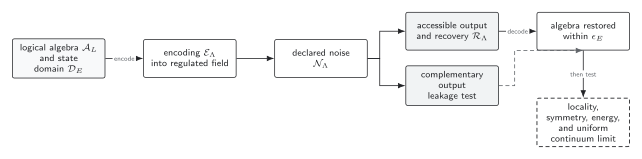
Correctability relates one logical algebra, one noise channel and complement, one state or energy domain, and one recovery class. Environmental forgetting supports recovery only in the matching metric; locality, symmetry, and continuum convergence are additional tests. The diagram is schematic and not to scale.
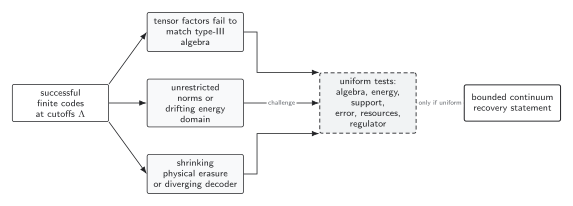
A sequence of successful finite codes does not establish a continuum code unless its logical algebra, physical erasure region, energy domain, recovery error, and locality bounds converge uniformly. Type-III structure and regulator-dependent tensor factors require an algebraic target. The diagram is schematic.
References
Section titled “References”- Bravyi, Sergey, Matthew B. Hastings, and Frank Verstraete. “Lieb–Robinson Bounds and the Generation of Correlations and Topological Quantum Order.” Physical Review Letters 97 (2006): 050401. DOI. Open PDF.
- Bravyi, Sergey, David Poulin, and Barbara Terhal. “Tradeoffs for Reliable Quantum Information Storage in 2D Systems.” Physical Review Letters 104 (2010): 050503. DOI. Open PDF.
Original QFT.org content:CC BY 4.0, unless an item supplies different terms. Third-party material retains its own terms.