

Continuum Codes and Type-III Obstacles
Continuum QFT invalidates several finite-code shortcuts: local algebras are generally type III rather than matrix factors, sharply localized excitations can require unbounded energy, unrestricted channel norms can be too strong, and regulator tensor factors need not converge canonically. These facts do not forbid QEC; they force the logical algebra, state domain, and limiting topology to be formulated directly.
Required background. Operator-Algebra Quantum Error Correction supplies algebraic correctability. Von Neumann Factors and Type-III Local Algebras supplies the continuum local structure.
Helpful background. Why Continuum QFT Does Not Factorize Naively identifies the failed tensor-factor inference.
Which finite-dimensional steps fail
Section titled “Which finite-dimensional steps fail”Reduced density matrices. A local type-III algebra does not come with a trace or density matrix intrinsic to the region. Restrict a global normal state to the algebra and use algebraic relative quantities or a controlled split/regulator construction.
Maximally mixed code tests. Infinite-dimensional logical systems have no normalized maximally mixed state. Channel-state tests use finite logical subspaces, faithful reference states, or energy-constrained families.
Unrestricted diamond distance. Arbitrarily energetic inputs can make nearby field channels maximally distinguishable. Align the norm with a physical energy or observable domain.
Strict tensor complement. The commutant of a local algebra may not be represented as all operators on a complementary Hilbert factor. Use algebra inclusions, duality conditions, and explicit boundary conventions.
Bounded local dimension. Lattice code tradeoffs often assume a uniform finite on-site dimension. Bosonic regulators need a truncation whose error is controlled as the local cutoff grows.
Split inclusions as an interface
Section titled “Split inclusions as an interface”For nested regions , the split property can provide a type-I factor
This creates an approximate tensor interface separated by a buffer. The construction depends on the collar width and on nuclearity or energy conditions; Buchholz and Wichmann establish a foundational energy-level-density condition behind such causal independence Buchholz and Wichmann 1986, §§2–4. As the buffer shrinks, entanglement and implementation costs can diverge. A code proved in has a continuum interpretation only after this dependence is tracked. Summers reviews the striking vacuum correlations that coexist with these algebraic independence properties Summers 2008, §§4–6.
Comparing a lattice sequence with an algebraic target
Section titled “Comparing a lattice sequence with an algebraic target”Let map a set of continuum smeared observables into a lattice regulator. A useful convergence claim requires
on the code energy domain, together with convergence of states and channels on the same test algebra. The lattice code projector itself need not converge in operator norm. What must converge is the logical action and recovery guarantee relevant to physical observables.
If a page assumes a canonical , a literal product , or an exact partial trace in the continuum without a split or regulator, the argument stops at that step.
Evidence boundary
Section titled “Evidence boundary”As of 10 August 2026, continuum operator-algebra QEC is mathematically viable in specific constructions, but generic lattice-code intuition does not supply a universal field-code limit. Each proposal needs an explicit algebra map, energy domain, error topology, and uniform convergence proof. Holographic reconstruction is a distinct application and does not remove these generic requirements.
Exercises
Section titled “Exercises”Type-III correction. Does the absence of a regional density matrix prevent restricting a state to a local algebra?
Solution
No. A state is a positive normalized functional on the algebra, and a global normal state restricts normally. What fails is representing that restriction by a trace-class density matrix intrinsic to a canonical regional Hilbert factor.
Shrinking split buffer. Why must collar width be recorded?
Solution
The intermediate type-I factor and its preparation resources depend on the separation. Bounds can deteriorate or diverge as the collar closes, so a fixed-buffer result is not automatically an exact sharp-boundary statement.
Recovery and continuum maps
Section titled “Recovery and continuum maps”The first diagram follows the task from logical algebra through noise, environmental leakage, and constrained recovery; inspect which metric and recovery family support the guarantee. The second identifies the additional uniformity tests required before finite-regulator correctability becomes a continuum field-code statement.
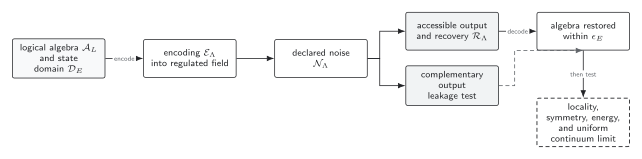
Correctability relates one logical algebra, one noise channel and complement, one state or energy domain, and one recovery class. Environmental forgetting supports recovery only in the matching metric; locality, symmetry, and continuum convergence are additional tests. The diagram is schematic and not to scale.
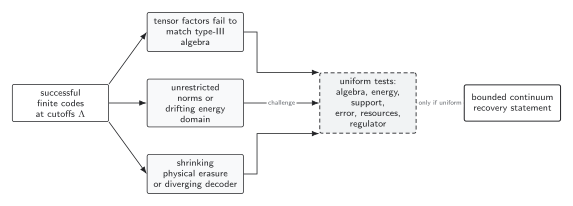
A sequence of successful finite codes does not establish a continuum code unless its logical algebra, physical erasure region, energy domain, recovery error, and locality bounds converge uniformly. Type-III structure and regulator-dependent tensor factors require an algebraic target. The diagram is schematic.
References
Section titled “References”- Buchholz, Detlev, and Eyvind H. Wichmann. “Causal Independence and the Energy-Level Density of States in Local Quantum Field Theory.” Communications in Mathematical Physics 106 (1986): 321–344. DOI.
- Summers, Stephen J. “Yet More Ado About Nothing: The Remarkable Relativistic Vacuum State.” arXiv:0802.1854 (2008). Preprint.
Original QFT.org content:CC BY 4.0, unless an item supplies different terms. Third-party material retains its own terms.