

Entanglement Entropy of Free Fields
Free scalar and fermion theories are the principal controlled benchmarks for subregion entropy. Their ground and thermal states are Gaussian, so correlation matrices, replica determinants, and—in conformal limits—symmetry methods can be compared on the same regulated problem. The comparison reveals which terms are universal and which depend on mass, state, geometry, boundary conditions, or cutoff.
Required background. Review Gaussian fields and sources, heat kernels and spectral determinants, and Gaussian correlation-matrix entropy. Helpful background. Replica branched geometries supplies an independent formulation.
Canonical benchmarks
Section titled “Canonical benchmarks”For a free scalar on a spatial lattice,
in the vacuum. Restricting and to a set of sites gives the symplectic spectrum and entropy. A free, number-conserving fermion is similarly determined by the occupied-mode projector restricted to . These are exact statements about the discretized theory and provide small-system tests for replica or Monte Carlo implementations.
The interval result of Holzhey, Larsen, and Wilczek 1994, pp. 443–467 gives, for a two-dimensional CFT vacuum on the infinite line,
where is the central charge and is cutoff dependent. For a free real massless scalar the zero mode must be specified before applying this expression in finite periodic volume. For a free Dirac fermion no scalar zero-mode ambiguity appears, although spin structure and boundary conditions still matter.
In higher dimensions a smooth entangling surface has a leading divergence proportional to its area. Srednicki 1993, pp. 666–669 provides the classic spherical-lattice scalar example. The coefficient of the power divergence depends on the regulator; subleading logarithms or finite combinations can be more robust under stated geometric and renormalization conditions.
The structural map places Entanglement Entropy of Free Fields on the route from a regulated subsystem to integer moments, spectral checks, analytic continuation, and a continuum claim.
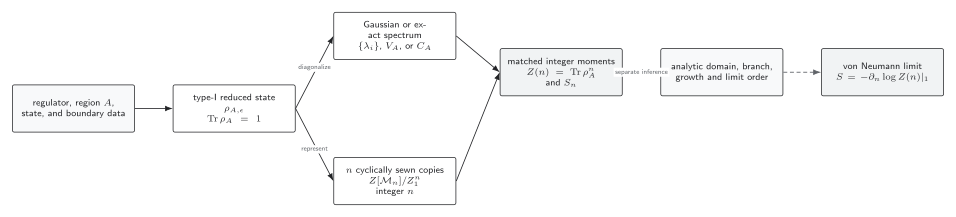
The spectral and replica routes must agree on matched integer moments at fixed regulator. Continuation from those moments to is logically separate and must state its analytic domain, branch, growth conditions, and order of limits. Schematic.
Mass, dimension, state, and geometry
Section titled “Mass, dimension, state, and geometry”A mass introduces a correlation length . For regions much smaller than , the answer approaches the critical form plus controlled mass corrections. For regions much larger than , correlations across a smooth boundary are localized within , so the entropy is dominated by boundary terms. Thermal or excited states can add extensive contributions; one must not label those terms vacuum entanglement without subtracting or otherwise controlling the state dependence.
Corners and conical features generate additional logarithms. Physical boundaries introduce boundary-condition data. A curved entangling surface allows local intrinsic- and extrinsic-curvature invariants. Free-field coefficients are excellent benchmarks for these structures, but they are not automatically the coefficients of an interacting theory.
Correlation-matrix and replica comparison
Section titled “Correlation-matrix and replica comparison”Choose a massive scalar interval or half-space and compute its entropy at several lattice spacings by two routes:
- restrict the vacuum covariance and diagonalize its symplectic spectrum;
- evaluate the corresponding integer replica determinant with identical boundary conditions and cutoff geometry.
At compare the same Rényi entropy before any continuation. Then vary at fixed physical mass, region, and volume. Agreement at one spacing tests implementation; common scaling over several spacings tests the continuum interpretation. Keep the determinant normalization and zero-mode prescription visible so the two methods do not merely share the same hidden error.
Infrared challenge
Section titled “Infrared challenge”Approach the massless periodic scalar in two ways: at fixed finite volume, and after taking the volume large. The constant mode has frequency , so its covariance becomes singular as . If two prescriptions yield different constants or additional logarithms, those pieces are infrared dependent. Do not absorb them into the ultraviolet area-law coefficient. Zero Modes, Boundaries, and Infrared Sensitivity treats this separation in detail.
Before exporting this calculation, use the validity map to check normalization, infrared data, spectral or continuation control, and matched continuum scaling independently.
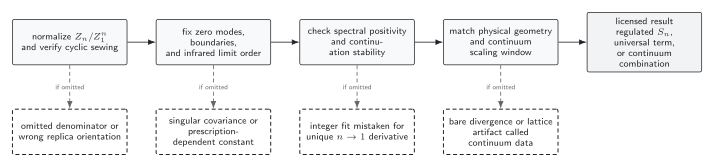
Normalization and sewing establish the intended integer moment; zero-mode and boundary control establish the infrared state; spectral and continuation checks control ; geometry matching and a scaling window establish the continuum target. Omitting any stage licenses only a weaker conclusion. Schematic.
References
Section titled “References”- Holzhey, Christoph, Finn Larsen, and Frank Wilczek. “Geometric and Renormalized Entropy in Conformal Field Theory.” Nuclear Physics B 424 (1994): 443–467. arXiv; DOI.
- Srednicki, Mark. “Entropy and Area.” Physical Review Letters 71 (1993): 666–669. arXiv; DOI.
Further reading
Section titled “Further reading”Original QFT.org content:CC BY 4.0, unless an item supplies different terms. Third-party material retains its own terms.