

Reflected Entropy and Canonical Purifications
Reflected entropy is the entanglement entropy of a particular doubled purification of a mixed bipartite state. “Canonical” means canonical after the algebra, representation, and conjugation are fixed; it does not mean that the auxiliary copies are physically prepared. The construction measures total correlations and differs from both mutual information and negativity.
Required background. Mutual Information and Regulator-Independent Correlations supplies relative entropy, monotonicity, and the continuum distinction between type-III algebras and split type-I factors. Helpful background. Entanglement Negativity in QFT supplies a contrasting mixed-state measure based on a partial transformation rather than a purification.
The shared structure map places these constructions side by side, while the canonical comparison table records their different domains. Statements below about holographic identification are limited to primary literature available through 10 August 2026 and to the state classes stated explicitly.
Canonical vectorization and normalization
Section titled “Canonical vectorization and normalization”Choose a factorized orthonormal basis and define vectorization by
For a normalized density operator , its positive square root gives
The Hilbert–Schmidt inner product supplies both essential checks:
The reflected entropy is the entropy across the cut,
These definitions and recovery identities are Dutta and Faulkner 2021, §1, eqs. (1)–(3). A factorized basis change acts by local unitaries on the doubled factors, so the entropy is basis independent even though a coordinate vectorization was used to calculate it.
The diagram shows which copies are auxiliary and which partial trace defines the measure. Inspect the cut rather than interpreting and as new laboratory systems.
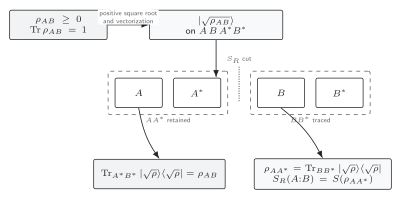
Vectorization turns into a normalized pure state on . Tracing produces , and its entropy equals that across the complementary cut. The construction assumes a fixed type-I tensor product or split realization. Schematic; not to scale.
Continuum algebras and the split factor
Section titled “Continuum algebras and the split factor”Standard form supplies a canonical positive-cone vector for a normal state on a von Neumann algebra, but it does not by itself turn a sharp QFT region into a tensor factor with a finite entropy. For spacelike-separated regions with
the split property provides an intermediate type-I factor . If the state vector is cyclic and separating for , , and , modular conjugation selects a state-dependent canonical factor Doplicher and Longo 1984, §§1–2; Dutta and Faulkner 2021, §7, eqs. (99) and (104)–(108).
A lattice regulator or another split factor can also define a type-I reflected entropy, but its collar width, center, and limiting prescription remain part of the result. Calling the purification canonical does not erase those choices.
Bounds and exact limiting cases
Section titled “Bounds and exact limiting cases”For finite-dimensional or otherwise finite type-I entropies,
The lower bound follows from strong subadditivity, and the upper bound from positivity of and in the canonical purification Dutta and Faulkner 2021, §2, eqs. (20)–(25). Two normalization checks are especially useful:
and
The canonical purification is well defined when is nonfaithful: take its positive square root on its support. What can become singular are formulas that insert , a modular inverse, or inverse covariance blocks. Those formulas must be restricted to the support or defined by a controlled faithful limit.
Two-mode Gaussian application
Section titled “Two-mode Gaussian application”Use quadratures with and vacuum covariance . If a two-mode Gaussian covariance matrix has Williamson form
purify each thermal normal mode with a star mode using the block
Apply the Gaussian unitary associated with to the physical normal modes and its conjugate to the star modes. Explicitly, if flips every momentum in the position-basis convention, the star phase-space map is . Reorder the result as and restrict the doubled covariance matrix to . If its symplectic eigenvalues are , then
This correlation-matrix construction is developed for free scalar QFT in Bueno and Casini 2020, §2.1, eqs. (16)–(27). It makes the regulator and numerical controls explicit: require every input and output symplectic eigenvalue to be at least within tolerance, vary lattice spacing at fixed physical geometry, and compare with both bounds.
Two exact two-mode reductions benchmark the algorithm.
Product thermal modes. For
the canonical purification factorizes between and . Hence , saturating the lower bound even though each individual mode is mixed.
Pure two-mode squeezed state. Let
With , each one-mode reduction has entropy . Since the physical state is pure,
which saturates both bounds. Although this state is nonfaithful, the support definition is regular; only an inverse-based implementation needs a limiting prescription.
Purification and holographic scope
Section titled “Purification and holographic scope”Altering the purifier by an arbitrary unitary generally changes . It still purifies , but it no longer defines reflected entropy unless it implements the same canonical standard-form identification. The shared validity map records this failure separately from support and regulator failures.
For Euclidean-prepared holographic states on a time-reflection-symmetric slice, the leading semiclassical proposal is
The factor of two and normalization are Dutta and Faulkner 2021, §1, eqs. (4) and (8). The original derivation imposes the time-reflection setup in §1; its dynamical extension is proposed there, not established as a generic QFT theorem. Neither this geometric relation nor an arbitrary purification defines outside its stated domain.
Exercises
Section titled “Exercises”1. Verify the canonical purification
Section titled “1. Verify the canonical purification”Using , prove its norm identity and physical partial-trace identity for .
Solution
Orthogonality gives
For , this is . Tracing the second copy gives matrix elements
Thus the doubled vector is normalized and reduces to the original state on .
2. Derive the upper bound
Section titled “2. Derive the upper bound”Use the canonical purification to show and then obtain the symmetric upper bound.
Solution
The star reduction has the same spectrum as the corresponding physical reduction, so . Positivity of mutual information between and gives
Hence . Repeating the argument for and using purity of the doubled state, , yields . Combining them gives .
3. Gaussian limiting cases
Section titled “3. Gaussian limiting cases”Compute and for the product thermal covariance and the pure two-mode squeezed covariance above. Identify which bounds are saturated.
Solution
For the product covariance, . Its canonical vector is , a product across . Therefore , while additivity gives .
For the two-mode squeezed state, the physical state is pure and each one-mode reduction has mean occupation and entropy . Thus
The product state saturates the lower bound at zero. The pure state saturates both the lower bound and .
4. Alter the purification
Section titled “4. Alter the purification”Let for two qubits. Compare the canonical purification with the state obtained by swapping and . What does this failure injection show?
Solution
The canonical purification is
which is a product across , so . A unitary swap of and leaves the physical marginal unchanged but produces
Both Bell pairs now cross the cut, so . The new state is a valid purification but not the canonical one. Therefore “entropy of a purification” is not a definition of reflected entropy; the canonical standard-form identification is essential.
References
Section titled “References”- Bueno, Pablo, and Horacio Casini. “Reflected Entropy for Free Scalars.” Journal of High Energy Physics 11 (2020): 148. DOI. Open preprint.
- Doplicher, Sergio, and Roberto Longo. “Standard and Split Inclusions of von Neumann Algebras.” Inventiones Mathematicae 75 (1984): 493–536. DOI.
- Dutta, Souvik, and Thomas Faulkner. “A Canonical Purification for the Entanglement Wedge Cross-Section.” Journal of High Energy Physics 03 (2021): 178. DOI. Open preprint.
Original QFT.org content:CC BY 4.0, unless an item supplies different terms. Third-party material retains its own terms.