

Operator-Algebra Quantum Error Correction
Operator-algebra quantum error correction protects a logical algebra even when no canonical tensor-factor subsystem exists and even when other code degrees of freedom are allowed to change. This is the natural language for superselection sectors, centers, subsystem codes, and continuum local algebras. Correctability is a statement about the algebra and channel together, not about a preferred encoding basis.
Required background. Operator Algebras and Positive Functionals: a Bridge supplies commutants and completely positive maps. Superselection Rules and Accessible Entanglement supplies sector and center structure. Error Models, Codes, and Recovery Conditions supplies the channel task.
Helpful background. Regions, Causal Complements, and Nets of Observables supplies the continuum interpretation.
Correcting an algebra rather than every state variable
Section titled “Correcting an algebra rather than every state variable”Let project onto a finite regulated code and let be the logical -algebra. It is correctable for if there is a recovery such that
For Kraus operators , a finite-dimensional criterion is
Thus the error products may act nontrivially on gauge degrees of freedom as long as they lie in the commutant . When , its commutant on the code is scalar and the condition reduces to Knill–Laflamme. The Heisenberg formulation and this generalization are developed by Bény, Kempf, and Kribs Bény, Kempf, and Kribs 2007, pp. 1–3.
Direct-sum structure and classical centers
Section titled “Direct-sum structure and classical centers”A finite-dimensional algebra has the form
The label is classical center information, carries protected quantum information, and is a gauge subsystem whose state need not be restored. This subsystem formulation and its error conditions are developed by Kribs and collaborators Kribs et al. 2006, §§2–4. A channel can preserve the center while erasing some quantum blocks, or vice versa. Reporting a single “number of logical qubits” loses this structure.
As a simple example, take
Noise that acts only on leaves the qubit block and the classical sector label correctable, even though the complete code-space state changes. Enlarge by adding a gauge observable; the commutator test can fail immediately. This is the prescribed adversarial check.
Continuum formulation
Section titled “Continuum formulation”In algebraic QFT, replace the finite matrix algebra by a von Neumann algebra , an encoding normal -homomorphism or channel into the physical representation, and normal recovery maps. The equation is tested on declared bounded observables and normal states, often with an energy restriction. A type-III local algebra is not written as , but the algebra-and-commutant statement remains meaningful.
Domain details matter when unbounded fields are used: work with bounded functions, resolvents, or smeared exponentials in the observable algebra, then recover affiliated unbounded operators only with additional domain control.
What the criterion does not supply
Section titled “What the criterion does not supply”- It does not construct a local or efficient recovery.
- It does not choose the physically relevant algebra or center convention.
- It does not prove stability under regulator removal.
- It does not forbid environment access to commuting classical center data.
- Exact equality on a dense-looking finite operator set is insufficient unless continuity controls its closure.
Exercises
Section titled “Exercises”Gauge noise. Let and . Verify algebra correctability.
Solution
commutes with every . Hence the logical algebra is correctable although the gauge state can be changed irreversibly.
Center leakage. Does copying a classical sector label to the environment violate no cloning?
Solution
No. Center observables commute and encode classical information. What cannot be independently broadcast is the noncommuting quantum algebra. The code claim must say whether the center itself is meant to be private or recoverable.
Recovery and continuum maps
Section titled “Recovery and continuum maps”The first diagram follows the task from logical algebra through noise, environmental leakage, and constrained recovery; inspect which metric and recovery family support the guarantee. The second identifies the additional uniformity tests required before finite-regulator correctability becomes a continuum field-code statement.
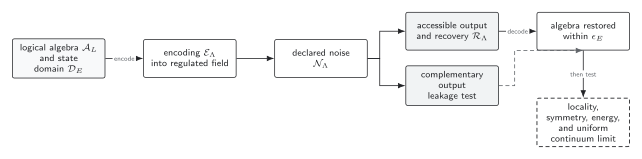
Correctability relates one logical algebra, one noise channel and complement, one state or energy domain, and one recovery class. Environmental forgetting supports recovery only in the matching metric; locality, symmetry, and continuum convergence are additional tests. The diagram is schematic and not to scale.
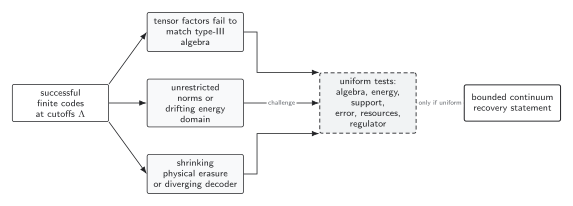
A sequence of successful finite codes does not establish a continuum code unless its logical algebra, physical erasure region, energy domain, recovery error, and locality bounds converge uniformly. Type-III structure and regulator-dependent tensor factors require an algebraic target. The diagram is schematic.
References
Section titled “References”- Bény, Cédric, Achim Kempf, and David W. Kribs. “Generalization of Quantum Error Correction via the Heisenberg Picture.” Physical Review Letters 98 (2007): 100502. DOI. Open PDF.
- Kribs, David W., Raymond Laflamme, David Poulin, and Maia Lesosky. “Operator Quantum Error Correction.” Quantum Information & Computation 6 (2006): 382–399. Open PDF.
Original QFT.org content:CC BY 4.0, unless an item supplies different terms. Third-party material retains its own terms.