

Witnesses for Entanglement, Scrambling, and Recoverability
A witness certifies one bounded conclusion from finitely many observables. An entanglement witness can exclude separable states; an OTOC witness can establish operator influence under its normalization; a decoupling or recovery witness can bound a task-specific decoder error. None generally supplies full tomography, an entropy, or a universal scrambling claim.
Required background. From Field Data to Information Claims supplies the claim ladder.
Helpful background. Entanglement Witnesses and Local Tomography Limits supplies measurement limits, and Scrambling Evidence and Claim-Status Matrix supplies adversarial controls.
Entanglement witnesses
Section titled “Entanglement witnesses”A Hermitian is an entanglement witness for a specified bipartite state space if
while a negative expectation for the observed state certifies entanglement. With uncertainty , a decision rule might require , with fixed before inspecting the result and multiplicity handled if many witnesses are searched.
In continuum or gauge settings, separability depends on the chosen commuting algebras and superselection restrictions. The witness must be bounded or well defined on an energy domain, and the measurement channel must faithfully estimate its smeared components.
Scrambling and recovery witnesses
Section titled “Scrambling and recovery witnesses”An OTOC or squared commutator witnesses influence for selected operators, contour, state, and normalization. To support scrambling as loss from an inaccessible output, add a channel-state or decoupling bound. To certify recovery, evaluate an explicit decoder or a theorem whose complementary-channel hypotheses are measured.
A useful composite witness reports a vector rather than one scalar; the channel-state analysis of Hosur and collaborators provides one structured connection between OTOCs and multipartite information under explicit assumptions Hosur et al. 2016, §§2–4:
The licensed claim is the intersection of its components. Rapid commutator growth with poor recovery evidence remains an influence claim.
Adversarial moment matching
Section titled “Adversarial moment matching”For every finite observable set , search or optimize states that match
within uncertainty while differing in the target resource. Semidefinite programming can bound entanglement over finite truncations; Gaussian and non-Gaussian alternatives can share covariances; coherent noise and true unitary scrambling can share an OTOC decay. The spread of target values over compatible states is an identification interval, not a statistical error bar.
Benchmark witnesses on known positive and negative states and on deliberately misspecified detector models. Gühne and Tóth review the logic and construction of entanglement witnesses Gühne and Tóth 2009, §§2–4.
Claim ceilings
Section titled “Claim ceilings”| Observation | Certifies | Does not by itself certify |
|---|---|---|
| negative calibrated | nonseparability for the defined algebras | entropy or distillable entanglement |
| covariance criterion violation | entanglement under its general validity | Gaussianity or full state |
| OTOC/commutator signal | operator influence | decoupling or recoverability loss |
| small environment distinguishability | approximate privacy on tested domain | local efficient decoding |
| explicit decoder success | recovery for tested code, noise, and metric | asymptotic capacity or continuum threshold |
As of 10 August 2026, witness evidence remains task and measurement-model specific: no finite OTOC, covariance, or decoder test is by itself a universal certificate of continuum scrambling, entropy, or code capacity.
Exercises
Section titled “Exercises”Multiple search. Why must witness selection be separated from evaluation?
Solution
Choosing the most negative result among many noisy witnesses inflates false positives. Use preregistration, multiplicity correction, data splitting, or a valid simultaneous bound.
Compatible alternatives. What should be reported if an entangled and a separable state both fit every measured observable?
Solution
The data do not certify entanglement. Report the observable constraints and identification interval, then add a measurement that separates the alternatives or state a model-dependent conclusion.
Inference and failure-control maps
Section titled “Inference and failure-control maps”The first diagram traces the complete path from raw records to a bounded information claim; inspect the assumption attached to every arrow. The second maps shared and method-specific failure channels to held-out tests, regulator variation, replication, and correction.
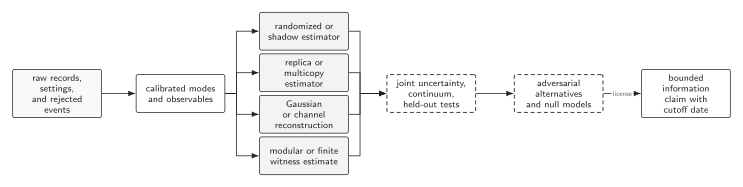
Entropy, tomography, witness, and recovery methods enter at the estimator stage, but all share calibration, uncertainty, continuum, and alternative-model tests. The final statement is no stronger than the least validated arrow. The diagram is schematic and not to scale.
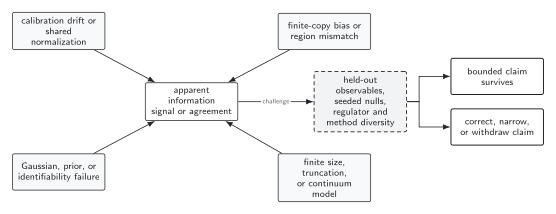
Different estimators can share the same calibration or normalization bias, so numerical agreement is not automatically independent replication. Adversarial nulls, held-out observables, regulator variation, and genuinely independent implementations set the claim ceiling and trigger correction when needed. The diagram is schematic.
References
Section titled “References”Original QFT.org content:CC BY 4.0, unless an item supplies different terms. Third-party material retains its own terms.