

Shape Dependence and Entanglement Variations
Shape dependence asks how entanglement changes under a controlled displacement of one reference surface. A regulated type-I entropy contains local area and contact terms that move with the cutoff prescription; the separated-point kernel and a properly signed universal functional can instead encode continuum CFT data. The expansion is local in shape space: it does not predict an order-one deformation, a topology change, or a cusp. This page treats spatial normal deformations on a fixed Cauchy slice. Deformations in the timelike normal direction, null variations, and the quantum null energy condition require a separate Lorentzian analysis.
Required background. Use contact terms in Ward identities to keep coincident contributions required by conservation, the CFT stress tensor to interpret , and Universal Terms and Entangling-Surface Geometry to distinguish a regulated entropy from its invariant remainder.
Normal displacements and response kernels
Section titled “Normal displacements and response kernels”Work on the fixed Cauchy slice . A smooth entangling surface is codimension one in that spatial slice and has one outward spatial unit normal . If is the metric induced on , then . Write a nearby surface as
where is a reference length and is dimensionless. A regulator then defines
A short replica derivation explains why stress-tensor and defect data enter. Perform this step in Euclidean signature after Wick rotation. Use an infinitesimal diffeomorphism with normal boundary value to return the deformed surface to the reference surface. The surface is then fixed, while the background metric changes by
Varying the replicated generating functional with this metric perturbation inserts the stress tensor. At second order there are two stress-tensor insertions, variations of the insertions themselves, and terms supported where the two deformations coincide. Integrating the diffeomorphism Ward identity toward the codimension-two twist defect packages its local response in the displacement operator :
Here labels the two transverse directions and is the delta distribution supported on the defect. The fixed-time problem retains only the outward spatial component. Applying the replica derivative at relates the separated part of the entropy Hessian to the corresponding stress-tensor—or equivalently displacement-operator—two-point function. Coincident terms are still required to complete the Ward identity.
Consequently, the kernels include distributions supported at . Those contact terms carry the regulator, local counterterms, and Ward-identity completion. At separated points, the planar vacuum-CFT kernel for spatial normal displacements is
The normalization is defined by the Euclidean stress-tensor correlator, with positive-definite metric ,
Here
with . This equation fixes the convention for ; unitarity gives . The equal-time spatial kernel above is obtained after continuing this Euclidean correlator back to the Lorentzian theory and restricting both displacements to . It is regulator independent only away from coincidence Faulkner, Leigh, and Parrikar 2016, §1, eqs. (3)–(7), pp. 2–4, PDF. In the replica description the corresponding local deformation is generated by the twist defect’s displacement operator Bianchi et al. 2016, §2, eqs. (2.8)–(2.13), pp. 6–7, PDF.
This distinction corrects a tempting overstatement: the full regulated first variation need not vanish. For example, dilating a disk changes its perimeter divergence. What vanishes for a vacuum CFT sphere is the linear variation of the universal functional; Allais and Mezei 2015, §II.A, eqs. (9)–(29), pp. 3–5, PDF derives that statement while retaining the cutoff boundary terms.
The chapter structure map places these shape derivatives on the geometric branch, and the canonical comparison table records why they are not interchangeable with mutual information or purification-based measures.
Sphere harmonics and the universal Hessian
Section titled “Sphere harmonics and the universal Hessian”For a round sphere, define the signed universal functional
The negative sign of the separated planar kernel refers to the second variation of the entropy itself. The parity-dependent sign in , together with the conformal map from a plane to a sphere, makes the sphere Hessian below positive in a unitary CFT. Contact terms are essential to complete the integrated response and recover the symmetry zero modes; the separated kernel alone should not be used to infer those modes. Expand a fixed-time radial deformation in real, unit-normalized hyperspherical harmonics,
The mode is a dilation and is a translation to first order. For , the coefficient of is
Faulkner, Leigh, and Parrikar proved this formula for general CFTs 2016, §1, eq. (9), pp. 4–5, and §4.2, eqs. (108)–(110), p. 22, PDF, extending the broad holographic family in Mezei 2015, §I.B, eqs. (I.4)–(I.9), pp. 3–4, PDF. It is a statement about the universal functional, not the unsubtracted area law.
The following figure separates the symmetry zero modes, the controlled higher harmonics, and the nonsmooth limit. Inspect how the domain changes before trying to take or large.
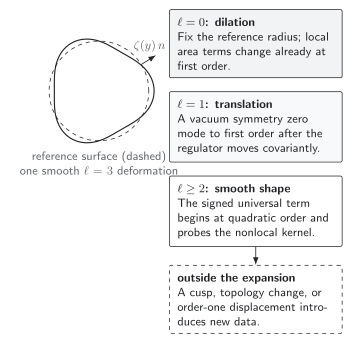
For a small fixed-time deformation of a vacuum-CFT sphere, are symmetry modes and each smooth harmonic contributes with the positive weight in the universal Hessian. A cusp or order-one deformation is a different limit with additional singular data. Schematic; not to scale.
One-mode analytic cutoff/anomaly benchmark
Section titled “One-mode analytic cutoff/anomaly benchmark”Take , a real conformal scalar, and one unit-normalized harmonic with . Let denote the standard type-A anomaly coefficient used on the preceding page and let denote the standard Weyl-squared anomaly coefficient. The scalar-normalized anomaly coefficients used below obey
For one real conformal scalar, and , so . The stress-tensor normalization used above therefore gives
The separated-point CFT Hessian therefore predicts
Now compare this continuum prediction with the logarithm in a cutoff entropy. In the scalar-normalized anomaly convention just defined, the analytic replica result for a smooth surface in flat four-dimensional spacetime is
Here is the intrinsic Euler density, normalized so that ; its integral is fixed by topology. The tensor is the extrinsic curvature of within the spatial slice and . Reversing the chosen normal flips both and , so the displayed quadratic invariant is unchanged. Expanding it for gives
and hence the analytic cutoff/anomaly calculation yields
This exactly matches the separated-point result. The anomaly formula and scalar normalization are given in Allais and Mezei 2015, §I, eq. (8) and footnote 2, p. 2, PDF; its quadratic expansion is the specialization of their §III, eqs. (48)–(50), pp. 8–9. This is an analytic comparison, not a reported finite-lattice dataset. It assumes a smooth deformation, , fixed topology, the vacuum state, and a covariant short-distance cutoff. It has no statistical uncertainty: the displayed coefficient is exact at order . A finite- central-difference estimate would have an truncation after averaging and ; varying would supply the numerical error check. Power divergences and finite constants remain regulator dependent and are not part of the match.
Failure injections: cusp and fixed cutoff
Section titled “Failure injections: cusp and fixed cutoff”The smooth expansion fails visibly for on a circle. Its Fourier coefficients decay as , whereas the harmonic weight grows as . Consequently,
does not converge. The divergence is not a bad numerical implementation of the smooth Hessian: it announces new corner data in the nonsmooth limit.
An inconsistent cutoff produces a different failure. For the unnormalized mode ,
If the cutoff grid is held fixed and the perimeter term is not refitted for each shape, the raw quadratic estimator contains and diverges as . A covariantly moved regulator plus an independent local subtraction removes that contamination; it does not alter the nonlocal coefficient. The validity map summarizes the assumptions that must be held fixed in making this comparison.
Common pitfalls
Section titled “Common pitfalls”Saying that the sphere’s full first variation vanishes. The universal functional is stationary, but the regulated area term generally changes. State which piece is being varied.
Calling every term in the second variation universal. Coincident contact terms remain local and scheme dependent. Only the separated kernel, or a fully subtracted integrated functional, has the stated universality.
Taking a nonsmooth limit term by term. Slow harmonic decay can make the quadratic sum diverge. A corner introduces a new logarithmic structure and must be analyzed in its own domain.
Exercises
Section titled “Exercises”- In , use to compare a uniform dilation with the universal zero mode.
Solution
Set . The regulated entropy changes at first order by
which is nonzero and divergent. The CFT universal constant is scale independent, so its derivative is zero. Thus dilation is a zero mode of the universal functional but not of the full regulated entropy.
- Reproduce the real-scalar coefficient from both the general harmonic formula and the regulated anomaly formula.
Solution
For , the prefactor before the harmonic product is
The product is . Inserting gives
To verify the curvature side explicitly, choose
The quadratic curvature functional in the cited convention is
For , the quantity in parentheses is , so
Equivalently, and the scalar anomaly term is . Thus the separated-point and regulated calculations agree.
- Explain separately why defeats the smooth harmonic sum and why a fixed lattice cutoff can defeat a smooth calculation.
Solution
The cusp makes the Fourier coefficients fall only as . Multiplying their squares by the weight leaves , whose sum diverges logarithmically. No refinement of a finite harmonic truncation turns that nonsmooth surface into a uniformly valid smooth perturbation.
For a smooth cosine, the harmonic sum is finite, but the physical perimeter changes by . If the area-law coefficient is not refitted, division by leaves a false contribution proportional to . The first failure changes the continuum singularity class; the second is a regulator/subtraction error.
- Why can the separated-point kernel be universal even though the full second-variation distribution is scheme dependent? Explain the role of the displacement Ward identity and the modes.
Solution
At , local counterterms cannot connect the two points. Conformal symmetry therefore fixes the nonlocal power law, and its coefficient is the physical stress-tensor normalization ; equivalently, the replica Ward identity expresses this response through the separated displacement-operator two-point function. At , metric variations and local counterterms generate delta functions and their derivatives, so the complete distribution is scheme dependent there. Those contact terms are nevertheless required by the Ward identity. After they are included and the universal functional is isolated, dilation and translation become the symmetry zero modes. Dropping the contact completion would incorrectly infer their response from the separated kernel alone.
References
Section titled “References”- Allais, Andrea, and Márk Mezei. “Some Results on the Shape Dependence of Entanglement and Rényi Entropies.” Physical Review D 91, no. 4 (2015): 046002. DOI. Open PDF.
- Bianchi, Lorenzo, Marco Meineri, Robert C. Myers, and Michael Smolkin. “Rényi Entropy and Conformal Defects.” Journal of High Energy Physics 2016, no. 07 (2016): 076. DOI. Open PDF.
- Faulkner, Thomas, Robert G. Leigh, and Onkar Parrikar. “Shape Dependence of Entanglement Entropy in Conformal Field Theories.” Journal of High Energy Physics 2016, no. 04 (2016): 088. DOI. Open PDF.
- Mezei, Márk. “Entanglement Entropy across a Deformed Sphere.” Physical Review D 91, no. 4 (2015): 045038. DOI. Open PDF.
Original QFT.org content:CC BY 4.0, unless an item supplies different terms. Third-party material retains its own terms.