

Energy, Entropy, and Localization
Energy enters quantum field theory in several mathematically different ways. It can be the expectation of a Hamiltonian before and after a cyclic drive, a stress tensor averaged along a worldline or null generator, the modular energy of a spatial region, the heat deposited in a reservoir, or one term in the energy account of a measurement-and-feedback protocol. These energy-related quantities can differ in dimension, normalization, and operational meaning, and they do not obey one universal inequality. This chapter’s organizing rule is therefore simple: write down the operation and the energy functional before naming the bound.
Helpful background. Relative entropy in QFT supplies the algebraic comparison of states. Modular Hamiltonians and domains and the first law and quadratic response distinguish exact first-order identities from finite inequalities. The stress tensor and charge algebra, thermal KMS condition, and CFT stress tensor provide the operator input used below.
Enter this chapter
Section titled “Enter this chapter”Start with passivity, work, and information: it fixes the Hamiltonian, the admissible cyclic operations, and the sign convention for extracted work. Then study complete passivity and KMS structure, where the question changes from one copy to every finite tensor power. A state can be passive for one copy yet become a work resource when several copies are driven collectively.
The stress-energy sequence begins with timelike quantum energy inequalities, continues to the averaged null energy condition, and then turns to information-theoretic statements through relative-entropy Bekenstein-type bounds and the quantum null energy condition. These pages remain separate because a sampled timelike average, a complete null integral, a regional modular Hamiltonian, and a local null shape derivative are inequivalent objects.
The final sequence asks what negative energy and information processing can do operationally. Quantum interest describes compensation constraints in specified free-field pulse models. Entropy bounds, species, and regulators explains why raw entanglement entropy is not a regulator-independent energy resource. Localization and measurement cost and Landauer erasure make the apparatus and reservoir explicit. Quantum energy teleportation then combines a correlated ground state, a local measurement, a causal classical message, and a conditional remote operation. The dated bounds status comparison closes the chapter.
The first figure is a dictionary. Read each row horizontally: the object on the left determines the mathematical statement in the middle and the conclusion on the right. Moving vertically changes the question rather than strengthening the same bound.
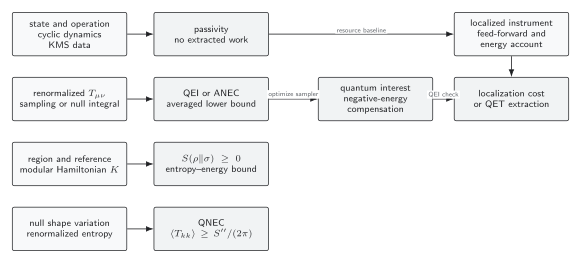
Work extraction, sampled-energy bounds, regional entropy inequalities, and measurement-and-feedback protocols begin from different data. Each arrow licenses only the conclusion on its own row; none of the rows is an omnibus energy condition. The diagram is schematic and not to scale.
Work and energy averages answer different questions
Section titled “Work and energy averages answer different questions”For a state , Hamiltonian , and admissible cyclic unitary , define extracted work by
The cycle returns the externally controlled Hamiltonian to ; it need not return the state to . A passive state satisfies for every unitary in the declared operation class. This statement already depends on the Hamiltonian, its energy domain, and which operations are admitted. Complete passivity asks for the same property of for every finite under collective cyclic operations. Under the standard -dynamical hypotheses, completely passive states are ground or KMS states; the precise theorem is given by Pusz and Woronowicz 1978, Theorems 1.1 and 1.4, pp. 275–281.
A quantum energy inequality instead constrains a smeared stress-tensor expectation. A typical timelike worldline statement has the form
where is a smooth sampling function, specifies the field theory and renormalization prescription, and is the observer’s trajectory. It bounds a weighted energy density, not extractable work. For the free scalar field, Fewster and Eveson 1998 prove bounds for broad classes of smooth sampling functions; Fewster 2012, §§ 2–4 explains how the field, mass, dimension, trajectory, boundaries, and reference state enter.
The sampling scale is physical. If a normalized profile is narrowed according to
then . Thus the four-dimensional massless-scalar bound weakens as at short duration. A QEI does not imply pointwise positivity; it quantifies how the magnitude and duration of negative energy trade against one another within its theorem domain.
Null averages, modular energy, and entropy variation
Section titled “Null averages, modular energy, and entropy variation”Let be a complete affinely parametrized null generator with tangent . ANEC concerns
In broad classes of unitary Lorentz-invariant QFTs on Minkowski spacetime, follows from modular-theoretic or causality arguments. Faulkner et al. 2016 obtain ANEC from deformed half-space modular Hamiltonians and monotonicity of relative entropy; Hartman, Kundu, and Tajdini 2017 derive it from microcausality and lightcone operator expansions under their stated interacting-QFT assumptions. A finite null segment is not a complete generator, and changing the affine normalization changes the numerical integral.
Relative entropy answers a regional comparison question. For states and restricted to the same observable algebra,
so that whenever both differences are defined. This becomes an energy-looking bound only when the reference modular Hamiltonian has a local stress-tensor representation. For the vacuum half-space at ,
The additive constant cancels in expectation-value differences. Positivity then yields a weighted regional energy–entropy inequality, not a universal statement for every definition of , , and . This regulator-safe interpretation and its resolution of the naive species problem are developed in Casini 2008, §§ 2–3.
QNEC is local in a different sense. Schematically, for a null deformation parameter of an entangling cut,
with the normalization of , the entropy prescription, surface conditions, and diagonal shape variation fixed. Early proofs covered free or superrenormalizable bosonic theories on stationary null surfaces Bousso et al. 2016; later work established a much broader interacting-QFT result under explicit UV and modular-flow assumptions Balakrishnan et al. 2019. QNEC is not obtained by differentiating ANEC, and ANEC is not obtained by integrating QNEC without controlling boundary and off-diagonal terms.
Operational protocols require a complete energy account
Section titled “Operational protocols require a complete energy account”An information-processing protocol introduces physical systems not present in a stress-tensor inequality: a memory, probe, controller, clock, reservoir, message register, or conditional actuator. Their energies cannot be silently assigned to the field.
For a memory initially uncorrelated with a thermal reservoir at inverse temperature , an exact unitary evolution gives the Landauer identity
where is the memory’s entropy decrease and is the reservoir’s energy gain. The two final terms are nonnegative, recovering . Equality requires an ideal limit in which final correlations and reservoir disturbance vanish. Finite-reservoir corrections and the exact identity are derived in Reeb and Wolf 2014.
Quantum energy teleportation has another energy account. A local measurement by Alice injects energy into a correlated ground or stationary state. Its classical outcome travels causally to Bob, who applies an outcome-dependent local unitary and extracts from his neighborhood. The protocol must report at least
The local field energy near Bob can decrease, but the full system does not acquire energy from nothing. Without Alice’s message, Bob’s outcome-averaged operation cannot use her result; without the initial correlations, the conditional advantage disappears. Hotta’s introductory review gives the finite-system protocol and its energy accounting. A qubit or spin-chain implementation is evidence for that regulated model, not by itself a continuum-QFT experiment.
Claim–validity comparison
Section titled “Claim–validity comparison”The table compares the minimum information needed to state each result. It is a dictionary, not a ranking: a rigorous theorem can be narrow, while a laboratory implementation can realize a model without testing the corresponding continuum claim.
| Claim or protocol | Spacetime and state domain | Smearing or renormalization | Instrument, message, and feed-forward | Charge or sector | Energy quantity and account | Causal or geometric support | Governing condition | Evidence status | Decisive countercheck |
|---|---|---|---|---|---|---|---|---|---|
| Passivity | Stationary dynamics; state and cyclic unitaries in the energy domain | Same endpoint Hamiltonian and a consistent energy reference | No measurement required; operation class declared | Fixed representation or stated sector | Initial minus final system energy | Global or declared local operation algebra | Wext ≤ 0 for every allowed cycle | Structural theorem for the specified operation class | Add switching, control, or apparatus work |
| Complete passivity | Every finite tensor power with a specified composition rule | Same dynamics on each copy; finite-energy domain | Collective cyclic operation allowed | Product representation and conserved charges fixed | Total work across all copies | Composite-system operation algebra | Ground or KMS structure under standard hypotheses | Pusz–Woronowicz characterization | Activate a passive non-KMS state on several copies |
| Timelike QEI | Specified field and state class along a timelike curve or worldvolume | Smooth sampler and renormalized stress tensor | None | Theory dependent | Sampled energy density, not work | Sampling support and observer trajectory | Field-specific lower bound | Rigorous for important free-field settings | Narrow the sampler or change mass, boundary, or trajectory |
| ANEC | Complete affinely parametrized null generator; theorem-dependent state class | Renormalized null energy and convergent integral | None | Theorem dependent | Complete null integral, not device energy | Entire null line with fixed affine normalization | Integrated null energy is nonnegative | Broad flat-space QFT proofs under stated hypotheses | Truncate the line or rescale its affine parameter |
| Relative-entropy bound | State pair on one region with a known reference modular Hamiltonian | Common algebraic definition or regulator subtraction | None | Same observable algebra and sector | Modular-energy difference | Chosen region and reference state | Entropy change does not exceed modular-energy change | Exact consequence of relative-entropy positivity | Change the region, algebra, or reference state |
| QNEC | Suitable continuum state and null-deformed entangling cut | Renormalized stress tensor and entropy shape variation | None | Usually fixed sector | Local null energy density, not total work | Local cut and normalized null congruence | 2π times null energy bounds the diagonal second variation | Free-field and broad interacting-QFT proofs with explicit assumptions | Retain cutoff artifacts or mix affine normalizations |
| Quantum interest | Specified free field and negative/positive pulse family | Sampling theorem and pulse idealization fixed | None | Usually neutral free field | Pulse area and separation, not extractable work | Timelike history of one observer | Positive repayment grows with allowed separation | Proved in important model classes, not universal across QFT | Smooth the pulses or change field, dimension, or boundary |
| Localization or measurement cost | Specified probe–field model and finite spacetime support | Switching and spatial profile control ultraviolet response | Probe preparation, coupling, readout, and reset declared | Coupling must respect charges and gauge constraints | Field, probe, switching, clock, and controller energy | Interaction support and causal factorization | Protocol-specific cost or error bound | No single universal localization-energy theorem | Change switching time while holding only spatial width fixed |
| Landauer erasure | Specified memory, reservoir, temperature, and final error | Finite entropy and energy accounting | Erasure channel and retained feedback record declared | Additional conserved quantities enter through generalized potentials | Reservoir heat plus work and control costs | Physical memory–reservoir coupling | βQ equals entropy decrease plus correlation and disturbance terms | Exact finite-reservoir identities and refinements | Use an initially correlated or nonthermal reservoir |
| Quantum energy teleportation | Correlated ground or stationary state in a specified model | Local Hamiltonian density and energy zero fixed | Local measurement, classical message, conditional remote operation | Model-dependent charges and control algebra | Measurement injection, remote extraction, control, and reset reported separately | Feed-forward remains inside the future light cone | Correlation-assisted conditional local extraction | Exact models and quantum-hardware demonstrations; continuum claims remain model specific | Remove the message, correlations, or injected-energy account |
Failure controls that change the conclusion
Section titled “Failure controls that change the conclusion”The second figure is a diagnostic sequence. A proposed statement must survive five independent questions: Which quantity is being bounded? On which domain and geometry? With what normalization and renormalization? Which physical operations occur? Does the complete causal and energetic account support the advertised conclusion?
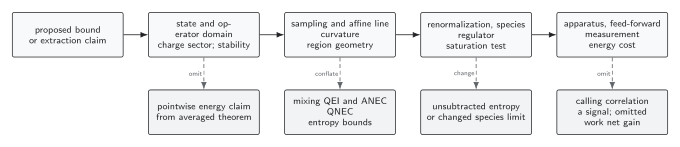
Independent checks prevent five common errors: inferring pointwise positivity from an averaged theorem, comparing differently normalized null quantities, treating raw cutoff-dependent entropy as finite, calling a local energy decrease extracted work, or calling correlation-assisted conditional extraction a superluminal signal. The map is schematic.
These controls can be applied without redoing an entire proof:
- Change the sampler or support. If a claimed QEI number does not scale when the sampling duration changes, its dimensions or normalization are wrong. If ANEC fails only after truncating the null line, the truncated observable is not ANEC.
- Change the reference or regulator. A regional relative-entropy inequality must survive a common regulator change. Raw entanglement entropy and raw energy separately need not.
- Remove the operational resource. A QET advantage must disappear when the classical message or the relevant correlations are removed. A Landauer claim must change when the reservoir is finite, nonthermal, or initially correlated.
- Close the energy account. A decrease of the field energy in one region is not automatically useful work. Include probe preparation, switching, control, readout, message storage, and reset before reporting a net gain.
Exercises
Section titled “Exercises”Sampling-scale check
Section titled “Sampling-scale check”Let . Show that has the same norm as and that
Explain why a four-dimensional massless-scalar QEI with this derivative norm does not imply a pointwise lower bound.
Solution
With and ,
Two derivatives give . Therefore
As , the permitted negative lower bound diverges like . The theorem constrains finite-duration averages but supplies no finite pointwise lower bound.
Affine-normalization check
Section titled “Affine-normalization check”Rescale a future-directed affine parameter by with . Determine how
transforms. Why is the sign of ANEC invariant even though its numerical value is not?
Solution
The new tangent is , while . Hence
Because , the sign is unchanged. A numerical comparison between two ANEC integrals is meaningful only after their affine normalizations are matched.
Finite-reservoir Landauer account
Section titled “Finite-reservoir Landauer account”An unbiased classical bit is erased while the reservoir inverse temperature is . Suppose the final memory–reservoir mutual information is nats and the reservoir relative entropy is nats. What is the minimum value of allowed by the exact identity?
Solution
Perfectly erasing an unbiased bit decreases the memory entropy by . Therefore
The ideal Landauer value is not reached because the final correlations and reservoir disturbance contribute an additional nats.
Scope boundary
Section titled “Scope boundary”This chapter treats nongravitational or fixed-background QFT. It does not derive curved-spacetime QEIs, the quantum focusing conjecture, black-hole generalized entropy, or holographic proofs; those belong to later volumes. “Bekenstein-type” means a regional inequality obtained from relative-entropy positivity with a specified modular Hamiltonian. “Quantum energy teleportation” means correlation-assisted local extraction with causal classical feed-forward. Neither phrase licenses a universal gravitational bound or superluminal transport.
References
Section titled “References”- Balakrishnan, Souvik, Thomas Faulkner, Zuhair U. Khandker, and Huajia Wang. “A General Proof of the Quantum Null Energy Condition.” Journal of High Energy Physics 2019, no. 9 (2019): 020. DOI. Open preprint.
- Bousso, Raphael, Zachary Fisher, Jason Koeller, Stefan Leichenauer, and Aron C. Wall. “Proof of the Quantum Null Energy Condition.” Physical Review D 93 (2016): 024017. DOI. Open preprint.
- Casini, Horacio. “Relative Entropy and the Bekenstein Bound.” Classical and Quantum Gravity 25 (2008): 205021. DOI. Open preprint.
- Faulkner, Thomas, Robert G. Leigh, Onkar Parrikar, and Huajia Wang. “Modular Hamiltonians for Deformed Half-Spaces and the Averaged Null Energy Condition.” Journal of High Energy Physics 2016, no. 9 (2016): 038. DOI. Open preprint.
- Fewster, Christopher J. “Lectures on Quantum Energy Inequalities.” Lecture notes, arXiv:1208.5399, 2012. Open preprint.
- Fewster, Christopher J., and Simon P. Eveson. “Bounds on Negative Energy Densities in Flat Spacetime.” Physical Review D 58 (1998): 084010. DOI. Open preprint.
- Hartman, Thomas, Sandipan Kundu, and Amirhossein Tajdini. “Averaged Null Energy Condition from Causality.” Journal of High Energy Physics 2017, no. 7 (2017): 066. DOI. Open preprint.
- Hotta, Masahiro. “Quantum Energy Teleportation: An Introductory Review.” arXiv:1101.3954, 2011. Open preprint.
- Pusz, Władysław, and Stanisław L. Woronowicz. “Passive States and KMS States for General Quantum Systems.” Communications in Mathematical Physics 58 (1978): 273–290. DOI.
- Reeb, David, and Michael M. Wolf. “An Improved Landauer Principle with Finite-Size Corrections.” New Journal of Physics 16 (2014): 103011. DOI. Open preprint.
Original QFT.org content:CC BY 4.0, unless an item supplies different terms. Third-party material retains its own terms.