

Regions, Causal Complements, and Nets of Observables
A continuum subsystem in relativistic QFT is first a region together with its observable algebra, not a tensor factor chosen by coordinates. A usable assignment must preserve inclusion, make spacelike algebras commute, transform covariantly, and contain enough Cauchy data to implement the time-slice principle. Those conditions say which measurements are localized and which comparisons between states are operationally meaningful.
Required background. Review operator algebras and positive functionals, spacelike-compatible observables, and microcausality. Helpful background. Local composite operators explain why pointlike fields must be smeared before they generate bounded local observables.
Nets of local observables
Section titled “Nets of local observables”Let be a causally well-behaved open region of Minkowski spacetime. A Haag–Kastler net assigns a unital algebra to each such region. In a chosen representation one normally works with the von Neumann algebra
The assignment is constrained by four logically distinct requirements:
- Isotony: implies .
- Locality: if and are spacelike separated, then for .
- Covariance: for the represented spacetime symmetry .
- Time slice: an arbitrarily thin neighborhood of a Cauchy surface for a globally hyperbolic region generates the same algebra as the region’s causal development.
These axioms answer different questions. Isotony orders available operations; locality licenses compatible spacelike measurements; covariance compares observers; the time-slice property expresses dynamical propagation. None alone identifies the algebra of the causal complement with the commutant —that stronger statement is Haag duality.
The original algebraic formulation makes this separation explicit Haag and Kastler 1964, pp. 848–861. The representation matters: the abstract net is state-independent, but factor type, normal states, and commutants are properties of its represented realization.
The structural map places Regions, Causal Complements, and Nets of Observables among sharp local algebras, split inclusions, and regulated or operational substitutes.
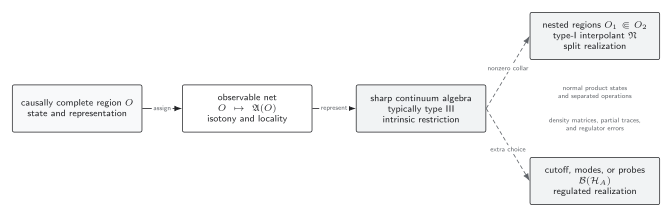
A causally complete region determines a sharp local algebra, usually type III. A nonzero split collar or an explicit cutoff, mode selection, or probe model can instead supply a type-I realization; these alternatives enable ordinary density matrices but retain different physical approximations. Schematic, not to scale.
Free scalar check
Section titled “Free scalar check”For a real free scalar field, take real test functions with compact support in and Weyl operators
where is the causal propagator. The local algebra is generated by with . If , the generating set for is contained in that for , proving isotony. If the supports are spacelike separated, , so the Weyl operators commute. This is the smeared-field version of the locality check; writing at spacelike separation is only shorthand for the distributional statement.
Removing the causal-support hypothesis breaks the commutation argument. Removing covariance prevents transport of the construction between regions. Changing representation can change which states are normal even when the abstract Weyl relations are unchanged. These are diagnostic failures, not minor notation choices.
What the subsystem contains
Section titled “What the subsystem contains”A state restricted to is the functional . Two global states that agree on every are indistinguishable by operations admitted in , even if they differ globally. This operational content is intrinsic; a density matrix appears only after an additional type-I realization, regulator, or split inclusion.
A full reconstruction of nets and superselection sectors requires additional axioms and is outside this page. Here the represented net is the physical starting point for entropy, modular theory, measurement, and recovery.
Before applying this result, use the validity map to keep the algebra, state, operation class, resources, and approximation fixed.
For a side-by-side statement of the chapter’s subsystem choices, use the subsystem comparison table.
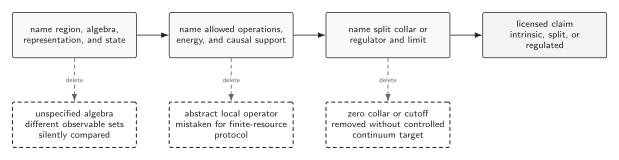
Every local-information claim must specify the represented algebra and state, the allowed operations and resource support, and any split collar or regulator. The dashed lower boxes show what fails when the algebra, protocol, or limiting prescription is left implicit. Schematic.
References
Section titled “References”- Haag, Rudolf, and Daniel Kastler. “An Algebraic Approach to Quantum Field Theory.” Journal of Mathematical Physics 5 (1964): 848–861. DOI.
Original QFT.org content:CC BY 4.0, unless an item supplies different terms. Third-party material retains its own terms.