

Microcausality and Relativistic Compatibility
In flat four-dimensional relativistic QFT, microcausality says that physical observables localized in spacelike-separated regions commute. A declared -graded field algebra uses the graded bracket instead, so two odd fields anticommute while even physical observables still commute. This makes the ordering of spacelike-localized observations compatible with relativity and forces retarded response built from their commutator to vanish outside the causal cone. It does not erase vacuum correlations, make every propagator causal, define every admissible intervention, or turn an auxiliary gauge-fixed field into a physical observable. Those distinctions are the scope of this page.
Required background. Spacelike Compatibility and Local Observables supplies smearing, the graded bracket, the field-versus-observable distinction, and the Pauli–Jordan calculation reused as the structural test.
Helpful background. Hyperbolic Equations and Causal Propagators supplies causal support, retarded and advanced Green operators, and the distinction between hyperbolic propagation and other propagators.
Spacelike observable algebras commute
Section titled “Spacelike observable algebras commute”For spacetime regions and , write
If denotes the bounded physical observables localized in , microcausality is the statement
The conclusion is algebraic compatibility: either observable can be placed first in a product without changing that product. Lorentz covariance alone does not imply this relation. Covariance controls how regions, states, and fields transform; locality is an additional property that a construction must impose or verify. Fewster and Rejzner 2019, arXiv v2, §§ 4.1–4.2, printed pp. 13–16 (PDF) formulate this distinction using local observable algebras.
Unbounded fields require a controlled version. Let and be test functions whose supports are spacelike separated, and let the smeared fields act on a declared common invariant domain . The point notation is then shorthand for a distributional statement about on ; a vanishing vacuum matrix element alone is weaker than an operator or algebraic locality relation. Even a zero commutator on one shared core need not by itself establish strong commutativity or joint spectral measurability, which is why the operational statement below uses bounded local algebras.
Graded locality belongs to fields, ordinary locality to observables
Section titled “Graded locality belongs to fields, ordinary locality to observables”For homogeneous fields of degrees , define
The field-level condition is
It is an ordinary commutator unless both fields are odd, in which case it is an anticommutator. In the usual fermion-parity grading, physical observables are even, so spacelike-separated observables commute in the ordinary sense. Moving an even composite past another even composite produces an even number of fermionic signs.
The grading is an input here. Deriving which grading is compatible with spin, positivity, the spectrum condition, and relativistic covariance is the separate Spin–Statistics Connection. Microcausality must not be used as a circular proof of that theorem.
The free scalar commutator has causal support
Section titled “The free scalar commutator has causal support”The required first application is a free real scalar of mass . With , , and
the mode algebra gives, as an operator-valued distribution on the finite-particle domain,
where the page convention is
At equal time the two terms cancel under ,
The derivative check reproduces . Every nonzero spacelike has a proper-orthochronous Lorentz frame in which , while is invariant under that group. Therefore
After smearing,
whenever the two supports are spacelike separated. This is a verification in one free model, not a derivation of locality from covariance for every QFT. Schwartz 2014, § 12.6, printed pp. 219–221 gives the free-field calculation and causal-support result.
Relativistic compatibility is order independence, not decorrelation
Section titled “Relativistic compatibility is order independence, not decorrelation”Different inertial frames can reverse the time ordering of spacelike-separated events. For physical observables and , microcausality removes the resulting ambiguity because . More generally, if two orderings of a finite product differ only by adjacent swaps of observables localized in mutually spacelike regions, repeated use of local commutativity gives the same product. This is the bounded lemma behind ordering comparisons; constructing coherent prefactorization products on time-orderable covers requires additional hypotheses and is deferred to the theorem-level continuation below.
Order independence does not mean that the state factorizes. For the free scalar vacuum,
At spacelike separation the two orderings agree, but their common value is generally nonzero. For , , and ,
Thus microcausality does not imply a product state, statistical independence, absence of entanglement, or a tensor-product factorization of local algebras. Weinberg 1995, § 5.2, printed p. 202 gives the spacelike free-field transform, while Fewster and Rejzner 2019, arXiv v2, § 5.2, printed pp. 26–27, and § 7, printed pp. 30–32 (PDF) distinguish persistent correlation from stronger independence properties.
A bounded no-signaling implication needs an operation model
Section titled “A bounded no-signaling implication needs an operation model”Microcausality has a precise operational consequence once the interventions are specified. Let a finite family of bounded operators describe a nonselective local operation and obey
For with , each commutes with . The dual operation therefore leaves Bob’s observable fixed:
For every state , the nonselective expectation is unchanged,
The unitary special case is . This conclusion assumes a physical local observable algebra, bounded locally implementable operation elements, spacelike separation, and normalization—equivalently, unitality of , or trace preservation in a density-operator representation. A selective outcome can change conditional statistics in an entangled state, but using that conditional change requires learning which outcome occurred. Microcausality alone does not define every admissible operation, supply a subsystem tensor product, or prove a universal measurement theorem. Fewster and Rejzner 2019, arXiv v2, § 6, printed p. 30, and § 7, printed pp. 30–32 (PDF) provide a bounded local-operation illustration and then separate Einstein causality from fuller independence requirements.
The following schematic map separates the exact algebraic statement from those extra operational assumptions. Inspect the solid implication path and the explicitly barred non-implications.
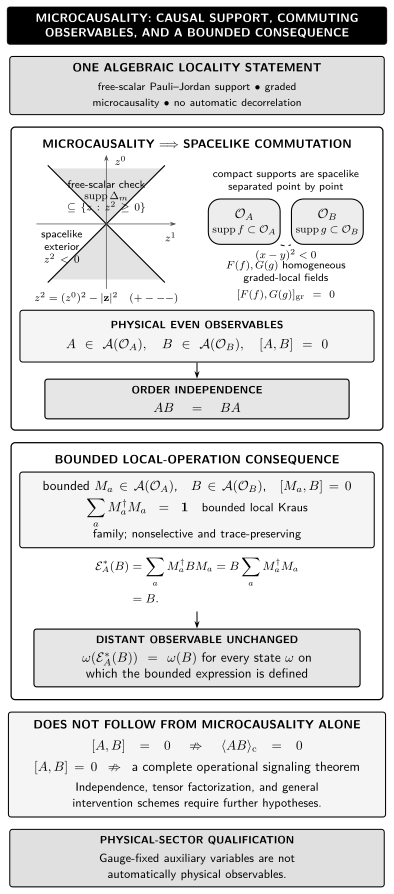
Microcausality relates spacelike-separated supports to graded field compatibility and ordinary commutation of physical observables. For bounded, normalized, nonselective local operations it also yields across the spacelike separation. It does not force correlations to vanish or supply every assumption of a general operational no-signaling theorem. The diagram is schematic and not to scale.
The same distinctions can be read without the figure:
| Layer | Controlled statement | Direct consequence | What remains separate |
|---|---|---|---|
| Spacetime supports | Every point of one support is spacelike to every point of the other | The locality bracket is tested on a well-defined pair of regions | Dynamics and a choice of physical algebra |
| Graded fields | The graded bracket of the smeared fields F(f) and G(g) vanishes on a common domain | Compatibility with the declared field grading | A spin–statistics derivation or an observable interpretation |
| Physical observables | The ordinary commutator of spacelike-localized even observables A and B vanishes | Order independence and vanishing spacelike retarded response | Zero correlations, statistical independence, or tensor factorization |
| Local interventions | The bounded elements Mₐ are localized in one physical observable algebra and obey Σₐ Mₐ†Mₐ = 1; B belongs to a spacelike-separated physical observable algebra | The dual nonselective operation leaves B fixed | A complete classification of physical interventions or gauge constraints |
Commutators, propagators, and propagation answer different questions
Section titled “Commutators, propagators, and propagation answer different questions”For the site convention , and when has no explicit source dependence, linear response of is
If the observables are microcausal, this response vanishes at spacelike separation. In the free scalar example,
This statement combines time orientation with commutator support. It does not make the Wightman or Feynman two-point function vanish outside the cone; those objects answer state-correlation and time-ordering questions. Nor does microcausality alone prove a domain-of-dependence theorem for a differential equation. Finite propagation follows from the hyperbolic operator, its coefficients, geometry, boundary conditions, and the selected retarded or advanced solution. The massive Pauli–Jordan distribution has support inside and on the causal cone, not only on its boundary.
Gauge-fixed fields require a physical-observable qualification
Section titled “Gauge-fixed fields require a physical-observable qualification”A gauge-fixed potential can be a useful local auxiliary representative without itself being a physical observable. In a covariant free-photon construction the auxiliary space is indefinite until a physical condition and null quotient are imposed. In a physical-mode description, the transverse projector contains an inverse spatial Laplacian and is nonlocal in space. Neither representation permits a raw component-field bracket to stand in automatically for a statement about measurable local quantities.
For the free electromagnetic field, commutators of appropriately smeared gauge-invariant field strengths are tensorial linear combinations of derivatives of the massless Pauli–Jordan distribution. Differentiation does not enlarge distributional support, so these commutators vanish at spacelike separation. By contrast, gauge-invariant charged operators may require noncompact dressings because of Gauss law; compact-support locality cannot simply be assumed for them. Physical-Mode Quantization of the Free Electromagnetic Field and Covariant Free-Photon Quantization and Propagator provide the two free descriptions. Gauge-Invariant and Dressed Observables develops the broader physical-observable question.
What microcausality does not establish
Section titled “What microcausality does not establish”- It does not follow from covariance or the spectrum condition, and it does not imply either one.
- It does not imply vacuum uniqueness, a mass gap, clustering, statistical independence, or absence of entanglement.
- It does not make Wightman or Feynman correlators vanish at spacelike separation.
- It does not supply isotony, additivity, the time-slice property, Haag duality, or the other axioms of a local net.
- It does not construct an interacting theory or prove causal factorization of renormalized time-ordered products.
- It does not derive the spin–statistics connection from the declared field grading.
- It does not replace the causal geometry and global-hyperbolicity hypotheses needed on curved spacetime.
Check your understanding
Section titled “Check your understanding”Check 1: distinguish a field bracket from an observable bracket
Two odd fields have spacelike anticommutator zero. What bracket should vanish for two even observables built from them?
Answer. Each observable has degree zero, so the graded bracket reduces to the ordinary commutator. The minus signs used to exchange the constituent odd fields occur in pairs, giving for spacelike-separated even observables.
Check 2: locate the extra no-signaling assumptions
Which hypotheses beyond were used to prove ?
Answer. The operation elements are bounded and localized in Alice’s physical observable algebra; the regions are spacelike separated; and the nonselective operation is normalized by . Microcausality supplies commutation with , but it does not supply the operation model or normalization.
Check 3: classify the support statements
For the free scalar, which of , , , and the Feynman function must vanish at spacelike separation?
Answer. The commutator kernel vanishes there, and does as well. The Wightman and Feynman functions generally remain nonzero because they encode correlations and ordering rather than the commutator support alone.
Where to continue
Section titled “Where to continue”- Quantify correlations rather than commutators: Clustering, Vacuum Assumptions, and Long-Range Correlations asks when connected correlations decay and which gap or vacuum assumptions control the rate.
- State locality as a full net axiom: Haag–Kastler Nets and Locality develops isotony, local commutativity, covariance, and the additional algebraic structure.
- Continue the bounded ordering lemma: AQFT to Prefactorization on Time-Orderable Covers treats the hypotheses and coherence needed to construct prefactorization products from causal ordering data.
- Resolve gauge and dressing questions: Gauge-Invariant and Dressed Observables treats physical observables, Gauss-law constraints, and nonlocal dressings.
- Change the spacetime geometry: Curved Spacetimes, Cauchy Surfaces, and Global Hyperbolicity supplies the causal structure needed before curved-spacetime locality statements.
References
Section titled “References”-
Fewster, Christopher J., and Kasia Rejzner. “Algebraic Quantum Field Theory—an Introduction.” arXiv:1904.04051v2, 2019; published in Progress and Visions in Quantum Theory in View of Gravity, edited by Felix Finster, Domenico Giulini, Johannes Kleiner, and Jürgen Tolksdorf, 1–61. Birkhäuser, 2020. DOI. Open manuscript PDF, v2.
-
Schwartz, Matthew D. Quantum Field Theory and the Standard Model. Cambridge University Press, 2014. DOI.
-
Weinberg, Steven. The Quantum Theory of Fields. Volume I: Foundations. Cambridge University Press, 1995. DOI.
Original QFT.org content:CC BY 4.0, unless an item supplies different terms. Third-party material retains its own terms.