

Wick’s Theorem and Free Gaussian Factorization
Wick’s theorem rewrites a time-ordered product of free fields as a sum of normal-ordered products multiplied by every allowed set of contractions. For a selected free vacuum the contractions are c-number two-point distributions, so taking the vacuum expectation value removes every term with an uncontracted field: centered bosonic correlators become sums over pairings with plus signs, while fermionic pairings carry the parity of the graded permutation that produces them. Differentiating the free Gaussian source functional proves the same bosonic correlator formula independently, but it does not by itself prove the stronger operator identity.
The scope matters. The operator theorem below uses a fixed free-field creation–annihilation split and normal ordering relative to the same vacuum. Its correlator corollary extends to centered Gaussian or quasifree states after the covariance and ordering are declared. Fields are understood after smearing or at a regulator; coincident composite products need an additional definition.
Required background. The Generating Functional fixes normalized Lorentzian source differentiation and , while Gaussian Fields and Sources supplies the regulated Gaussian completion.
Helpful background. Gaussian Vectors, Processes, Random Distributions, and Wick Structure develops Gaussian moment structure and its infinite-dimensional qualifications.
Free-field contractions
Section titled “Free-field contractions”Choose the four-dimensional free-scalar vacuum and split the field into annihilation and creation parts,
with
Normal ordering places every creation part to the left of every annihilation part . With , define a contraction by the operator difference
For a free scalar, the commutators generated while reordering the two parts are c-numbers. Consequently,
There is no extra factor of in this contraction. In the notation of the preceding pages the inverse kernel is instead . The ordering, state, and boundary prescription are part of ; a Wightman, thermal, retarded, or in–in two-point function cannot silently replace it.
The operator theorem
Section titled “The operator theorem”Let be a partial pairing of : a set of disjoint unordered pairs, with the labels belonging to those pairs. For the free scalar,
The empty pairing supplies the fully normal-ordered product. A term with one pair contains one contraction and normal-ordered fields; a complete pairing has no fields left. Every partial pairing occurs once, and every bosonic term has positive sign.
The product of unpaired fields retains their original label order before normal ordering.
Proof sketch. Put the fields in time order and split the first one into creation and annihilation parts. Moving its creation part to its normal-ordered position gives the uncontracted term. Moving its annihilation part through the remaining fields gives one c-number commutator with each possible partner, hence one contraction for every choice of that partner. Apply the same step to the fields left unpaired. Induction on produces each partial pairing exactly once; because scalar exchanges are ungraded, it introduces no minus signs. The full normal-ordered operator identity is developed in Schwartz 2014, § 7.A, pp. 100–103. An independent creation–annihilation pairing derivation for free-field matrix elements appears in Weinberg 1995, § 6.1, pp. 261–262.
The theorem may also be packaged as
Matching powers of recovers the operator formula. Vacuum expectation sets every nonconstant normal product to zero, leaving only complete pairings.
Wick’s original paper states the normal-product rearrangement and its ordered-product extension in Wick 1950, Theorems 1–2, pp. 270–271; its preceding rules declare the Bose and Fermi sign conventions Wick 1950, § II, Rules B, D, and C′′, pp. 269–270. For historical context, Jacob 1999, “Berkeley period,” p. 340 situates this work within Wick’s postwar research; that chronology is separate from the proof.
Gaussian source differentiation gives complete pairings
Section titled “Gaussian source differentiation gives complete pairings”For the centered free scalar, the normalized source functional is
Only even powers of occur, so every centered odd correlator vanishes. For source derivatives at , only the term contributes. Its coefficient contains . Differentiation assigns the labeled arguments to the endpoints of the quadratic factors in equivalent ways, canceling the denominator. Finally,
cancels the remaining sign from the exponential. Thus
where is the set of complete pairings and
A useful recursive version, with base case , pairs the first argument with each possible partner:
where the hat means that argument is omitted; argument has already been paired. The exact quadratic functional and four-point differentiation appear in Schwartz 2014, § 14.3.2, p. 263.
This route proves the vacuum correlator formula. It does not contain the normal-ordered terms needed for the operator identity. Conversely, a general Gaussian-state pairing rule need not use the vacuum normal ordering chosen above. For a noncentered Gaussian, write ; moments contain singleton factors as well as pairings of the centered field , so odd full moments need not vanish.
The scalar four-point test
Section titled “The scalar four-point test”At fourth order the three complete pairings give
with . All three signs are positive. In a centered but non-Gaussian state, the general moment–cumulant relation instead reads
The free vacuum has ; an interacting theory or a non-Gaussian state need not. In particular, free equations of motion do not make every excited state Gaussian. Connected Correlators and Cumulants develops this diagnostic without assuming factorization.
Fermionic signs come from graded permutations
Section titled “Fermionic signs come from graded permutations”For odd free-field operators , time ordering and normal ordering are graded: each exchange of two odd operators contributes a minus sign. Define
where is normal ordering relative to the selected free vacuum. For a partial pairing , write every pair as , order the pairs by increasing , and leave all unpaired labels in their original relative order. Let be the permutation
The fermionic term carries . This algorithm counts the graded exchanges needed to bring paired fields together; a drawing’s number of arc crossings is only a mnemonic after the field order and pair orientation have been fixed.
With the unpaired labels kept in their original order, the graded operator theorem is
For the selected free vacuum, which is a centered Gaussian state, vacuum expectation leaves the Pfaffian expansion
At four points the abstract sign pattern is
For the ordered Dirac fields
the and contractions vanish in the charge-preserving free vacuum. Define the raw correlator consistently with The Fermion Propagator by
Under the abstract convention above, the exchange pairing is and is even, so its term is . Reorienting the second contraction into the physical order gives
Equivalently, the two charge-oriented blocks have order , an odd permutation. Either account gives the same four-point function:
The relative minus sign is permutation parity. It does not come from the Dirac numerator, antiparticles, or a negative norm. The fermionic permutation rule and its first sign example are developed in Weinberg 1995, § 6.1, pp. 267–268; the formal Fermi sign rules and operator theorem appear in Wick 1950, § II, Rules B, D, and C′′, pp. 269–270; Theorems 1–2, pp. 270–271. A Grassmann-source derivation requires declared left/right derivatives and source order; Grassmann Functional Integrals for Free Fermions supplies that construction.
The diagram makes the combinatorics visible: compare all three scalar pairings with the two charge-preserving Dirac pairings, then inspect where the single odd exchange changes the sign.
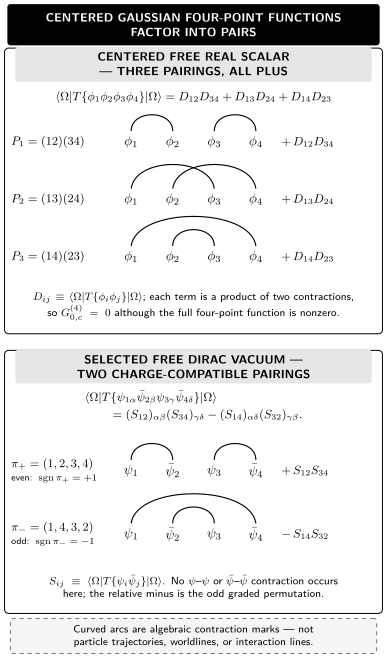
On a narrow screen, swipe the diagram or focus it and use the left/right arrow keys; Home and End move to its edges. Open the full-size diagram.
Complete four-point contraction patterns for a centered free real-scalar vacuum and the selected charge-preserving free Dirac vacuum. Each arc denotes a two-point contraction, not a particle trajectory or interaction line. The scalar products all enter with plus signs; the Dirac exchange product has a relative minus fixed by fermionic permutation parity. Schematic, not to scale.
The original diagram is by OpenAI Codex for QFT.org and is available under CC BY 4.0. Download its editable TikZ source and scientific source notes.
| Ordered fields | Complete pairing | Contribution |
|---|---|---|
|
|
|
|
|
|
|
|
|
|
|
|
|
|
direct: |
|
|
|
exchange: |
|
What the theorem does not say
Section titled “What the theorem does not say”It is not an identity for exact interacting fields. Perturbation theory applies the theorem to free interaction-picture fields inside the Dyson expansion. Wick Expansion for Interacting Fields develops that step, diagram conversion, and symmetry factors.
It is not a claim that every free-theory state is Gaussian. The selected free vacuum is Gaussian, as are declared quasifree states. An arbitrary superposition or density matrix can carry higher connected correlations even when the Hamiltonian is free.
Normal ordering is not composite-operator renormalization. It removes the selected vacuum contractions in this free representation. Products at coincident points remain singular distributions; Free Wick Products and Point Splitting develops their controlled definition.
The contraction is not state-independent. A new vacuum, thermal state, time-dependent background, ordering, or contour changes the two-point function and may change the appropriate normal ordering. The theorem must be restated with those data rather than reusing or by name.
Common pitfalls
Section titled “Common pitfalls”Using the inverse kernel as the scalar contraction. The contraction is the raw ordered correlator . The delta-normalized inverse used on the generating-functional page is .
Saying that all odd moments vanish. Odd moments vanish for a centered Gaussian. A nonzero mean supplies singleton blocks and can make odd full moments nonzero.
Giving every fermion pairing the same sign. Fermionic signs follow from the parity of a declared graded permutation. Pair orientation matters, as .
Reading contraction arcs as dynamics. The arcs record algebraic pairings of two-point functions. They are not propagating particles, interaction vertices, or a proof of Feynman rules.
Check your understanding
Section titled “Check your understanding”Use the stated criteria to locate any error in contraction conventions, pairing combinatorics, or fermionic signs.
| Mode | Prompt | A satisfactory response | Repair or continuation |
|---|---|---|---|
| Retrieval | Define a scalar contraction | Gives and names the ordering and vacuum | Free-field contractions |
| Proof structure | Explain the induction step in the operator theorem | Splits one field, produces the uncontracted normal product, and obtains one c-number commutator or anticommutator for each possible partner | The operator theorem |
| Sign check | Differentiate at order | Cancels from the Gaussian with and leaves each pairing once | Gaussian source differentiation gives complete pairings |
| Counting | Use the recursion to count the six-point scalar terms | Pairs label with five choices, then the remaining four labels in three ways, giving | Gaussian source differentiation gives complete pairings |
| Fermion sign check | Explain the minus in the Dirac exchange term | Tracks the odd permutation or uses ; does not invoke antiparticles or the numerator | Fermionic signs come from graded permutations |
| Counterexample | Add a nonzero connected four-point function | Says that the three pairings no longer exhaust , so the state or theory is non-Gaussian at fourth order | The scalar four-point test |
Where to continue
Section titled “Where to continue”- Use the theorem in perturbation theory: Wick Expansion for Interacting Fields develops the Dyson expansion, diagrams, and symmetry factors.
- Derive the Grassmann Gaussian: Grassmann Functional Integrals for Free Fermions fixes derivative order and reproduces the Pfaffian signs from sources.
- Define coincident products: Free Wick Products and Point Splitting treats the distributional limit rather than declaring normal ordering sufficient.
- Diagnose non-Gaussianity: Connected Correlators and Cumulants isolates the connected remainder omitted by the pairing formula.
References
Section titled “References”- Jacob, Maurice. “Gian-Carlo Wick.” Biographical Memoirs 77 (1999): 333–349. DOI.
- Schwartz, Matthew D. Quantum Field Theory and the Standard Model. Cambridge: Cambridge University Press, 2014. DOI.
- Weinberg, Steven. The Quantum Theory of Fields, Volume I: Foundations. Cambridge: Cambridge University Press, 1995. First edition; 2005 paperback, 2012 printing consulted. DOI.
- Wick, Gian-Carlo. “The Evaluation of the Collision Matrix.” Physical Review 80, no. 2 (1950): 268–272. DOI.
Original QFT.org content:CC BY 4.0, unless an item supplies different terms. Third-party material retains its own terms.