

Wightman, Euclidean, Local-Algebraic, Constructive, and Perturbative Frameworks
Wightman, Euclidean/Osterwalder–Schrader, and local-algebraic QFT foreground different primitive objects: fields and vacuum distributions, Euclidean correlation data, or nets of local observables. Constructive QFT instead asks whether a concrete regulated model can be shown to exist in a controlled limit, while perturbative algebraic QFT constructs local observables order by order as formal series. These descriptions are connected by important theorems and conditional constructions, but they are not automatically interchangeable. Every arrow must name its source and target object, its hypotheses, and the strength of the result.
Required background. What Is a Quantum Field Theory? supplies the distinction between a candidate action and a complete physical specification. Euclidean Correlators and Schwinger Functions supplies the Schwinger hierarchy, reflection-positivity distinction, and continuation boundary. Microcausality and Relativistic Compatibility supplies the field-versus-observable locality qualification.
Helpful background. Operator Algebras and Positive Functionals supplies -algebras, states, and the Gelfand–Naimark–Segal construction. Locally Convex, Nuclear, and Rigged Hilbert Spaces supplies the distributional spaces on which fields and correlation hierarchies live.
Framework labels choose different primitive data
Section titled “Framework labels choose different primitive data”A framework is not merely a notation for the same list of objects. It determines which objects are given first, which consistency conditions are imposed, and which further objects must be constructed.
Wightman-style QFT. One starts with a Hilbert space with positive-definite inner product, an invariant vacuum, a strongly continuous unitary Poincaré action, and operator-valued tempered distributions on a common invariant dense domain. Covariance, forward-cone spectral support, locality or graded locality, adjoints, and vacuum cyclicity constrain that system. Equivalently only after invoking the relevant reconstruction theorem, one may start from a full hierarchy of vacuum -point distributions satisfying the selected positivity, covariance, spectral, locality, temperedness or regularity, adjoint, and vacuum conditions; the reconstructed theory is unique only in the theorem’s stated unitary-equivalence sense. A two-point function determines that hierarchy only inside a declared Gaussian or quasifree class Summers 2016, arXiv v2, § 1, printed pp. 2–4 (PDF).
Euclidean/Osterwalder–Schrader QFT. The primitive data may be a full hierarchy of Schwinger distributions—symmetric in the bosonic case and graded as appropriate for fermionic fields—or, more strongly, a Euclidean random-distribution measure that produces it. Euclidean covariance, the relevant exchange symmetry, reflection positivity, and theorem-version-specific regularity and growth conditions are separate inputs; clustering enters when the selected reconstruction statement requires the corresponding vacuum property. Reflection positivity alone is not the reconstruction theorem. The 1973 formulation must be read with its 1975 correction: a full corrected hypothesis package is what supports Euclidean-to-relativistic reconstruction Osterwalder and Schrader 1973, § 3, printed pp. 87–90 (Open PDF), Osterwalder and Schrader 1975, Introduction and § IV.1, printed pp. 281–283 and 287–288 (Open PDF). The strengthened linear-growth package is sufficient for reconstruction, but the Schwinger functions obtained by analytically continuing a Wightman theory need not satisfy that condition; equivalence of those two resulting classes is not known Summers 2016, arXiv v2, § 3, printed pp. 9–10 (PDF).
Local-algebraic QFT. The primitive object is an assignment of an algebra of observables to each suitable spacetime region,
with isotony, Einstein causality, covariance or dynamics, and any additivity or time-slice property stated explicitly. A positive state is additional data; its GNS construction supplies a representation. A preferred vacuum and pointlike fields are not contained in a bare net automatically. Fewster and Rejzner develop the local-algebraic axioms, the free scalar algebra, Weyl generators, and quasifree states in Fewster and Rejzner 2019, arXiv v2, §§ 4.1–4.3, printed pp. 13–23 (PDF).
Constructive QFT. This is an existence program, not one rival axiom list. Typical input is a regulated family of Euclidean measures, Hamiltonians, or lattice models together with counterterms, tuning rules, a limiting topology, and a chosen observable class. The result sought is a proof that a limit exists and satisfies a named Euclidean, Wightman, or algebraic package. A finite cutoff model is not yet a continuum QFT. Summers describes both the existence objective and the work needed to remove regulators and verify Osterwalder–Schrader properties in Summers 2016, arXiv v2, §§ 1 and 3, printed pp. 1–2 and 9–18 (PDF).
Perturbative and perturbative-algebraic QFT. One starts from a free theory, a local interaction functional, time-ordered products or a renormalization prescription, suitable local or microcausal functionals, and formal power series—typically in the coupling and . Causal factorization constructs interacting observables and local -algebras within that formal-series category. The standard formal construction alone supplies neither convergence nor an exact positive Hilbert-space or -algebraic model Fredenhagen and Rejzner 2013, arXiv v2, §§ 5–7, printed pp. 21–34 (PDF), Summers 2016, arXiv v2, § 7, printed pp. 45–47 (PDF).
| Description | Primitive or working data | Carrier of state, positivity, and locality | Controlled output | Not supplied automatically |
|---|---|---|---|---|
| Wightman | Hilbert space, vacuum, Poincaré action, and operator-valued distributions; alternatively a complete compatible n-point hierarchy | Positive Hilbert inner product, vacuum state, spectral condition, and field locality on controlled domains | Vacuum distributions and their structural consequences | An interacting construction, Euclidean measure, or bounded local net without further work |
| Euclidean / Osterwalder–Schrader | Schwinger hierarchy or a stronger Euclidean random-field measure | Euclidean symmetry, reflection form, regularity and growth package, and any clustering input | Euclidean correlation data and, under the corrected theorem package, reconstructed relativistic data | Reconstruction from reflection positivity alone or a pointwise Wick-rotation rule |
| Local algebraic | Region-to-algebra assignment with inclusion, locality, covariance, and declared dynamical properties | Algebraic states and their representations; commutation of algebras in causally disjoint regions | Local observable relations; representations and sectors only after state and selection data are supplied | Point fields, a preferred vacuum, or a spectrum condition absent from the input |
| Constructive | Regulated models, counterterms, limiting procedure, topology, and observable class | The target framework’s conditions, verified after the required limits | A concrete model satisfying a named structural package | Continuum existence merely from a finite regulator or formal action |
| Perturbative / pAQFT | Free theory, local interaction, renormalized time-ordered products, and formal series | Algebraic relations and causal factorization in a formal-series category | Order-by-order interacting observables and formal local algebras | Convergence or a nonperturbative C*-model with a positive state from the formal construction alone |
These labels therefore lie on different axes. “Constructive” says how an existence claim is established; “perturbative” says what expansion category is used; “Wightman,” “Euclidean,” and “local algebraic” primarily say which mathematical objects and conditions are foregrounded. Hollands and Wald give a broader comparison of particle, Euclidean, functional, perturbative, and algebraic approaches in Hollands and Wald 2014, arXiv v2, § 1, printed pp. 5–8 (PDF).
Every arrow needs a theorem label
Section titled “Every arrow needs a theorem label”An arrow is meaningful only after its endpoints are typed. “Euclidean data reconstruct Lorentzian data” is incomplete until it names the full hierarchy, the positivity and growth package, the target equivalence notion, and the theorem version. Likewise, “fields generate a net” is straightforward for bounded free Weyl generators but conditional for general unbounded fields: one must invoke a specified field-to-net theorem with its domain, energy-bound, self-adjointness, and strong-commutativity or locality conclusions Borchers and Yngvason 1990, pp. 607–615.
The figure summarizes the most useful arrows. Inspect the arrow labels and the crossed routes: the diagram is not an equivalence pentagon, and a bare Lagrangian never points directly to a completed theory.
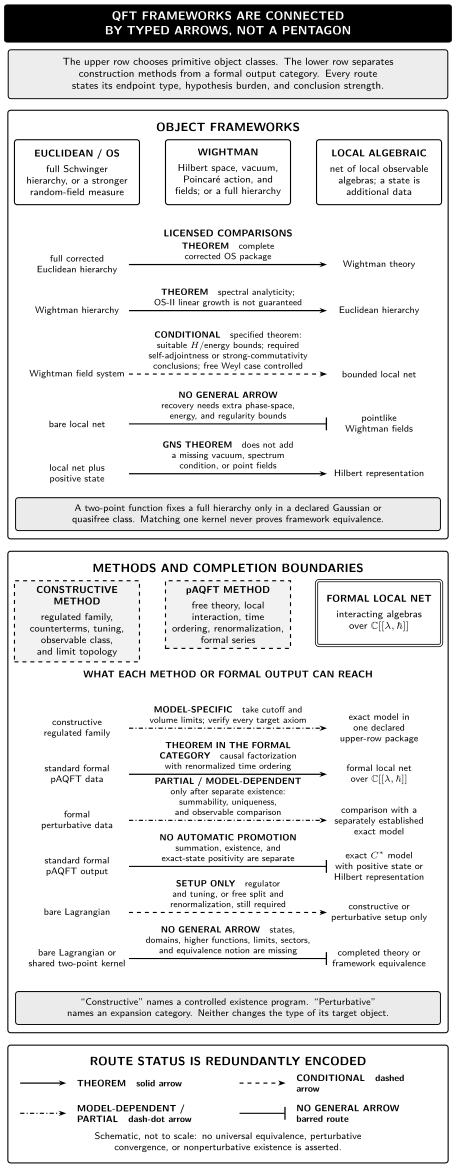
Typed comparison of five QFT descriptions. Solid arrows denote theorem-backed results under the written hypothesis package, dashed arrows denote conditional constructions, dash-dot arrows denote model-dependent or partial comparisons, and barred routes denote the absence of a general arrow. The diagram is schematic and not to scale; it does not assert universal equivalence, convergence, or nonperturbative existence.
The semantic fallback below records every relation in the figure independently of its layout.
| Source | Target | Status | Necessary control | What the arrow does not say |
|---|---|---|---|---|
| Full Euclidean hierarchy | Wightman theory | Theorem-backed | Complete corrected Osterwalder–Schrader covariance, symmetry, positivity, regularity or growth, and vacuum package | Reflection positivity alone reconstructs a theory, or the strengthened sufficient package characterizes every Wightman theory |
| Wightman theory | Schwinger hierarchy, not necessarily in the sufficient Osterwalder–Schrader linear-growth class | Theorem-backed analytic continuation | Wightman axioms, spectral analyticity, and distributional boundary-value control | The result automatically satisfies every sufficient Euclidean-to-Wightman growth package or is the moment hierarchy of a probability measure |
| Wightman field system | Bounded local net | Conditional construction | The hypotheses of a specified field-to-net theorem—for example suitable energy bounds together with the required self-adjointness and strong-commutativity or locality conclusions; the free Weyl case is controlled | Every unbounded field system automatically gives a Haag–Kastler net |
| Local net plus positive state | Hilbert representation | Theorem-backed GNS construction | Positive normalized functional on the algebra | The representation gains a vacuum, spectrum condition, or point fields that were not inputs |
| Bare local net | Pointlike Wightman fields | No general arrow | Specific recovery theorems require additional phase-space, energy, and regularity bounds | Observable nets universally determine charged or pointlike field coordinates |
| Constructive regulated family | Declared Euclidean, Wightman, or local-algebraic target | Model-specific conditional construction | Every required regulator and volume limit, plus verification of every named target condition | The adjective constructive replaces the existence proof |
| Standard formal pAQFT construction | Formal local net over power series | Theorem-backed inside the formal category | Renormalized time-ordered products, causal factorization, and the stated covariance and locality conditions | A formal local net is already an exact nonperturbative C*-model with a positive state |
| Formal local net | Exact C*-algebraic model with a positive state or Hilbert-space representation | No automatic promotion | Separate summation or convergence, existence, exact-state positivity, and completion results | The formal construction alone supplies an exact target |
| Formal perturbative data | Independently constructed exact model or observable | No general construction; model-specific comparison | Separate existence or summability result, uniqueness control, and matching of a specified observable class | Formal coefficients construct, or uniquely determine, a nonperturbative completion by themselves |
| Bare Lagrangian | Constructive setup | Conditional setup input only | Regulator, counterterms, tuning prescription, limiting topology, and observable class | The setup proves that a continuum target exists |
| Bare Lagrangian | pAQFT setup | Conditional setup input only | Free split, local interaction, time-ordered products, and renormalization prescription | The action alone fixes a formal local net without those choices |
| Bare Lagrangian or shared two-point kernel | Completed theory or framework equivalence | No general arrow | States, observables, domains, regulator removal, higher functions, sectors, and an equivalence notion | Matching equations or one kernel makes two theories equivalent |
“No general arrow” is not always an open problem. Sometimes the proposed map is ill-typed, sometimes counterexamples rule out the unqualified statement, and sometimes a genuine theorem exists only after adding hypotheses. Reserve “open” for a specified question—such as whether a particular formal series has a unique nonperturbative completion in a declared observable class—not for every missing arrow. For example, pointlike-field recovery from local observable algebras is available under additional phase-space and energy bounds in specific results, not for every net Fredenhagen and Hertel 1981, pp. 555–561.
One free scalar in all five descriptions
Section titled “One free scalar in all five descriptions”Take a massive real scalar with . This example is unusually well controlled: its Gaussian hierarchy, Euclidean measure, Fock representation, and Weyl algebra can all be constructed explicitly. It is therefore a compatibility test, not evidence that arbitrary interacting theories admit the same web of arrows.
Wightman data
Section titled “Wightman data”The vacuum two-point distribution is
It has forward mass-shell support, solves the Klein–Gordon equation in each argument, and determines all higher vacuum functions by Wick pairing because the state is quasifree. The last clause is essential: outside a declared Gaussian class, identical two-point data need not determine identical higher correlation functions Fewster and Rejzner 2019, arXiv v2, §§ 4.2–4.3, printed pp. 15–23 (PDF).
Euclidean and constructive data
Section titled “Euclidean and constructive data”The continued Euclidean covariance is
It obeys
For a Schwartz test function supported at positive Euclidean times, the free reflection form reduces to
This is reflection positivity for the displayed Gaussian kernel, not merely positivity of the multiplier . Measure existence is a separate check. For every real ,
Thus is a continuous positive quadratic form on Schwartz space. Bochner–Minlos gives the centered Gaussian probability measure on with covariance , and Wick pairing gives its Schwinger hierarchy. The displayed squared norm separately proves reflection positivity for this free covariance. Gaussian Vectors, Processes, Random Distributions, and Wick Structure develops the dimension-general random-distribution construction and its regulator boundary. These checks do not replace verification of the rest of a selected Osterwalder–Schrader package. In an interacting model, writing a formal weight such as does not prove that an analogous continuum measure exists.
Local-algebraic data
Section titled “Local-algebraic data”Let and take real compactly supported test functions modulo the image of . With the causal symplectic form , the abstract Weyl generators satisfy
The algebra is generated by with . If the supports of and are spacelike separated, causal support gives , so the generators commute. A quasifree vacuum state on this algebra supplies, through GNS, the familiar free Fock representation. The bare algebra alone did not already contain that preferred state Fewster and Rejzner 2019, arXiv v2, §§ 4.2–4.3, printed pp. 15–23 (PDF).
Perturbative data
Section titled “Perturbative data”The same free theory is the exact reference system at zeroth order. A local interaction produces formal expressions of the form
with time-ordered products and finite renormalization choices constrained by causal factorization. Setting returns the compatible free objects above. It says nothing about convergence at , a unique nonperturbative completion, or the existence of an exact positive interacting Hilbert-space representation.
The free scalar therefore supplies five mutually consistent descriptions because all required constructions can be checked directly. The agreement includes the mass shell, Euclidean Green equation, reflection form, Wick hierarchy, Weyl locality, and vacuum representation. It does not turn the five labels into universally equivalent definitions.
A Lagrangian is input, not a completed theory
Section titled “A Lagrangian is input, not a completed theory”A local expression such as
specifies candidate dynamics and vertices. It does not by itself choose a state, define products of distributions, remove a regulator, construct an observable algebra, establish positivity, prove an infinite-volume limit, or select an equivalence notion. Those missing data are precisely why the same Lagrangian can appear in perturbative calculations, a lattice regularization, a constructive Euclidean program, or a formal algebraic deformation without those outputs being identical claims.
The warning also runs in the other direction. A Wightman hierarchy or a local observable net may define a theory without a preferred Lagrangian coordinate system. Lagrangian notation is often the most economical calculational input once its prescriptions are fixed; it is not a universal mathematical definition of QFT.
Common non-arrows
Section titled “Common non-arrows”One two-point function does not define an arbitrary theory. It fixes a Gaussian hierarchy only after Gaussianity or quasifreeness is declared. Higher connected functions, superselection sectors, global observables, and state spaces may differ.
A positive Euclidean covariance is not the complete Osterwalder–Schrader package. Reflection positivity is a reflected quadratic-form condition, and even it is only one input to reconstruction.
GNS does not manufacture missing physics. From an algebra and a positive state it constructs a Hilbert representation. It does not add locality, a vacuum, a spectrum condition, or pointlike fields that were absent from the source data.
A formal net is not automatically an exact net. Perturbative AQFT gives a powerful local algebraic construction over formal series. Summation, an exact positive representation, and nonperturbative existence are separate questions.
“Constructive” does not mean “Euclidean” by definition. Euclidean measures are a major route, but Hamiltonian and other constructions are possible. What makes the work constructive is the controlled existence proof for a declared target.
Check your understanding
Section titled “Check your understanding”1. A Euclidean two-point kernel is reflection positive. Has a Lorentzian QFT been reconstructed? No. One must still have the full compatible hierarchy and the corrected covariance, symmetry, regularity or growth, positivity, and vacuum package required by the chosen reconstruction theorem.
2. A local net and state have been given. What follows immediately? GNS supplies a Hilbert representation of that algebra and state. Pointlike fields, a Poincaré-invariant vacuum, and the spectrum condition require additional input.
3. All perturbative coefficients of one observable are known. Is the exact answer unique? Not without a summability and uniqueness result in the relevant function class. Distinct nonperturbative contributions can share the same formal asymptotic series.
4. Why is the free scalar comparison unusually strong? The full Gaussian hierarchy follows from its two-point covariance, the Euclidean Gaussian measure exists, the Weyl net is explicit, and the free Fock representation is controlled. Those special facts do not persist automatically in interacting models.
Where precise comparisons continue
Section titled “Where precise comparisons continue”- Recheck the page-level hypothesis map: the Structural Hypothesis Matrix separates covariance, spectrum, positivity, locality, clustering, dimension, and field assumptions before any theorem is invoked.
- Review the Euclidean reconstruction inputs: Reflection Positivity within Osterwalder–Schrader Reconstruction places reflection positivity inside the corrected larger package without replacing the reconstruction theorem.
- Develop interacting existence claims by method: Interacting QFT: Definitions, Limits, and Handoffs distinguishes regulators, renormalized perturbation theory, lattice limits, and constructive or algebraic continuations.
- Type the mathematical objects before comparing them: QFT Frameworks, Object Classes, and Typed Maps develops the precise source and target categories behind the arrows.
- State the strength of an equivalence claim: Equivalence, Uniqueness, and Comparison Notions separates equality, isomorphism, unitary equivalence, perturbative comparison, and weaker matching claims.
- Check both Euclidean–Lorentzian directions: OS–Wightman Comparison Directions and Failure Modes develops the theorem packages and nonconverses rather than treating continuation as a substitution rule.
- Return to the chapter: Structural Principles and Axiom Maps places framework comparison beside covariance, positivity, locality, clustering, spin–statistics, CPT, and failure tests.
References
Section titled “References”-
Borchers, Hans-Jürgen, and Jakob Yngvason. “Positivity of Wightman Functionals and the Existence of Local Nets.” Communications in Mathematical Physics 127 (1990): 607–615. DOI.
-
Fewster, Christopher J., and Kasia Rejzner. “Algebraic Quantum Field Theory—an Introduction.” arXiv:1904.04051v2, 2019; published in Progress and Visions in Quantum Theory in View of Gravity, edited by Felix Finster, Domenico Giulini, Johannes Kleiner, and Jürgen Tolksdorf, 1–61. Birkhäuser, 2020. DOI. Open manuscript PDF, v2.
-
Fredenhagen, Klaus, and Joachim Hertel. “Local Algebras of Observables and Pointlike Localized Fields.” Communications in Mathematical Physics 80 (1981): 555–561. DOI.
-
Fredenhagen, Klaus, and Katarzyna Rejzner. “Perturbative Algebraic Quantum Field Theory.” In Mathematical Aspects of Quantum Field Theories, edited by Damien Calaque and Thomas Strobl, 17–55. Mathematical Physics Studies. Springer, 2015. DOI. Open PDF, arXiv:1208.1428v2, revised 2013.
-
Hollands, Stefan, and Robert M. Wald. “Quantum Fields in Curved Spacetime.” Physics Reports 574 (2015): 1–35. DOI. Open PDF, arXiv:1401.2026v2.
-
Osterwalder, Konrad, and Robert Schrader. “Axioms for Euclidean Green’s Functions.” Communications in Mathematical Physics 31 (1973): 83–112. DOI. Open PDF.
-
Osterwalder, Konrad, and Robert Schrader. “Axioms for Euclidean Green’s Functions II (with an Appendix by Stephen Summers).” Communications in Mathematical Physics 42 (1975): 281–305. DOI. Open PDF.
-
Summers, Stephen J. “A Perspective on Constructive Quantum Field Theory.” arXiv:1203.3991v2 [math-ph], revised 2016 (originally submitted 2012). Stable record. Open PDF, v2.
Original QFT.org content:CC BY 4.0, unless an item supplies different terms. Third-party material retains its own terms.