

Regulator Dependence and Continuum Complexity
A continuum complexity comparison is a statement about a matched family of regulated tasks, not the formal limit of one bare number. One must hold physical targets and tolerances fixed, translate gate resources across regulators, classify allowed divergent terms, and show whether any remainder is stable under reference and scheme changes. In many reasonable task families no finite universal limit exists; that is a legitimate conclusion.
Required background. Regulator Removal and Renormalized Predictions supplies the distinction between bare cutoff dependence and matched physics. Circuit Complexity in Quantum Field Theory supplies the regulated resource task.
Helpful background. From Lattice Entropy to a Continuum Claim provides an analogous order-of-limits discipline.
A family of tasks indexed by the cutoff
Section titled “A family of tasks indexed by the cutoff”Let denote a lattice, mode, or energy cutoff. For each value choose
and matching maps that identify the same low-energy observables and physical volume. The comparison is controlled if target errors vanish or remain below a fixed physical tolerance and if the resource maps do not introduce cutoff-dependent free operations.
A fit may take the form
Dimensional analysis restricts powers but does not make their coefficients universal. , , and can depend on gate locality, generator normalization, reference correlations, cost norm, boundary conditions, and zero-mode prescription.
What may be subtracted
Section titled “What may be subtracted”Renormalized observables use counterterms because locality, symmetry, and a physical renormalization condition constrain them. A complexity subtraction needs an analogous rule in resource space. An allowed local counter-cost must be defined for the same preparation task and transformed consistently between schemes. Otherwise
is merely a convention that can assign any desired finite remainder.
Reference matching is especially important. If approaches the target in the ultraviolet, the leading divergence can disappear because the reference has absorbed preparation work. That can be useful, but reference preparation must be charged or the comparison labeled reference-relative.
Three outcomes
Section titled “Three outcomes”Regulated operational quantity. The cutoff is part of a laboratory or simulation specification. Report directly with its error; no continuum limit is needed.
Universal comparison class. Ratios, differences, or scaling exponents are stable under a declared set of regulator and reference translations. State that equivalence class and the residual variations.
No continuum resource. Every candidate remainder changes under admissible gate or reference choices, or the cost diverges at fixed physical accuracy. Then the honest result is nonexistence for that task family, not a missing calculation.
Matched multi-regulator workflow
Section titled “Matched multi-regulator workflow”- Choose at least two regulator families with matched low-energy observables.
- fix physical volume, target, reference preparation rule, and error tolerance.
- normalize gates by their continuum generators or physical control amplitudes.
- compute several cutoffs and propagate optimizer and approximation errors.
- fit only power and logarithmic structures permitted by dimensional and boundary analysis.
- remove coarse points and vary the fit window.
- translate to the second regulator and test coefficients or claimed remainder.
- vary the reference and cost within the declared equivalence class.
The finite-mode reproducible verification workflow is designed for this comparison. Until executed, it supplies no numerical continuum evidence.
Evidence boundary
Section titled “Evidence boundary”As of 10 August 2026, continuum circuit complexity remains definition indexed; there is no general theorem selecting a unique QFT gate set, counter-cost, or finite remainder. Gaussian calculations exhibit cutoff divergences and reference dependence within specified Nielsen-type costs Jefferson and Myers 2017, §§2–4, while continuum cost-function proposals explicitly retain regulator and penalty choices Chapman et al. 2018, pp. 1–4. Interacting and proposal-specific extensions require additional truncation and scheme controls. Claims should therefore be phrased as conditional scaling laws, not regulator-independent physical observables.
Exercises
Section titled “Exercises”Matched tolerance. Why is fixed Hilbert-space dimension not a continuum comparison?
Solution
Changing the lattice spacing at fixed dimension changes physical volume or removes modes in a way that need not approximate the same state. A continuum family fixes physical observables and tolerance while increasing the degrees of freedom according to a matching map.
Finite difference. Two target states have costs with the same leading divergence. Is their difference universal?
Solution
Not automatically. Subleading and finite terms can depend on reference, gates, cost, boundary counter-costs, and how the targets are matched. Universality requires demonstrating cancellation under all allowed translations, not observing it in one regulator.
Task and validity maps
Section titled “Task and validity maps”The first diagram distinguishes target objects and their admissible resource models; inspect which equivalence class is being minimized over. The second shows the definition changes and physical controls that must be held fixed before two complexity values or growth laws are compared.
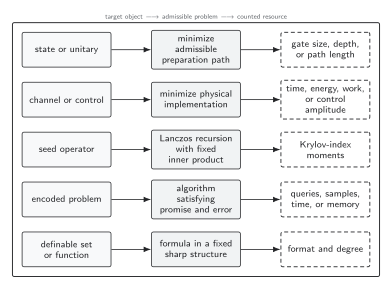
A complexity value is defined only after the target object selects an admissible family of paths or descriptions. Circuit length, physical control cost, Krylov spread, algorithmic resources, and sharp o-minimal format or degree answer different questions. The diagram is schematic and not to scale.
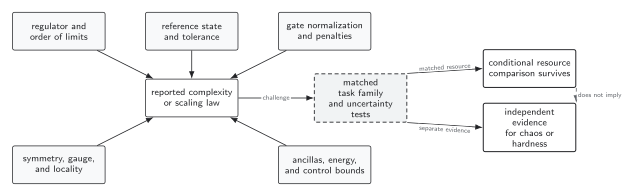
Reference sensitivity, gate nonuniqueness, regulator dependence, symmetry constraints, and unbounded controls are distinct failure modes. A link from complexity growth to chaos or computational hardness requires separate evidence after those controls. The diagram is schematic.
References
Section titled “References”- Chapman, Shira, Michal P. Heller, Hugo Marrochio, and Fernando Pastawski. “Toward a Definition of Complexity for Quantum Field Theory States.” Physical Review Letters 120 (2018): 121602. DOI. Open PDF.
- Jefferson, Ro, and Robert C. Myers. “Circuit Complexity in Quantum Field Theory.” Journal of High Energy Physics 10 (2017): 107. DOI. Open PDF.
Original QFT.org content:CC BY 4.0, unless an item supplies different terms. Third-party material retains its own terms.