

Mutual Information for Disjoint Regions
Mutual information isolates correlations between two regions. At positive separation its usual regulated entropy combination has a finite continuum limit in many QFTs, but finiteness is a theorem with hypotheses—not a consequence of the word “disjoint.” The geometry enters through conformal cross ratios, while the state and operator spectrum determine the function of those ratios.
Required background. Mutual Information and Regulator-Independent Correlations supplies the relative-entropy definition, positivity, monotonicity, and the conditions under which ultraviolet terms cancel. Helpful background. Interval, Sphere, and Cylinder Entanglement in CFT supplies the single-interval entropy and twist-field conventions used below.
The shared structure map locates disjoint-region mutual information among the chapter’s other correlation measures. The canonical comparison table records which subsystem and regulator data each measure needs.
Mutual information in type-I and algebraic language
Section titled “Mutual information in type-I and algebraic language”For a density operator on a tensor product , natural logarithms give
This identity makes positivity and monotonicity under local channels immediate. A lattice cutoff or an explicitly chosen split type-I factor puts a QFT calculation in this setting.
Intrinsic local QFT algebras are normally type III, so the three individual von Neumann entropies in the first expression do not exist. For commuting region algebras and , the algebraic replacement is Araki relative entropy between the joint state and the normal product of its restrictions,
The normal product state is available for a split pair. Even then, may be infinite unless the state and theory satisfy further phase-space conditions; modular -nuclearity with is one sufficient condition Panebianco and Wegener 2021, §6, Theorem 25. Thus every finiteness claim below assumes either a matched regulator with a verified limit or a split algebraic setting in which the relative entropy is finite.
Two intervals, one cross ratio
Section titled “Two intervals, one cross ratio”Let
The conformally invariant cross ratio
approaches at large separation and at contact. Inspect those two limits, and the finite gap between and , in the following diagram.
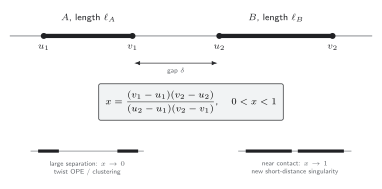
For ordered intervals of lengths separated by , the cross ratio is . Large separation gives , while contact gives and exposes short-distance structure. Schematic; not to scale.
For integer , the replica path integral gives a four-point function,
Conformal symmetry fixes its kinematic prefactor but leaves a function containing the replicated theory’s operator dimensions and OPE coefficients Calabrese, Cardy, and Tonni 2009, §2, eqs. (4)–(5), and §4, eqs. (38)–(39). Integer moments, the function , and an analytic continuation to are logically separate inputs; integer data alone do not prove a unique continuation.
For the Rényi mutual-information combination
the twist OPE at gives
where is the smallest allowed sum of scaling dimensions of replica-theory operators whose product has the vacuum quantum numbers. In the common case in which the lightest admissible contribution pairs two operators of dimension , ; it is not generally Cardy 2013, abstract and §§2–3.
Exact free-Dirac application
Section titled “Exact free-Dirac application”Consider the vacuum of the full massless Dirac field in dimensions and equal intervals
Here
With the full Dirac algebra and its vacuum state, the exact result is
This is the two-interval specialization of the extensive entropy formula Casini and Huerta 2009, §2, eqs. (2)–(4). It is positive because . Its controlled large-separation expansion is
At fixed , contact instead gives
The exact answer therefore displays both clustering and the contact divergence without suggesting a phase transition.
Where approximations and continuum claims fail
Section titled “Where approximations and continuum claims fail”A small- truncation is controlled only while successive retained terms decrease. At , the one-term approximation differs from the exact Dirac answer by about ; adding lowers the error below . At , the corresponding errors are about and . Approaching contact has therefore supplied the relevant failure injection: the exact finite- result survives, but the small- claim does not.
Ultraviolet cancellation has its own domain. Use the same cutoff, algebra, center, and boundary convention in , , and , then take the continuum limit at fixed physical separation. If the regions touch, new local contributions live at the common boundary and the separated-region cancellation argument no longer applies. Changing the state, global geometry, or replica continuation can also change the finite answer. The shared validity map summarizes these independent failure modes.
Mutual information measures total correlation. It does not determine logarithmic negativity, entanglement of purification, or a communication capacity without additional hypotheses and constructions.
Exercises
Section titled “Exercises”1. Geometry and the exact answer
Section titled “1. Geometry and the exact answer”For equal intervals of length and gap , derive . Evaluate the exact Dirac mutual information at and find its leading behavior for .
Solution
Substitution of , , , and gives
At , , hence
For , . Since ,
The power-law decay is a clustering check in this free theory.
2. An OPE failure injection
Section titled “2. An OPE failure injection”Compare and with at and . Which claim remains defensible at the larger cross ratio?
Solution
At ,
The relative errors are about and . At ,
with errors about and . At one may still claim that the displayed terms are the first terms of the small- expansion; one may not claim that the truncation accurately approximates the answer.
3. Boundary-by-boundary cancellation
Section titled “3. Boundary-by-boundary cancellation”Suppose a local regulator produces in one spatial dimension, where counts endpoints. Show that the divergent term cancels in for two separated intervals. Explain why this calculation does not prove intrinsic algebraic finiteness.
Solution
For separated intervals, and . Therefore
This proves cancellation of the assumed local divergence in one matched regulator. It does not construct a normal product state on the type-III algebra, prove the split property, or bound the Araki relative entropy. Those are additional algebraic and phase-space questions.
4. Why integer replicas are not enough
Section titled “4. Why integer replicas are not enough”Let be one analytic continuation of a sequence known at positive integers. Show that agrees with all integer data but can change the derivative at . What additional evidence makes a replica result credible?
Solution
For every integer , , so . However,
which changes an entropy extracted from a derivative at . A credible continuation therefore needs stated analyticity and growth assumptions, a derivation valid away from the integers, or independent checks such as an exact free-field result, covariance calculation, or controlled numerical extrapolation.
References
Section titled “References”- Calabrese, Pasquale, John Cardy, and Erik Tonni. “Entanglement Entropy of Two Disjoint Intervals in Conformal Field Theory.” Journal of Statistical Mechanics: Theory and Experiment (2009): P11001. DOI. Open preprint.
- Cardy, John. “Some Results on the Mutual Information of Disjoint Regions in Higher Dimensions.” Journal of Physics A: Mathematical and Theoretical 46 (2013): 285402. DOI. Open preprint.
- Casini, Horacio, and Marina Huerta. “Remarks on the Entanglement Entropy for Disconnected Regions.” Journal of High Energy Physics 03 (2009): 048. DOI. Open preprint.
- Panebianco, Lorenzo, and Benedikt Wegener. “Modular Nuclearity and Entanglement Measures.” arXiv:2110.05823 (2021). Open preprint.
Original QFT.org content:CC BY 4.0, unless an item supplies different terms. Third-party material retains its own terms.