

Complementary Recovery and Cleaning Relations
Complementary recovery and cleaning express the same structure from two directions: if erasure of a region is correctable for a logical algebra, its logical observables can be represented on the complementary accessible region; conversely, sufficiently complete complementary representatives imply that the erased region learns no protected information. The representatives agree only on the code and can have regulator-dependent tails in a continuum limit.
Required background. Erasure, Subregions, and Correctability supplies the region-noise task.
Helpful background. Operator-Algebra Quantum Error Correction supplies the logical algebra and commutant.
Cleaning a logical representative
Section titled “Cleaning a logical representative”Let project onto a finite code in . A physical operator represents a logical observable if has the desired action on the code. Cleaning from means finding supported on such that
If erasure of is exactly correctable, Heisenberg recovery supplies such a representative for every correctable logical observable. Cleaning lemmas make this relation explicit in local code settings Bravyi and Terhal 2009, §3, with extensions useful for fault-tolerant logical actions Pastawski and Yoshida 2015, §§II–III. If correction has error in a compatible norm, one obtains approximate representatives with a bound that must retain the norm and code domain.
The difference need not vanish outside the code. This fact prevents a cloning interpretation: two regional representatives are one logical operator modulo the ideal of operators annihilating the code, not two independent copies.
Complementary logical algebras
Section titled “Complementary logical algebras”For subsystem and algebra codes, the cleaning statement is asymmetric. A region may support observables in —gauge or center information—while all are cleanable. The correct theorem refers to the protected algebra, not every operator preserving the code space.
If two disjoint commuting regions each represent the same Abelian center observable, no conflict arises. If they independently represented a full noncommuting matrix algebra with tensor-independent actions, one could broadcast arbitrary quantum information; the code equivalence relations prevent that situation under exact assumptions.
Finite oscillator construction
Section titled “Finite oscillator construction”Take a regulated oscillator code with known isometry and choose an operator basis for the logical algebra. To find a complement representative, solve
for each . Exact zero residual verifies cleaning in the finite model. Approximate residuals should be compared with an independently evaluated recovery channel and held uniformly over the entire logical basis, not only one favored observable.
Use a complete basis including noncommuting logical operators and the identity. Check Hermiticity and multiplication relations after projection. A least-squares solution can reproduce matrix elements while having an exploding full norm; report the physical norm or energy-bounded action relevant to the continuum sequence.
Continuum localization and tails
Section titled “Continuum localization and tails”In continuum QFT, a strictly localized bounded representative may fail to exist because the target algebra is type III, because Haag duality has boundary qualifications, or because finite-energy operators cannot be compactly localized in the assumed way. A split construction can produce representatives separated from the erased region by a buffer. The continuum statement may then be approximate cleaning with tails controlled as the buffer, cutoff, and energy window are varied.
Demanding exact strict support after taking the limit is stronger than showing convergence on low-energy code states. State which one has been proved.
Exercises
Section titled “Exercises”Outside-code disagreement. If , must ?
Solution
No. Only their matrix elements and action within the code agree. They can act differently on orthogonal states and during processes that leave the code. Error analysis must therefore include leakage if such processes are allowed.
Incomplete basis. Why is cleaning logical alone insufficient to establish qubit erasure correction?
Solution
It protects only one commuting observable. The complementary region might still lose or leak logical and , destroying phase coherence. A full qubit algebra requires cleaning a generating noncommuting set with controlled relations.
Recovery and continuum maps
Section titled “Recovery and continuum maps”The first diagram follows the task from logical algebra through noise, environmental leakage, and constrained recovery; inspect which metric and recovery family support the guarantee. The second identifies the additional uniformity tests required before finite-regulator correctability becomes a continuum field-code statement.
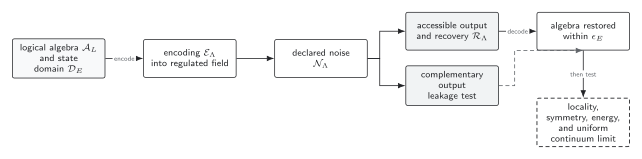
Correctability relates one logical algebra, one noise channel and complement, one state or energy domain, and one recovery class. Environmental forgetting supports recovery only in the matching metric; locality, symmetry, and continuum convergence are additional tests. The diagram is schematic and not to scale.
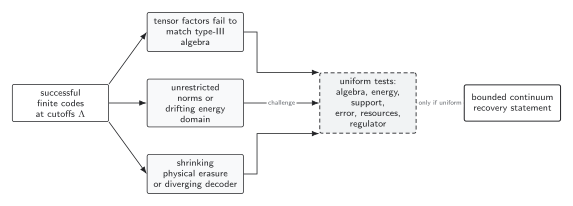
A sequence of successful finite codes does not establish a continuum code unless its logical algebra, physical erasure region, energy domain, recovery error, and locality bounds converge uniformly. Type-III structure and regulator-dependent tensor factors require an algebraic target. The diagram is schematic.
References
Section titled “References”- Bravyi, Sergey, and Barbara Terhal. “A No-Go Theorem for a Two-Dimensional Self-Correcting Quantum Memory Based on Stabilizer Codes.” New Journal of Physics 11 (2009): 043029. DOI. Open PDF.
- Pastawski, Fernando, and Beni Yoshida. “Fault-Tolerant Logical Gates in Quantum Error-Correcting Codes.” Physical Review A 91 (2015): 012305. DOI. Open PDF.
Original QFT.org content:CC BY 4.0, unless an item supplies different terms. Third-party material retains its own terms.