

Regularization, Continuum Limits, and Code Validation
A regulated code has a continuum QFT limit only when its logical algebra, encoded states, noise, recovery, and error bounds converge together on a fixed physical domain. Pointwise success at each cutoff is insufficient if recovery constants grow, erasure regions shrink, energy windows drift, or the logical identification changes. The central requirement is a cutoff-uniform statement before the limit is taken.
Required background. Continuum Codes and Type-III Obstacles supplies the target algebraic structure. Approximate Recovery and Information–Disturbance supplies the recovery error.
Helpful background. From Lattice Entropy to a Continuum Claim supplies a parallel regulator-removal workflow.
The convergence diagram
Section titled “The convergence diagram”Let index regulators. A validation packet contains:
- logical algebras and a limiting ;
- embeddings of a dense bounded test algebra;
- code-state domains matched to a fixed physical energy ;
- noise representing a fixed physical process or erasure region;
- recoveries obeying declared locality and resource bounds;
- errors in one compatible topology.
The desired square approximately commutes:
with or a stated nonzero limit. Here the displayed notation abbreviates the matching Heisenberg or Schrödinger equation; do not mix pictures in an actual proof.
Uniformity checklist
Section titled “Uniformity checklist”Algebra matching. Products, adjoints, commutators, symmetry actions, and center data converge on the test algebra.
State matching. Correlators or normal functionals converge uniformly enough to control the error metric, including reference-entangled states.
Physical support. Erasure and recovery regions are held fixed in physical coordinates, with smearings and boundary collars stated.
Energy control. The same physical Hamiltonian normalization and energy cap are used; high-energy truncation tails vanish uniformly. The energy-constrained norms of Shirokov and Winter provide two compatible analytical interfaces for this step Shirokov 2018, §§2–4 Winter 2017, §§3–5.
Recovery control. Decoder norm, range, duration, ancilla energy, and conditioning do not diverge unnoticed.
Regulator independence. At least one inequivalent regulator family or matching scheme reproduces the claimed limiting statement within error.
A bosonic-code validation workflow
Section titled “A bosonic-code validation workflow”For a family of oscillator or lattice-field codes:
- fix a continuum logical qubit through smeared low-energy observables;
- construct and measure encoding error;
- erase a fixed physical region and compute complementary leakage;
- construct and evaluate energy-constrained recovery error;
- enlarge local Hilbert truncation at each ;
- fit with uncertainty and remove coarse regulators;
- repeat with a second discretization or smearing family;
- report recovery resources and any nonuniform constant.
If but decoder energy grows like , the result is a mathematical approximate recovery sequence, not a finite-resource continuum protocol. Both statements can be valuable when separated.
Rejecting a false threshold
Section titled “Rejecting a false threshold”Suppose a numerical erasure threshold appears stable in site units. Replot against physical erasure density and size, hold the energy domain fixed, and increase local Fock dimension. If the crossing drifts or recovery constants grow, the threshold was regulator dependent. A continuum threshold additionally needs a stable family of physical noise channels and finite-size scaling, not one curve crossing.
Exercises
Section titled “Exercises”Pointwise versus uniform. For every logical state suppose its recovery error tends to zero, but the worst-case state depends on . What is missing?
Solution
Pointwise convergence does not control the supremum over the logical or energy domain. A code guarantee needs uniform convergence, compactness plus an equicontinuity argument, or a weaker task stated explicitly.
Divergent decoder. Does prove operational continuum recovery if decoder time tends to infinity?
Solution
It proves only existence of increasingly accurate regulated recoveries. An operational claim must also bound duration and other resources in the intended limit.
Recovery and continuum maps
Section titled “Recovery and continuum maps”The first diagram follows the task from logical algebra through noise, environmental leakage, and constrained recovery; inspect which metric and recovery family support the guarantee. The second identifies the additional uniformity tests required before finite-regulator correctability becomes a continuum field-code statement.
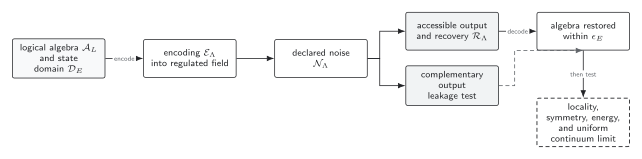
Correctability relates one logical algebra, one noise channel and complement, one state or energy domain, and one recovery class. Environmental forgetting supports recovery only in the matching metric; locality, symmetry, and continuum convergence are additional tests. The diagram is schematic and not to scale.
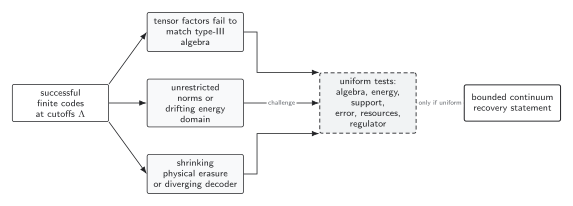
A sequence of successful finite codes does not establish a continuum code unless its logical algebra, physical erasure region, energy domain, recovery error, and locality bounds converge uniformly. Type-III structure and regulator-dependent tensor factors require an algebraic target. The diagram is schematic.
References
Section titled “References”- Shirokov, Maxim E. “Energy-Constrained Diamond Norms and Their Use in Quantum Information Theory.” Problems of Information Transmission 54 (2018): 20–33. DOI. Open PDF.
- Winter, Andreas. “Energy-Constrained Diamond Norm with Applications to the Uniform Continuity of Continuous Variable Channel Capacities.” arXiv:1712.10267 (2017). Preprint.
Original QFT.org content:CC BY 4.0, unless an item supplies different terms. Third-party material retains its own terms.