

Subsystem and Gauge-Code Structures in QFT
Subsystem and gauge-code language separates protected logical observables from degrees of freedom that may change without affecting the task. In a gauge QFT there is an additional, conceptually different structure: physical gauge redundancy and Gauss constraints determine the observable algebra itself. Calling both structures “gauge” does not make them interchangeable.
Required background. Operator-Algebra Quantum Error Correction supplies the logical-algebra formulation.
Helpful background. Gauge Constraints, Centers, and Edge Data supplies physical gauge constraints and boundary centers.
Four algebras to keep distinct
Section titled “Four algebras to keep distinct”At a finite regulator, organize the construction by:
- the kinematic algebra before constraints;
- the physical observable algebra commuting with Gauss constraints, modulo redundancy;
- the code gauge algebra whose state is intentionally unprotected;
- the logical algebra, typically a subalgebra of the commutant of code gauge operations on the physical code.
A subsystem code has a decomposition on each sector, as in the operator-QEC framework of Kribs and collaborators Kribs et al. 2006, §§2–4,
with logical algebra . Code gauge operations may alter without logical damage. By contrast, a physical gauge transformation acts redundantly and does not label a second physical state.
Constraints and regional centers
Section titled “Constraints and regional centers”For a lattice gauge theory, Gauss operators define the physical subspace. Regional observable algebras may have center elements measuring boundary electric flux or another chosen boundary quantity. The center label yields a direct sum of sectors, not a freely manipulable tensor factor.
An extended-Hilbert-space construction adds boundary degrees of freedom so a tensor factor exists. Casini, Huerta, and Rosabal compare this with algebraic center choices Casini, Huerta, and Rosabal 2014, §§2–4. A code built there must say which edge states are physical resources and how the final logical algebra maps back to gauge-invariant observables. Otherwise apparent recovery may act only on auxiliary edge variables.
Small regulator construction
Section titled “Small regulator construction”Choose a finite gauge lattice and:
- solve or project the Gauss constraints;
- identify a physical logical Wilson or dressed-matter algebra;
- choose a separate code gauge algebra, if desired;
- define gauge-preserving noise and recovery;
- test operator-algebra correctability on the physical subspace;
- repeat under an alternative boundary-center convention.
Allowing constraint-violating errors creates leakage out of the physical Hilbert space. Correction then needs a leakage model and a way to measure or restore constraints. Simply projecting back can be nonlocal and energetically costly.
What survives a convention change
Section titled “What survives a convention change”Physical predictions for gauge-invariant observables should agree after a correct translation, but regional entropies, tensor factorizations, and which boundary center is exposed can differ. A robust code claim identifies the common gauge-invariant logical algebra and states which recovery resources depend on the convention.
Exercises
Section titled “Exercises”Two meanings of gauge. Can a code gauge qubit be identified with a gauge orbit coordinate?
Solution
Not generally. A code gauge qubit is a physical subsystem whose state is ignored by the protected task. A gauge orbit coordinate is redundant and does not represent a physical degree of freedom. Conflating them changes the observable algebra.
Constraint leakage. Why is projecting a noisy state back to the Gauss-law sector not automatically a valid local recovery?
Solution
The projector can be nonlocal, nonunitary, and require syndrome information across the lattice. A physical recovery must specify measurements, controls, causal support, success probability, and energy cost.
Recovery and continuum maps
Section titled “Recovery and continuum maps”The first diagram follows the task from logical algebra through noise, environmental leakage, and constrained recovery; inspect which metric and recovery family support the guarantee. The second identifies the additional uniformity tests required before finite-regulator correctability becomes a continuum field-code statement.
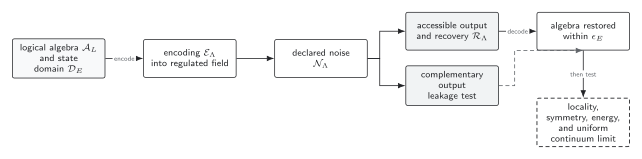
Correctability relates one logical algebra, one noise channel and complement, one state or energy domain, and one recovery class. Environmental forgetting supports recovery only in the matching metric; locality, symmetry, and continuum convergence are additional tests. The diagram is schematic and not to scale.
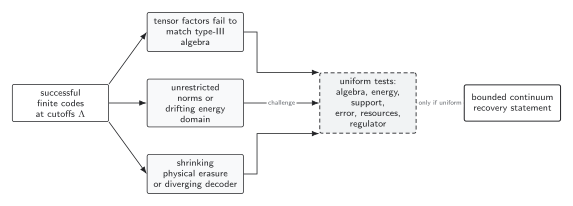
A sequence of successful finite codes does not establish a continuum code unless its logical algebra, physical erasure region, energy domain, recovery error, and locality bounds converge uniformly. Type-III structure and regulator-dependent tensor factors require an algebraic target. The diagram is schematic.
References
Section titled “References”- Casini, Horacio, Marina Huerta, and José Alejandro Rosabal. “Remarks on Entanglement Entropy for Gauge Fields.” Physical Review D 89 (2014): 085012. DOI. Open PDF.
- Kribs, David W., Raymond Laflamme, David Poulin, and Maia Lesosky. “Operator Quantum Error Correction.” Quantum Information & Computation 6 (2006): 382–399. Open PDF.
Original QFT.org content:CC BY 4.0, unless an item supplies different terms. Third-party material retains its own terms.