

Replica Trick and Branched Geometries
The replica construction computes integer moments by sewing Euclidean copies cyclically along the chosen regulated subsystem. The construction is exact only after the state-preparation path integral, cut orientation, boundary conditions, zero-mode treatment, and normalization have been fixed. Analytic continuation away from integer is a separate step.
Required background. Review Euclidean correlators and Schwinger functions, boundaries and state preparation, and regulated subregion entropy. Helpful background. Heat kernels and spectral determinants provide one way to evaluate Gaussian replica partition functions.
Sewing the density matrix
Section titled “Sewing the density matrix”Prepare a vacuum wavefunctional by a Euclidean path integral over and its conjugate over . Cutting the surface into gives matrix elements
with the fields on identified across the cut. Multiplication and the trace identify the upper bank of sheet with the lower bank of sheet along , cyclically modulo . Along , each sheet is sewn to itself. The result is a branched Euclidean manifold with branch locus and
The denominator is not optional: it enforces and cancels the vacuum normalization of the independent copies. Reversing one bank or sewing with the inverse permutation changes the operator being computed. Fermions additionally require a consistent spin structure and signs around the replica cycle.
The structural map places Replica Trick and Branched Geometries on the route from a regulated subsystem to integer moments, spectral checks, analytic continuation, and a continuum claim.
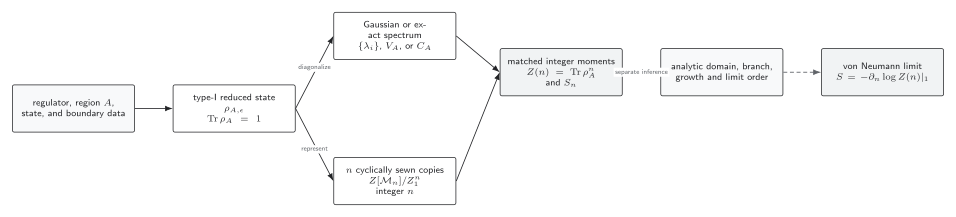
The spectral and replica routes must agree on matched integer moments at fixed regulator. Continuation from those moments to is logically separate and must state its analytic domain, branch, growth conditions, and order of limits. Schematic.
Integer-n information
Section titled “Integer-n information”For , the Rényi entropy is
This equation makes three domains explicit: the original regulated theory, the integer replica number, and the branched geometry. Singular curvature at may be regulated by smoothing the cone, but the smoothing prescription can generate local surface terms. Boundaries, zero modes, and gauge constraints also have to be reproduced on every sheet; none disappears through the topology of the cover.
For a vacuum interval in a two-dimensional CFT, the branched surface can be represented by a twist–antitwist pair, as in Holzhey, Larsen, and Wilczek 1994, pp. 443–467 and Calabrese and Cardy 2004, § 3. Conformal covariance gives
where is normalization dependent and is the endpoint regulator. The exponent is the robust integer- result. Its derivative at is licensed only after a continuation has been chosen; see Rényi Entropies and Replica Analytic Continuation.
Independent checks
Section titled “Independent checks”For a discretized free scalar, construct the two-sheeted geometry at and compare with the covariance-matrix result. The comparison must use the same lattice region, mass, outer boundary, and zero-mode prescription. It should also satisfy
Omitting fails the first check. A wrong sewing orientation can violate complement symmetry or disagree with exact diagonalization. Passing a single smoothness check is weaker than passing identities tied to normalization and the independently constructed spectrum.
Before exporting this calculation, use the validity map to check normalization, infrared data, spectral or continuation control, and matched continuum scaling independently.
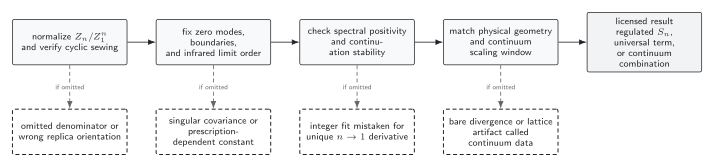
Normalization and sewing establish the intended integer moment; zero-mode and boundary control establish the infrared state; spectral and continuation checks control ; geometry matching and a scaling window establish the continuum target. Omitting any stage licenses only a weaker conclusion. Schematic.
References
Section titled “References”- Calabrese, Pasquale, and John Cardy. “Entanglement Entropy and Quantum Field Theory.” Journal of Statistical Mechanics: Theory and Experiment 2004 (2004): P06002. arXiv; DOI.
- Holzhey, Christoph, Finn Larsen, and Frank Wilczek. “Geometric and Renormalized Entropy in Conformal Field Theory.” Nuclear Physics B 424 (1994): 443–467. arXiv; DOI.
Original QFT.org content:CC BY 4.0, unless an item supplies different terms. Third-party material retains its own terms.