

Infinite-Dimensional and Energy-Constrained Channel Distances
Two infinite-dimensional channels can be uniformly close on every state in a fixed low-energy shell and still be maximally far apart in the ordinary diamond norm. The useful replacement is a resource-indexed distance: fix a nonnegative input Hamiltonian, its zero of energy, a budget, the physical channel input, and the role of the reference system, then optimize only over states in that energy shell. The result retains the usual one-shot discrimination meaning and can certify a cutoff uniformly over all admissible entangled probes.
This page derives that norm and a reproducible bosonic cutoff certificate. The certificate controls an ideal channel and a trace-preserving Fock-cutoff implementation at fixed mean occupation. It does not imply an unconstrained diamond bound, and it fails if the Hamiltonian is rescaled with the cutoff or if an energetic system that enters the device is mislabeled as an inert reference.
Required background. Operational Distinguishability and Continuity Bounds supplies trace-norm channel discrimination, the factor-of-two convention, and the reason an unconstrained bosonic diamond norm can be too strong.
Helpful background. Fidelity, Chernoff Bounds, and State Overlap supplies the state-level overlap inequalities used to interpret individual probes.
Use the chapter’s task-comparison table to compare this constrained channel norm with state bias, fidelity, entropy continuity, and the corresponding out-of-domain failures.
Energy shells make channel distance operational
Section titled “Energy shells make channel distance operational”Let and be separable input and output Hilbert spaces. Write for the trace-class operators on , and let be completely positive, trace-preserving linear maps. Choose a nonnegative self-adjoint operator with ground energy normalized to zero. For , define
Here is the set of positive trace-class operators with unit trace. The inequality selects the states whose mean input energy does not exceed .
The energy-constrained diamond distance is
The identity channel on is essential: an entangled input can distinguish channels better than every uncorrelated probe. The energy restriction, however, is on the system that actually enters the unknown channel. For separable Hilbert spaces the supremum may be taken over pure with a reference isomorphic to ; no independent reference Hamiltonian is needed for this mathematical optimization. These reductions and the norm’s basic properties are given in Shirokov 2018, § 3, pp. 23–27.
Helstrom’s binary decision theorem gives the optimal success probability for each output pair Helstrom 1976, Chapter IV, pp. 88–118. Optimizing that result over the admissible channel inputs gives
Our norm therefore ranges from to . A value means that no admissible strategy improves its success probability above . This is a worst-case statement over the whole energy shell, not an average over a chosen ensemble.
Two elementary checks accompany every use:
The first follows because the smaller energy shell is a subset of the larger one. The second follows because the constrained optimization uses fewer states. Neither permits the reverse inference: a small distance at one finite says nothing about probes outside that shell.
If has discrete eigenvalues of finite multiplicity that diverge to infinity, then any fixed energy-constrained diamond norm above the ground energy generates strong, pointwise convergence on the set of channels Shirokov 2018, Proposition 3, pp. 25–27. A sequence can therefore converge on every input state without converging in the ordinary diamond norm. This statement depends on the spectral compactness provided by ; an operator with an uncontrolled infinite-dimensional zero-energy sector does not supply the same compactness.
The structural diagram locates the energy shell inside the channel discrimination task. Inspect the channel branch: the Hamiltonian and budget are part of the input set, while the reference passes through an identity channel.
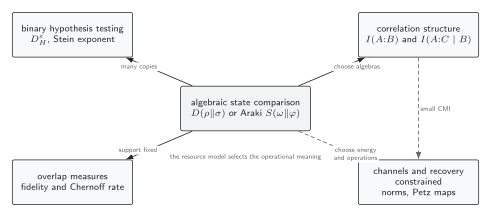
The Hamiltonian, energy budget, input algebra, reference convention, and output measurement define one discrimination task. State fidelity or relative entropy can bound parts of that task, but neither substitutes for the channel optimization. Schematic.
A trace-preserving Fock cutoff
Section titled “A trace-preserving Fock cutoff”Consider one normalized bosonic wavepacket mode , with annihilation operator , number operator
and every orthogonal mode fixed in the vacuum. Write for its -particle Fock state. Energy is measured in units of the chosen mode quantum, so is a mean-occupation budget. If the physical frequency is retained, write , use the physical budget , and replace each ratio below by . For a broad wavepacket or a multimode field, the actual field Hamiltonian and its spectral projector must replace this effective one-mode model.
Let
A hard cutoff must still define a channel on every input, including the discarded sector. Use the cutoff-and-replace channel
It is completely positive and trace preserving. One Kraus representation is
The channel retains every matrix element within the first Fock levels, removes coherences with the tail, and replaces tail population by vacuum. This explicit definition matters: the compression alone is trace decreasing and is not a deterministic implementation.
Let be ideal noiseless transmission of the wavepacket mode. More generally, if is any channel after the cutoff, compare with . For an arbitrary, possibly entangled , define
Because ,
This spectral-tail step uses the same in the norm and in the cutoff estimate. Apply the gentle-measurement estimate to Arzani, Booth, and Chabaud 2025, Methods, Lemma 1 and Eq. (10):
For completeness, purify and split the purifying vector into its retained and omitted components. A direct two-component calculation gives the same bound for the pure state; taking a partial trace cannot increase trace norm.
The vacuum-replacement term is positive and has trace , so the triangle inequality gives
Finally, trace distance contracts under . Taking the supremum proves
The derivation did not assume a product input or a finite-dimensional reference. It therefore certifies every admissible entangled probe, not only the states used in a numerical test.
A reproducible ideal-versus-cutoff benchmark
Section titled “A reproducible ideal-versus-cutoff benchmark”For ideal transmission, the leading square-root dependence cannot be removed. Assume and prepare the coherent two-Fock-level superposition—not a Glauber coherent state—
Its mean occupation is exactly , while . The pure-state trace-distance formula gives
Combining this lower witness with the uniform upper certificate,
If , the admissible input makes the two outputs orthogonal, so the distance is exactly . The cutoff is useful only when is large compared with the fixed physical budget.
The numerical rows and all analytic checks are stored in the machine-readable recovery benchmark. Each row is generated from , the lower endpoint , and the clipped upper endpoint . The record separates a fixed-cutoff energy sweep from a fixed-energy cutoff sweep, so the two limits are not silently interchanged.
At fixed cutoff , increasing the admissible mean occupation exposes more of the omitted sector:
| Mean occupation | Tail bound | Witness lower bound | Uniform upper bound |
|---|---|---|---|
| 0.25 | 0.0078125 | 0.1767766953 | 0.1845891953 |
| 0.5 | 0.015625 | 0.25 | 0.265625 |
| 1 | 0.03125 | 0.3535533906 | 0.3848033906 |
| 2 | 0.0625 | 0.5 | 0.5625 |
| 4 | 0.125 | 0.7071067812 | 0.8321067812 |
| 8 | 0.25 | 1 | 1.25 |
| 16 | 0.5 | 1.4142135624 | 1.9142135624 |
| 32 | 1 | 2 | 2 |
Conversely, at fixed , raising the cutoff shrinks the certified interval. The upper endpoints are:
| Retained maximum | 3 | 7 | 15 | 31 | 63 | 127 |
|---|---|---|---|---|---|---|
| Uniform upper bound | 1.9142135624 | 1.25 | 0.8321067812 | 0.5625 | 0.3848033906 | 0.265625 |
For this benchmark the formulas are analytic: there is no sampling error, fit uncertainty, or optimizer tolerance. Decimal values in the structured record are rounded representations of exact expressions. The interval between the lower witness and upper certificate is a theorem gap, not a statistical error bar. It narrows relative to the leading term as .
The first line certifies convergence on each fixed energy shell. The second shows why the same finite cutoff cannot uniformly approximate arbitrarily energetic inputs.
Adversarial tests of the resource definition
Section titled “Adversarial tests of the resource definition”Rescaling the Hamiltonian destroys cutoff convergence
Section titled “Rescaling the Hamiltonian destroys cutoff convergence”Keep the same cutoff channel but replace the fixed number operator by
At the fixed numerical budget , the omitted state is admissible for every . Ideal transmission leaves it unchanged, whereas the cutoff channel sends it to vacuum. Hence
The apparent contradiction with the preceding convergence is only a change of problem: one unit of represents physical quanta. Norm values at different are comparable only when the Hamiltonian, its zero, and its units are held fixed.
The structured adversary fixes and . The true trace-norm error of the admissible witness is . Reusing the fixed- formula as though its tail ratio were would instead report the false upper bound . This deliberate contradiction detects the hidden Hamiltonian change.
An inert reference may be energetic
Section titled “An inert reference may be energetic”The standard norm deliberately leaves unrestricted. This does not invalidate the cutoff proof, because every step used only the marginal tail and remained valid for arbitrary . For example,
has the same channel-distance witness for every reference excitation . An arbitrarily energetic label in a system that undergoes cannot enter the device or supply energy to the signal.
This conclusion changes if the alleged “ancilla” couples to the implementation, is measured jointly inside it, or supplies a pump. That mode is then part of the channel input, not the inert reference. A valid task must enlarge , state the joint Hamiltonian—such as when interaction terms can be neglected—and constrain the actual resource. A bound proved for says nothing about an unmodeled map acting on .
The strongest surviving claim is precise: the cutoff converges uniformly on each fixed -energy shell, even with arbitrary entanglement to an inert reference; it does not converge uniformly after cutoff-dependent energy rescaling or after enlarging the physical input without enlarging the constraint.
The validity diagram summarizes what must remain fixed. Inspect the energy and ancilla branches: changing either can define a new admissible state set even when the channel symbols look unchanged.
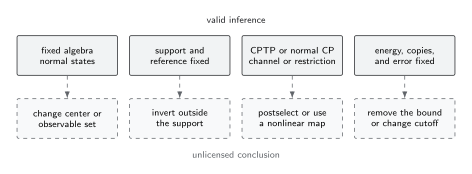
The fixed-Hamiltonian cutoff certificate survives arbitrary entanglement with a reference that undergoes the identity channel. It does not survive a cutoff-dependent energy scale, postselection, or an energetic auxiliary mode that participates in the implementation but is omitted from the constrained input. Schematic.
What the distance does and does not export
Section titled “What the distance does and does not export”An energy-constrained norm bound can be inserted into a protocol only when the protocol’s inputs obey the same constraint. For several channel uses, one must specify whether the budget applies per use, on average, or to the total input, and then prove the corresponding composition estimate. A single-use bound is not automatically a statement about asymptotic capacity. Uniform continuity of continuous-variable capacities requires additional entropy and energy-amplification hypotheses; see Winter 2017, §§ III and V.
For a multimode field, replace the one-mode projector by a spectral or mode-truncation projector for the declared field Hamiltonian. The same proof works whenever the first omitted sector has a known positive energy :
But the approximation channel, spectator modes, bandwidth, boundary conditions, and order of limits must then be stated. A large occupation cutoff for one chosen packet does not certify an ultraviolet cutoff of the full field.
For the operator-space and divergence framework underlying infinite-dimensional channel statements, continue to Noncommutative Lp Spaces, Divergences, and Information Bounds. For a compact comparison of state, recovery, and channel domains, continue to Information-Measure Domain and Validity Atlas.
Common pitfalls
Section titled “Common pitfalls”Constraining the output instead of the input. The discrimination strategy is chosen before the unknown channel acts, so the defining resource set belongs at the input. Output-energy bounds can support continuity theorems, but they do not replace the input constraint in the norm.
Calling a compression a channel. The map loses trace on the tail. A deterministic cutoff must say what happens there; changing the replacement rule changes the channel and can change constants in the certificate.
Calling the lower witness the norm. The two-Fock-level superposition proves a lower bound. The gentle-measurement argument proves a uniform upper bound. The interval between them is not numerical uncertainty and should not be collapsed without an optimization proof.
Charging the reference twice—or not charging a physical auxiliary mode. An inert purifying reference may be unrestricted in the standard norm. A mode that enters, powers, or is altered by the device is part of the physical input and must appear in the Hamiltonian constraint.
Exercises
Section titled “Exercises”1. Recover the discrimination formula
Section titled “1. Recover the discrimination formula”For equal prior probabilities, derive
Solution
For an admissible input , let and . The Helstrom formula gives
Optimizing over precisely the states satisfying produces the energy-constrained diamond norm. The factor follows from using a norm with maximum , rather than the half-diamond convention.
2. Verify the cutoff certificate
Section titled “2. Verify the cutoff certificate”Show that is trace preserving and prove
Solution
The Kraus operators obey
so is completely positive and trace preserving. For any admissible joint state, implies . The gentle-measurement estimate gives a trace-norm change at most when the state is compressed to the retained sector. The positive vacuum-replacement term has trace norm . Hence the total input change is at most , and contractivity under preserves this bound. Maximizing over inputs and using the universal channel-distance ceiling yields the result.
3. Choose a cutoff for a target error
Section titled “3. Choose a cutoff for a target error”Suppose the desired certified upper bound is at mean occupation . Find a sufficient condition on .
Solution
Write . The un-clipped certificate satisfies the target when
Thus
It is sufficient to choose
Round the right-hand side up to the next integer. This is conservative because it uses the uniform upper certificate, not the lower witness.
4. Separate a reference from a physical auxiliary input
Section titled “4. Separate a reference from a physical auxiliary input”At budget , show that makes the ideal and cutoff channels maximally distant. Then explain why an arbitrarily excited inert reference does not produce the same failure.
Solution
The state has , so it is admissible. Ideal transmission outputs , while outputs vacuum. The states are orthogonal, their trace-norm difference is , and no channel distance can be larger. Thus the constrained distance equals for every .
An inert reference is different because the compared maps are and . The cutoff proof already permits arbitrary , and its tail probability depends only on the -marginal. Reference excitation cannot enter either channel. If an auxiliary mode does enter the device, the identity assumption is false; that mode must be included in the channel input and in a new joint energy constraint.
References
Section titled “References”- Arzani, Francesco, Robert I. Booth, and Ulysse Chabaud. “Effective descriptions of bosonic systems can be considered complete.” Nature Communications 16 (2025): 9744. DOI.
- Helstrom, Carl W. Quantum Detection and Estimation Theory. Mathematics in Science and Engineering, vol. 123. New York: Academic Press, 1976. Publisher page.
- Shirokov, M. E. “On the Energy-Constrained Diamond Norm and Its Application in Quantum Information Theory.” Problems of Information Transmission 54, no. 1 (2018): 20–33. DOI. Open preprint.
- Winter, Andreas. “Energy-Constrained Diamond Norm with Applications to the Uniform Continuity of Continuous Variable Channel Capacities.” arXiv:1712.10267 (2017). DOI.
Original QFT.org content:CC BY 4.0, unless an item supplies different terms. Third-party material retains its own terms.