

Positivity, Monotonicity, and Data Processing
Relative entropy is nonnegative, and it cannot increase when the same physical loss of information is applied to both states. Those two statements sound elementary, but they become reliable tools in QFT only after the observable algebra, state order, support convention, and map direction are fixed. This page states the theorem in both Schrödinger and Heisenberg language, then checks it in an interval algebra and in a regulated bosonic Gaussian channel.
Required background. Use operator-algebraic positive maps and Relative Entropy for QFT States. Helpful background. Regulated Araki limits explain why changing a cutoff is not automatically a channel, while Markov generators and semigroups provide dynamical families of channels.
The chapter’s task-comparison table separates data processing from the extra hypotheses needed for testing, recovery, and channel-distance claims. Its structural map shows where those later interpretations branch.
Positivity on a declared algebra
Section titled “Positivity on a declared algebra”For normalized normal states and on one von Neumann algebra ,
and equality holds exactly when as functionals on . No faithfulness assumption is needed for that equality statement. Support controls the explicit support-mismatch branch. In finite dimensions, containment is also sufficient for finiteness; in infinite-dimensional type I it is necessary but the relative entropy can still diverge. For density operators,
In infinite dimension the first branch denotes the standard extended Umegaki functional, not the subtraction of two separately infinite traces, and it may itself equal . Thus two globally different preparations can have zero relative entropy after restriction if they induce the same state on the chosen local algebra. A support mismatch always gives . The nonfaithful extension and strict equality statement are Araki 1977, Definition 3.1 and Theorem 3.6(1), pp. 177–179.
Data processing in two pictures
Section titled “Data processing in two pictures”In the Schrödinger picture, let be completely positive and trace preserving. Equivalently, is the predual of the normal unital completely positive map . The extended-real inequality is
In the Heisenberg picture, write . For normal states on and ,
A normal unital -positive map—and more generally a normal unital Schwarz map—is already a sufficient algebraic hypothesis; complete positivity is the standard physical choice because it remains positive after adjoining arbitrary spectators. The general von Neumann-algebra statement and the subalgebra case follow from Hiai 2018, Theorem 4.1(iv), Eqs. (4.1)–(4.2). In finite dimensions, the channel form goes back to Lindblad 1975, pp. 147–151.
Restriction is the basic QFT example. If , isotony gives an inclusion . Applying the Heisenberg inequality to yields
No reduced density matrix is implied: the inclusion itself is the information-losing map.
Exact check: nested intervals
Section titled “Exact check: nested intervals”For smooth coherent initial data in the -dimensional free massless scalar model, let and
For the coherent state and vacuum , in that order, the Araki relative entropy on the causal-diamond algebra is
This is an intrinsic algebraic result, not a density-matrix ansatz; see Garbarz and Palau 2023, Eq. (91), p. 125016-9, and § IV.B.2, Eq. (95), p. 125016-10. For , splitting the larger interval into and its outer shell gives the exact gap
Every weight in the two integrals is positive away from measure-zero endpoints. Hence equality of the gap is equivalent to almost everywhere on ; by strict positivity, this is equivalent to equality of the coherent and vacuum restrictions on the specified CCR local algebra. The machine-readable interval benchmark evaluates this formula independently and compares it with nested site algebras on one fixed harmonic-chain regulator.
Exact check: additive Gaussian noise
Section titled “Exact check: additive Gaussian noise”Now regulate the scalar field in finite volume and select one normal mode with . Set , , and . With and , one has and vacuum covariance . For mean occupation , define the faithful thermal reference
and its coherent displacement . Because the two states have the same covariance,
Apply the same additive classical-noise channel to both states,
It leaves the displacement unchanged and sends . Therefore
For , , and ,
so the contraction is . The covariance changes from to , the first moment is preserved, and the same normal CPTP map acts on both inputs. These are the checks that make this a data-processing calculation rather than a slogan. In this convention the channel has and leaves the first moment fixed. Caruso et al. use the doubled covariance : their moment/covariance action is Caruso et al. 2008, § 1.2, Eqs. (16)–(17), p. 6, and this channel is their additive-noise class Caruso et al. 2008, § 2.4, p. 18 with and . Exact values and adversarial controls are available in the channel benchmark JSON.
Equality means recoverability of this pair
Section titled “Equality means recoverability of this pair”Equality in data processing is not the same as , and it does not make the channel invertible on every input. In finite dimensions with , equality holds exactly when a recovery channel recovers the declared pair. On the support of , the Petz map is
with inverses taken on supports. Let . The displayed completely positive map has trace ; a trace-preserving extension to the whole output space is obtained by adding for any fixed input state . It recovers , and finite-dimensional equality holds exactly when it also recovers . This is recovery of the declared pair, not an inverse of on all states; see Jenčová 2024, Remark 2 and Theorem 2, pp. 5–6, with Petz 1988, pp. 97–108 as the historical channel theorem. For a subalgebra , if and are faithful normal states and , equality under restriction is equivalent to for every , equivalently weak sufficiency Petz 1986, Theorem 4, pp. 127–128. Corollary 5 upgrades this to an ordinary state-preserving conditional expectation onto only when an expectation preserving one of the two states is already known to exist. An expression such as is not a licensed recovery equality case.
Where the theorem fails
Section titled “Where the theorem fails”The validity map below is worth reading as a checklist: a different map on each state, a nonlinear renormalized branch, or a map that does not preserve states is outside the theorem.
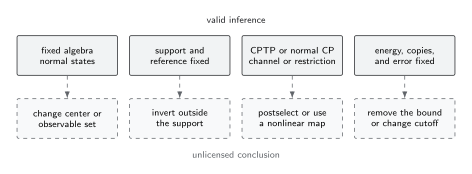
Restriction and additive Gaussian noise are valid information-losing maps. Renormalized postselection is nonlinear, while a nonpositive map can send a state outside the state space; neither supplies a counterexample to data processing. Schematic.
Postselection. Let
Their relative entropy is . Conditioning on the first two outcomes and renormalizing gives binary distributions and with relative entropy , ten times larger. The linear success operation is and is completely positive and trace nonincreasing. Dividing by makes the conditional update nonlinear, so it is not a CPTP channel. With , the full flagged instrument
is CPTP. It retains both the outcome flag and the within-branch state, and for this diagonal pair . If one discards the branch state and keeps only the binary flag, the two flag distributions are both and their relative entropy is zero.
A nonpositive map. The linear trace-preserving qubit map
sends to . The output is not a state, so output relative entropy is undefined. This exposes the failed positivity hypothesis rather than a failure of the theorem.
For theorem-level data processing and equality results on von Neumann algebras, continue to the rigorous noncommutative treatment.
Common pitfalls
Section titled “Common pitfalls”Treating support as an optional technicality. A support mismatch forces type-I relative entropy to ; in infinite dimensions, containment alone does not guarantee finiteness. Positivity itself remains an extended-real statement.
Calling cutoff refinement a channel. Two matrices at different lattice spacings need an explicit common embedding or channel before data processing compares them. Similar numerical values do not create that map.
Dropping the outcome probability. A normalized postselected branch can amplify distinguishability. Keep the classical outcome register and the failed branch when invoking DPI.
Overreading equality. Equality licenses recovery of the specified pair under stated support hypotheses. It does not imply global reversibility, locality, finite energy cost, or uniqueness of the recovery map.
Exercises
Section titled “Exercises”1. Reverse the pictures
Section titled “1. Reverse the pictures”Starting from a CPTP predual map , show that is normal, unital, and completely positive and that . Explain why restriction of states is dual to inclusion of observable algebras.
Solution
Trace preservation gives for every trace-class , hence . Matrix-level adjointness preserves complete positivity, and because acts on the preduals, its Banach adjoint is ultraweakly continuous, hence normal. If includes the smaller observable algebra, then forgets all expectation values outside ; it is the state-side restriction.
2. Derive the Gaussian contraction
Section titled “2. Derive the Gaussian contraction”Use and to derive and prove that .
Solution
Unitary conjugation gives . The cross term differs only by the occupation increase , so . For ,
which proves contraction. Within the declared range , equality occurs only for ; after extending the family by the identity-channel limit , also saturates the inequality.
3. Restore the postselection flag
Section titled “3. Restore the postselection flag”For the qutrit example, calculate the relative entropy before and after normalized conditioning. Then retain the success/failure flag together with the unnormalized postmeasurement block in each branch and verify that the direct-sum output relative entropy equals the input value. What remains if only the binary flag is retained?
Solution
The failure probabilities and failure states coincide. The success probability is for both inputs, while the conditional divergence is
The chain rule for the block-diagonal flagged state gives . Removing the factor by nonlinear renormalization creates the apparent tenfold increase. Keeping only the binary flag erases the within-success-branch distinction and leaves relative entropy zero.
References
Section titled “References”- Araki, Huzihiro. “Relative Entropy for States of von Neumann Algebras II.” Publications of the Research Institute for Mathematical Sciences 13, no. 1 (1977): 173–192. DOI.
- Caruso, Filippo, Jens Eisert, Vittorio Giovannetti, and Alexander S. Holevo. “Multi-Mode Bosonic Gaussian Channels.” New Journal of Physics 10 (2008): 083030. DOI. Open preprint.
- Garbarz, Alan, and Gabriel Palau. “Relative Entropy of an Interval for a Massless Boson at Finite Temperature.” Physical Review D 107 (2023): 125016. DOI. Open preprint.
- Hiai, Fumio. “Quantum -Divergences in von Neumann Algebras. I. Standard -Divergences.” Journal of Mathematical Physics 59 (2018): 102202. DOI. Open preprint.
- Jenčová, Anna. “Recoverability of Quantum Channels via Hypothesis Testing.” Letters in Mathematical Physics 114 (2024): 31. DOI. Open preprint.
- Lindblad, Göran. “Completely Positive Maps and Entropy Inequalities.” Communications in Mathematical Physics 40 (1975): 147–151. DOI.
- Petz, Dénes. “Sufficient Subalgebras and the Relative Entropy of States of a von Neumann Algebra.” Communications in Mathematical Physics 105 (1986): 123–131. DOI.
- Petz, Dénes. “Sufficiency of Channels over von Neumann Algebras.” The Quarterly Journal of Mathematics 39, no. 1 (1988): 97–108. DOI.
Original QFT.org content:CC BY 4.0, unless an item supplies different terms. Third-party material retains its own terms.