

Conditional Mutual Information and Quantum Markov Structure
Conditional mutual information answers an ordered question: after the mediator is retained, how much correlation between and remains? In finite dimensions, its exact vanishing is equivalent both to perfect recovery of from and to a precise direct-sum factorization of the state. A small positive value instead controls the accuracy of recovery; by itself it does not identify a nearby exact Markov state or a memoryless process in time.
Required background. Use Strong Subadditivity and Entropic Inequalities for the entropy inequality. Helpful background. Mutual Information and Regulator-Independent Correlations fixes the correlation language, while Markov generators and semigroups explains the different dynamical meaning of “Markov.”
The chapter’s task-comparison table separates this structural question from the extra metric, channel, locality, and energy data needed in a recovery problem.
Conditional correlation with an ordered mediator
Section titled “Conditional correlation with an ordered mediator”For a density operator on a finite-dimensional tripartite Hilbert space, define
Strong subadditivity gives . Two chain-rule forms explain the meaning of the quantity:
Thus access to cannot reduce what an observer holding can learn about . The quantity is symmetric under , but changing the conditioning system changes the question. In particular, and need not agree.
If is a classical register,
then
For a genuinely quantum , there is no basis-independent ensemble of conditional states with this interpretation. The diagram below places the exact statement and the later recovery question on their respective branches.
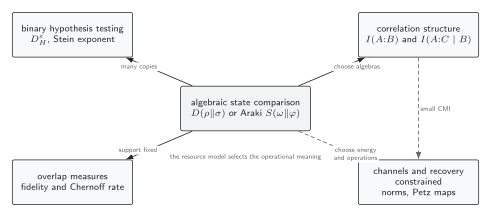
measures the correlation left between and when is retained. Exact zero has a structural theorem; a small positive value supports a separate quantitative recovery statement. Schematic.
Exact quantum Markov structure
Section titled “Exact quantum Markov structure”For an arbitrary finite-dimensional state , with no full-rank assumption, the following statements are equivalent:
- .
- There is a completely positive trace-preserving map such that
- The Hilbert space of the mediator has a direct-sum tensor decomposition for which
This is the Hayden–Jozsa–Petz–Winter structure theorem Hayden et al. 2004, Eqs. (10)–(11) and Theorem 6. The label is classical information stored nondestructively in . Once is fixed, splits into a left part that can correlate with and a right part that can correlate with ; there is no remaining correlation across .
The block-entropy identity
makes sufficiency transparent: inserting the four reduced HJPW states into the definition of conditional mutual information cancels the four copies of and every within-block entropy. The recovery implication is also short. Exact recovery and data processing imply
because acts only on . Since the difference of the two sides in the opposite order is , equality follows. The nontrivial direction from entropy equality to recovery is the equality case of relative-entropy monotonicity.
A useful corollary concerns pure states. If and , orthogonality of the direct-sum sectors permits only one nonzero , and purity of the product block gives
on the occupied support of .
Recovery on a rank-deficient support
Section titled “Recovery on a rank-deficient support”Let project onto . One exact recovery witness is the Petz map
where is the Moore–Penrose inverse: it is the ordinary inverse on and zero on the kernel. The map is completely positive and trace preserving for inputs supported on , because
To obtain a channel on all of , choose any state and set
This extension is completely positive and trace preserving. Its arbitrary action outside the support cannot affect recovery of , because has no weight there. Equivalently, the HJPW decomposition can be restricted to the occupied support; unused orthogonal summands carry zero probability.
This support-qualified formula is the specialization of the equality condition for relative-entropy data processing to Hayden et al. 2004, Theorem 3 and Eqs. (8), (10)–(11).
For a faithful state one may additionally write the operator equality
with identity operators on omitted factors understood. This logarithmic form should not be applied to a rank-deficient state without an explicit support restriction. For the operator-algebraic theorem and conditional-expectation formulation, see Sufficiency, Conditional Expectations, and Petz Recovery.
The word “Markov” here describes conditional independence in one state. It does not assert that the state arose from a time-local semigroup or that its dynamics has no memory.
What a small value does and does not imply
Section titled “What a small value does and does not imply”With natural logarithms and root fidelity , a small conditional mutual information guarantees a channel satisfying
This is the Fawzi–Renner recovery theorem Fawzi and Renner 2015, Theorem 5.1. It is a statement about closeness to a recovered state, not necessarily to an exact Markov state. If
then generally
Therefore the same map has not reconstructed from its own marginal, and need not vanish. This distinction is genuinely quantum: if
then , but quantum examples make the ratio arbitrarily large and can require a logarithmic dimension factor Ibinson, Linden, and Winter 2008, Theorem 4 and Examples 6–7.
Recovery handoff. Recovery and Approximate Markovianity develops the error bounds, metrics, and physical qualifications.
Map handoff. Petz, Rotated, and Universal Recovery Maps compares explicit recovery channels and their support and modular properties.
Neither a small dimensionless number nor high fidelity alone makes the channel local, energy limited, state independent, or experimentally implementable.
Contiguous equal-time intervals in a 1+1-dimensional CFT
Section titled “Contiguous equal-time intervals in a 1+1-dimensional CFT”Consider a unitary nonchiral CFT on the infinite line, use natural logarithms and units with propagation speed one, and denote the central charge by . At equal time, let
have lengths , , and , respectively. The letter avoids confusing the length of region with the central charge. Each region in the entropy combination—, , , and —is a single interval, so no disjoint-interval twist-field correlator is needed.
Vacuum
Section titled “Vacuum”For one interval of length ,
Using the same cutoff and endpoint prescription in all four terms gives
Both the cutoff and the nonuniversal constant cancel. The identity
shows that the logarithm is positive whenever . Equivalently, with
one has
The endpoint and thick-mediator limits are
and
For , ordinary nondegenerate equal-time intervals therefore do not saturate the common-regulator entropy form of strong subadditivity; this is the regulated sense in which they are non-Markov here. The divergence as is the singular limit in which the separated outer intervals become adjacent Calabrese and Cardy 2004, Eq. (16) and its derivative.
Thermal state
Section titled “Thermal state”At inverse temperature ,
Set , , and . Direct substitution gives
The hyperbolic identity
proves positivity and gives the numerically stable form
It passes three useful checks:
and, for with fixed,
At fixed positive , the high-temperature limit is the special case
Shrinking either outer interval sends to zero. Shrinking the mediator instead produces the adjacent-interval divergence
The vacuum mediator suppresses the conditional correlation algebraically, as ; a thermal correlation length changes this to exponential suppression. The reproducible benchmark record evaluates both formulas with stable logarithms and checks positivity and the large- limit. For example, with , , and ,
whereas at the exact thermal expression gives
These single-interval vacuum and thermal formulas follow from Calabrese and Cardy 2004, Eqs. (16) and (18).
Ordering and regulator stress tests
Section titled “Ordering and regulator stress tests”Two simple adversarial tests prevent false Markov conclusions.
Reorder the mediator. Let and be independent fair classical bits and let be a copy of :
Conditioned on , the variables and are independent, so
Conditioned on , however, and remain identical fair bits, so
For the spatial CFT arrangement, the same illicit reorder replaces the four single-interval entropies by
where is disconnected. The preceding single-interval formula therefore cannot be reused.
Mismatch the regulators. If the four CFT entropies use cutoffs , , , and , the reported result is shifted by
For the numerical vacuum example above, taking
adds and falsely reports . Taking even fabricates a negative value. A common cutoff and endpoint prescription are therefore part of the statement, not optional numerical details.
The failure map summarizes what must remain fixed when the exact theorem or an approximate recovery bound is applied.
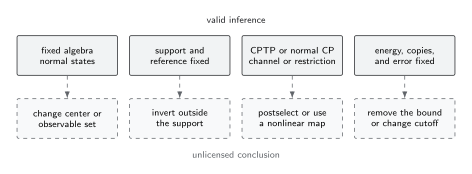
Exact and approximate Markov statements concern one ordered tripartite state. Reordering the mediator, changing support, mixing regulator prescriptions, or postselecting a different state changes the conditional information and its associated recovery problem. Schematic.
Continuum scope and null Markov geometry
Section titled “Continuum scope and null Markov geometry”In a continuum QFT, the four individual entropies may be divergent, and local algebras are generally type III rather than matrix tensor factors. One must not interpret a formal as conditional mutual information. A common regulator can define the combination in a controlled limit if convergence is proved; split constructions can supply type-I intermediates but still require a separate finiteness argument. Alternatively, one can work directly with relative entropy and modular inclusions.
For separable type-I tensor-product systems, conditional mutual information has a lower-semicontinuous extension based on finite-rank truncations, and the recovery theorem survives even when marginal entropies are infinite Shirokov 2016, Theorem 2 and Proposition 13. This does not turn the finite-dimensional HJPW direct sum into a classification of type-III local algebras.
There is nevertheless a special continuum vacuum Markov property. For causal regions and whose future horizons are cuts of the same null plane—and, in a CFT, for their conformal images on a common null cone—the modular Hamiltonians obey an inclusion–exclusion identity. With one compatible null-surface regulator, the corresponding entropy combination saturates strong subadditivity:
This is the null-surface result of Casini, Testé, and Torroba 2017, Eqs. (1.9)–(1.10) and §7. It concerns a special family of null cuts. It does not contradict the strictly positive equal-time interval formulas above, and it should not be translated into an HJPW factorization without a type-I regulator.
Common pitfalls
Section titled “Common pitfalls”Adding a faithfulness hypothesis to the exact theorem. Exact finite-dimensional recovery and the HJPW structure hold for rank-deficient states. Faithfulness is needed only for inverse or logarithmic formulas written without support qualifiers.
Calling the recovered approximation an exact Markov state. A channel may recover a state close to while changing its own marginal. Recoverability and distance to the HJPW set are different optimization problems.
Treating a spatial statement as dynamics. Conditional independence of ordered subalgebras says nothing by itself about a Lindblad generator, temporal divisibility, or memory kernels.
Subtracting continuum entropies term by term. The finite answer depends on a common limiting prescription. Region order, endpoints, state, and regulator must be held fixed throughout the combination.
Exercises
Section titled “Exercises”1. A classical sector stored in the mediator
Section titled “1. A classical sector stored in the mediator”Let
Show that and construct an exact recovery channel.
Solution
For each reduced state, use
The four entropies are
They cancel in . A channel can first dephase in the basis and then append :
This is completely positive and trace preserving and recovers the stated .
2. Why the support extension is trace preserving
Section titled “2. Why the support extension is trace preserving”Let . Verify that preserves trace on , and then verify that preserves trace on all inputs.
Solution
For , cyclicity of the trace and give
For arbitrary ,
Both summands in the extension are completely positive maps, so the extension is CPTP.
3. Vacuum positivity and the large-separation law
Section titled “3. Vacuum positivity and the large-separation law”Starting from the vacuum interval entropy, derive and show that it is positive. Then obtain the first nonzero term for .
Solution
Substitution cancels and and yields
The ratio equals
so . At large ,
Using gives
4. Thermal screening
Section titled “4. Thermal screening”Use the thermal interval formula to prove , recover the vacuum as , and find the leading behavior for .
Solution
With , , and , the hyperbolic identity on this page rewrites the entropy combination as
When , all three arguments are small and , which recovers the vacuum length ratio. For ,
This ratio is small, so expanding the logarithm gives
References
Section titled “References”- Calabrese, Pasquale, and John Cardy. “Entanglement Entropy and Quantum Field Theory.” Journal of Statistical Mechanics: Theory and Experiment 2004, no. 6 (2004): P06002. DOI. Open preprint.
- Casini, Horacio, Eduardo Testé, and Gonzalo Torroba. “Modular Hamiltonians on the Null Plane and the Markov Property of the Vacuum State.” Journal of Physics A: Mathematical and Theoretical 50, no. 36 (2017): 364001. DOI. Open preprint.
- Fawzi, Omar, and Renato Renner. “Quantum Conditional Mutual Information and Approximate Markov Chains.” Communications in Mathematical Physics 340, no. 2 (2015): 575–611. DOI. Open preprint.
- Hayden, Patrick, Richard Jozsa, Dénes Petz, and Andreas Winter. “Structure of States Which Satisfy Strong Subadditivity of Quantum Entropy with Equality.” Communications in Mathematical Physics 246, no. 2 (2004): 359–374. DOI. Open preprint.
- Ibinson, Ben, Noah Linden, and Andreas Winter. “Robustness of Quantum Markov Chains.” Communications in Mathematical Physics 277, no. 2 (2008): 289–304. DOI. Open preprint.
- Shirokov, M. E. “Measures of Quantum Correlations in Infinite-Dimensional Systems.” Sbornik: Mathematics 207, no. 5 (2016): 724–768. DOI. Open preprint.
Original QFT.org content:CC BY 4.0, unless an item supplies different terms. Third-party material retains its own terms.