

Topological and Long-Range Entanglement Interfaces
Topological entanglement subtraction cancels local boundary contributions and can isolate a long-range constant in a regulated, gapped ground state. The result is a diagnostic, not a complete phase classification: intrinsic topological order, invertible response, physical edges, and domain walls require different supporting evidence.
Required background. Use Mutual Information and Regulator-Independent Correlations to recognize balanced entropy combinations and the hypotheses under which local divergences cancel. Helpful background. Universal Terms and Entangling-Surface Geometry supplies the counterterm and shape analysis needed to decide whether a constant is universal.
The chapter’s structure map locates topological subtraction among geometric and multipartite constructions. Its comparison table separates it from raw entropy, while the validity map lists the state, geometry, algebra, and regulator choices that a claim must retain.
Evidence cutoff. Research-sensitive comparisons on this page include primary literature available through 25 August 2026.
The regulated long-range constant
Section titled “The regulated long-range constant”Start with a lattice or another type-I regulator for a -dimensional gapped ground state. Fix the region algebra—including the center or extended-Hilbert-space prescription in a gauge theory—the ground-state sector, the boundary condition, and a smooth disk-like region whose characteristic size obeys . Its entropy has the asymptotic structure
The local functional contains the cutoff-dependent perimeter term and may also contain curvature, corner, or lattice-orientation corrections. Writing it merely as is justified only after those terms have been excluded or held fixed. For intrinsic topological order under the standard assumptions,
where labels superselection sectors and are their quantum dimensions Kitaev and Preskill 2006, pp. 110404-1–110404-3, Eqs. (1)–(4). Gauge-theory entropy itself depends on the chosen local algebra and center, so that choice must precede the subtraction Casini, Huerta, and Rosabal 2014, §§II–IV.
Kitaev–Preskill and Levin–Wen signs
Section titled “Kitaev–Preskill and Levin–Wen signs”For the Kitaev–Preskill arrangement, three adjacent regions have a simply connected total union. With the signs shown below, the tripartite information is
Inspect how every local boundary segment appears with net coefficient zero, while one copy of the long-range constant remains.
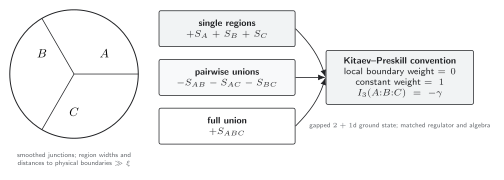
With the Kitaev–Preskill sign convention, the seven-term combination tends to . The gapped scaling regime requires every region width, junction-smoothing radius, and distance to a physical boundary to be —collectively, —within one matched regulator and algebra prescription. Schematic; not to scale.
The Levin–Wen annular construction uses four different regions and the convention
The factor of two counts the two annular boundary components; it is not a disagreement with the Kitaev–Preskill value. The original geometry and sign appear in Levin and Wen 2006, Fig. 1 and Eq. (1).
Application: topological, invertible, and trivial regulators
Section titled “Application: topological, invertible, and trivial regulators”The toric-code fixed point gives a transparent calculation. In the usual electric-center or extended-Hilbert-space realization, a simply connected region crossed by independent boundary links has
The local term is , while the closed-string constraint removes one bit. Hence , , and the Kitaev–Preskill combination is . Substituting the seven entropies cancels every boundary-link count and retains the single constraint term.
Now use the same lattice spacing, region shapes, algebra prescription, and sequence of for three families:
| Regulated family | Bulk sector data | KP limit | Evidence still needed |
|---|---|---|---|
| Toric-code topological fixed point | $\mathcal D=2$ | $-\log2$ | anyon sectors, braiding, and topology-dependent ground space |
| Invertible Chern phase | $\mathcal D=1$ | $0$ | Chern or thermal-Hall response and protected chiral edge data |
| Trivial atomic insulator | $\mathcal D=1$ | $0$ | absence of the protected response and edge structure |
This comparison fulfills two distinct purposes. The nonzero toric-code result detects long-range entanglement within its assumptions. The identical zero for the invertible and trivial families proves that topological entanglement entropy cannot distinguish them. That classification belongs with the topological-order/invertible distinction, where response and excitation data are included.
At finite , fit the three families to a common analysis protocol rather than comparing one convenient size. Record the seven entropies, their covariance, , the extrapolation model, and the stability of the limit when the smallest sizes are removed.
Gapped walls are not conformal interfaces
Section titled “Gapped walls are not conformal interfaces”A gapped domain wall between -dimensional topological phases can carry its own superselection sectors. A subtraction deliberately crossing that wall may extract a universal constant associated with those sectors Shi and Kim 2021, pp. 141602-1–141602-4 and Eqs. (1)–(3). That wall constant is not automatically the bulk on either side.
A gapless -dimensional conformal interface is a different problem. It can modify logarithmic or subleading terms, and a topological CFT interface can preserve the leading logarithmic coefficient while shifting the constant Brehm et al. 2016, §§2–3. Therefore “an interface contributes a constant or logarithm” is not one theorem: the dimension, gap, interface condition, region placement, and limiting geometry must be stated separately.
Adversarial test: an SPT edge false positive
Section titled “Adversarial test: an SPT edge false positive”Introduce a short-range-entangled symmetry-protected phase with but a protected physical edge Chen et al. 2013, §§I–II. If one KP region touches that edge, edge modes and a finite correlation length can leave an uncancelled residual. The correct test translates the entire seven-region arrangement into the bulk and independently increases both its size and its distance from the edge.
An illustrative failure injection is
with no intrinsic topological term. Setting gives
| $d/\xi$ | $I_3^{\mathrm{false}}$ | Interpretation |
|---|---|---|
| 1 | $-0.2550$ | large edge contamination |
| 2 | $-0.0938$ | still visible over a short size window |
| 4 | $-0.0127$ | drifting toward zero |
| 8 | $-0.00023$ | bulk limit exposes the false positive |
This exponential is a deliberately chosen contamination model, not a generic formula for an individual-region entropy. Its lesson is operational: a negative constant at one and is insufficient. For an intrinsic topological bulk, approaches after both and are large. For this SPT-edge control it approaches zero. Breaking the protecting symmetry at the edge, while leaving the bulk gapped, supplies a second check: a boundary contribution may change, whereas the intrinsic bulk subtraction should not.
Continuum and reporting boundary
Section titled “Continuum and reporting boundary”The robust statement is about the limit of a matched regulated family. A sharp type-III local algebra has no intrinsic von Neumann entropy whose constant can simply be read off. Keep separate:
- the algebraic QFT state and local algebras;
- the lattice, split, or extended-Hilbert-space representatives used to form the seven entropies;
- and the balanced limiting quantity claimed to be insensitive to an allowed regulator class.
Report the region diagram, every sign, , distances to physical boundaries and walls, corner smoothing, algebra and center, regulator, ground-state sector, statistical covariance, extrapolation uncertainty, and non-topological alternatives. A subtraction is evidence for a particular long-range constant, not a complete phase label.
Exercises
Section titled “Exercises”1. Cancel the local terms
Section titled “1. Cancel the local terms”Assume each entropy in the Kitaev–Preskill geometry has the form and that the regions are arranged so every local boundary segment cancels. Show the coefficient of in .
Solution
There are three single-region terms with plus signs, three pairwise-union terms with minus signs, and one triple-union term with a plus sign. The constant contribution is therefore
The geometrical construction separately ensures that each local segment in occurs with net coefficient zero. Both ingredients are necessary: the signs alone do not cancel a corner or physical-boundary term if the corresponding local geometry is unmatched.
2. Toric-code and annular normalizations
Section titled “2. Toric-code and annular normalizations”Using for a simply connected toric-code region, determine the Kitaev–Preskill value. Why does the Levin–Wen annular convention give twice that magnitude?
Solution
Every boundary-link contribution cancels in the KP combination. The remaining constraint terms give
The Levin–Wen construction compares thick annuli. Its two disconnected boundary components each carry the same topological constraint contribution, so its signed combination is
The two formulas use different geometries and conventions; dividing the annular result by two recovers the same .
3. Test identifiability at
Section titled “3. Test identifiability at D=1\mathcal D=1D=1”Suppose a Chern insulator and a trivial atomic insulator both give . Can any increase in numerical precision distinguish the phases using this limit alone? Name evidence that can.
Solution
No. Both have , so the topological subtraction predicts the same limiting number. Better precision only establishes that common value more accurately; it cannot recover information absent from the observable. A Chern number, quantized Hall or thermal-Hall response, spectral flow, and protected chiral edge structure can distinguish the invertible phase from the atomic one. Those data must be analyzed with their own boundary and symmetry assumptions.
4. Expose a boundary false positive
Section titled “4. Expose a boundary false positive”For , calculate the residual at . Explain why a scan only over could be misleading and give an acceptance test.
Solution
The values are
Over the first two points, noise or an overly flexible constant fit could hide the drift. The acceptance test varies and independently, removes the smallest values, and requires a stable nonzero intercept with consistent region geometry. Repeating the scan after gapping or otherwise changing the protected boundary supplies an adversarial control. This model has zero intercept and must be rejected as intrinsic topological order.
References
Section titled “References”- Brehm, Enrico M., Ilka Brunner, Daniel Jaud, and Cornelius Schmidt-Colinet. “Entanglement and Topological Interfaces.” Fortschritte der Physik 64 (2016): 516–535. DOI. Open preprint.
- Casini, Horacio, Marina Huerta, and José Alejandro Rosabal. “Remarks on Entanglement Entropy for Gauge Fields.” Physical Review D 89 (2014): 085012. DOI. Open preprint.
- Chen, Xie, Zheng-Cheng Gu, Zheng-Xin Liu, and Xiao-Gang Wen. “Symmetry-Protected Topological Orders in Interacting Bosonic Systems.” Physical Review B 87 (2013): 155114. DOI. Open preprint.
- Kitaev, Alexei, and John Preskill. “Topological Entanglement Entropy.” Physical Review Letters 96 (2006): 110404. DOI. Open preprint.
- Levin, Michael, and Xiao-Gang Wen. “Detecting Topological Order in a Ground State Wave Function.” Physical Review Letters 96 (2006): 110405. DOI. Open preprint.
- Shi, Bowen, and Isaac H. Kim. “Domain Wall Topological Entanglement Entropy.” Physical Review Letters 126 (2021): 141602. DOI. Open preprint.
Original QFT.org content:CC BY 4.0, unless an item supplies different terms. Third-party material retains its own terms.