

Claim–Evidence Records, Replication, and Retraction Handling
A scientific information claim should remain linked to the exact data, estimators, assumptions, regulator range, uncertainty, independent replications, contradictions, and later corrections that determine its current scope. Updating a conclusion must preserve the earlier record and explain why its evidential support changed. Correction narrows or changes a supported result; retraction withdraws a result that no longer has adequate support.
Required background. Cross-Method Benchmarks and Adversarial Null Tests supplies independent validation.
Helpful background. Scrambling Evidence and Claim-Status Matrix supplies claim-shaped evidence levels.
A claim record
Section titled “A claim record”For each material conclusion, preserve:
- a precise sentence with mathematical domain and physical scope;
- date and evidence cutoff;
- input datasets, source versions, and checksums;
- estimator, conventions, code environment, and parameters;
- assumptions and alternative explanations tested;
- statistical, systematic, and continuum uncertainty;
- supporting and contradicting results with independence map;
- current conclusion: supported, bounded, corrected, superseded, or withdrawn;
- reason, date, and downstream conclusions affected by every change.
This is scientific provenance, not a substitute for the exposition. The reader-facing page states the result and limitations; the structured record lets another researcher reproduce why that statement has its present scope.
Example life cycle
Section titled “Example life cycle”Initial model evidence. A Gaussian covariance calculation at three cutoffs suggests a universal entropy coefficient. The claim is explicitly conditional on Gaussianity and one discretization.
Independent replication. A replica estimator with separate code and normalization agrees on a frozen benchmark and two additional cutoffs. The conclusion strengthens to cross-method evidence within the same state preparation.
Contradicting evidence. A second regulator and a non-Gaussian null reveal that the fitted coefficient absorbs a calibration drift and omitted correction term. The original interval no longer has coverage.
Correction. Preserve the original files and publication date, add the new data and code, enlarge or change the continuum model, and issue a corrected coefficient if the result remains identified.
Retraction. If all surviving values depend on an untestable ansatz or the raw records are invalid, withdraw the universal coefficient claim while retaining valid regulated measurements.
Dependency propagation
Section titled “Dependency propagation”Represent scientific dependence explicitly: a derived scrambling claim may use a calibrated OTOC, a recovery experiment, and a continuum fit. If the recovery calibration is withdrawn, update every conclusion whose justification requires it. Do not delete the earlier conclusion or silently edit its date; link it to the correction and state which weaker claim survives.
Replication strength depends on independence. Reanalysis of the same raw data with the same calibration is useful code verification, not an independent experiment. A new platform sharing the same theoretical ansatz independently tests hardware but not the ansatz.
Retraction is not erasure
Section titled “Retraction is not erasure”Keep immutable source records where rights and privacy allow, mark invalid artifacts clearly, and prevent them from being used as current support. A correction should be machine- and human-readable, with a stable link from the original. The FAIR principles emphasize findability, accessibility, interoperability, and reuse of scientific data and metadata Wilkinson et al. 2016, Principles F1–R1.
As of 10 August 2026, the current scientific statement is the strongest conclusion supported after known corrections, contradictions, and dependence among replications are included; preserving an earlier result does not preserve its evidential status.
Exercises
Section titled “Exercises”Partial failure. A continuum extrapolation fails, but all finite-cutoff purities remain reproducible. What is withdrawn?
Solution
Withdraw or correct the continuum claim and any derived universal coefficient. Retain the regulated purity results with their original domains and uncertainties.
Same-data replication. How should a fully independent code reanalysis of one dataset be described?
Solution
It is an independent implementation or computational reproduction. It tests code and analysis choices but shares acquisition, calibration, and sample fluctuations; do not call it an independent experimental replication.
Inference and failure-control maps
Section titled “Inference and failure-control maps”The first diagram traces the complete path from raw records to a bounded information claim; inspect the assumption attached to every arrow. The second maps shared and method-specific failure channels to held-out tests, regulator variation, replication, and correction.
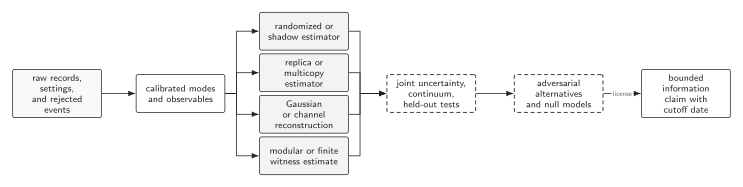
Entropy, tomography, witness, and recovery methods enter at the estimator stage, but all share calibration, uncertainty, continuum, and alternative-model tests. The final statement is no stronger than the least validated arrow. The diagram is schematic and not to scale.
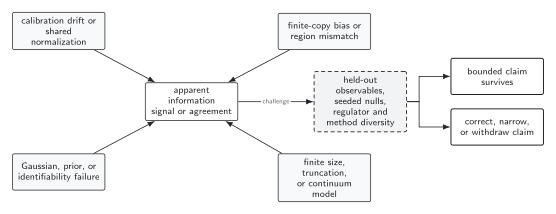
Different estimators can share the same calibration or normalization bias, so numerical agreement is not automatically independent replication. Adversarial nulls, held-out observables, regulator variation, and genuinely independent implementations set the claim ceiling and trigger correction when needed. The diagram is schematic.
References
Section titled “References”- Wilkinson, Mark D., Michel Dumontier, IJsbrand Jan Aalbersberg, et al. “The FAIR Guiding Principles for Scientific Data Management and Stewardship.” Scientific Data 3 (2016): 160018. DOI.
Original QFT.org content:CC BY 4.0, unless an item supplies different terms. Third-party material retains its own terms.