

Entropy of a Regulated Subregion
A subregion entropy is a property of a regulated state, subsystem, and limiting prescription. Before writing , one must specify the factorization or finite algebra that defines , the state, the geometric region, the ultraviolet and infrared regulators, the boundary treatment, and which quantities are held fixed as the regulator is removed.
Required background. Use direct sums and tensor products and why sharp continuum QFT does not factorize. Helpful background. Choosing a continuum subsystem distinguishes a cutoff algebra from a split or intrinsic local algebra.
The regulated object
Section titled “The regulated object”Let a regulator produce and a normalized state . The reduced state and entropy are
This definition is exact for the regulated model. Its continuum interpretation is not contained in the symbol . A complete prescription also fixes the physical region , the state normalization, the outer volume and infrared scale, the placement of the entangling surface relative to the regulator, and any boundary or center convention. In gauge theories the algebraic center requires further choices developed later in the volume; this page concerns ordinary regulated scalar and fermion factorizations.
The raw entropy generally diverges. It may still contain universal coefficients or enter combinations in which local divergences cancel, but a divergent bare value is not itself a finite continuum observable. Comparisons between regulators are meaningful only after matching physical geometry and separating the terms each regulator is allowed to shift.
The structural map places Entropy of a Regulated Subregion on the route from a regulated subsystem to integer moments, spectral checks, analytic continuation, and a continuum claim.
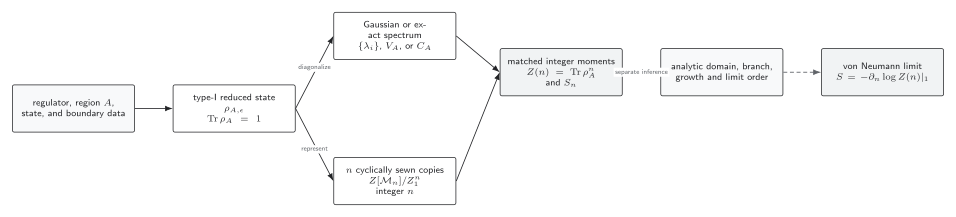
The spectral and replica routes must agree on matched integer moments at fixed regulator. Continuation from those moments to is logically separate and must state its analytic domain, branch, growth conditions, and order of limits. Schematic.
Harmonic-chain benchmark
Section titled “Harmonic-chain benchmark”The oscillator construction underlying this benchmark was developed in Bombelli et al. 1986, pp. 373–383 and applied to the area law in Srednicki 1993, pp. 666–669. For a chain with canonical variables and quadratic Hamiltonian
the vacuum is Gaussian. Restrict its covariance matrices and to sites in . If position–momentum cross-correlators vanish, the positive eigenvalues of are , and
This gives a concrete density-matrix entropy without pretending that the sharp continuum algebra factorizes. To compare a harmonic chain of spacing with a momentum-cutoff scalar field, match the physical interval length , mass , outer volume, and state. Then record whether is rounded inward or outward and how the continuum cutoff is shaped. The leading divergent pieces can differ even if an extracted logarithmic coefficient agrees.
Order of limits and a controlled challenge
Section titled “Order of limits and a controlled challenge”For a massive field in a box, , , and need not commute. A defensible sequence holds fixed while refining , controls finite-volume corrections, and only then studies an infrared limit. Periodic massless scalars require an explicit zero-mode prescription; omitting it makes the covariance matrix singular.
As a stress test, compute the same interval with two cutoff geometries or two boundary placements while holding all physical parameters fixed. If only the power divergence moves, a separately extracted universal coefficient may survive. If the claimed constant moves as well, it must be reported as regulator or boundary dependent. Ultraviolet Divergences and the Area Law explains the local expansion, and From Lattice Entropy to a Continuum Claim develops the extrapolation.
Common pitfalls
Section titled “Common pitfalls”Taking the partial trace before defining the factorization. In continuum QFT, “trace over the exterior” is not an intrinsic operation on a type-III local algebra. State the regulator or type-I realization first.
Comparing equal site counts. Equal numbers of sites do not imply equal physical regions when spacings, boundary placements, or lattice orientations differ. Match physical geometry before interpreting the difference.
Before exporting this calculation, use the validity map to check normalization, infrared data, spectral or continuation control, and matched continuum scaling independently.
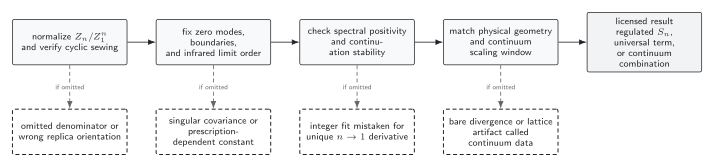
Normalization and sewing establish the intended integer moment; zero-mode and boundary control establish the infrared state; spectral and continuation checks control ; geometry matching and a scaling window establish the continuum target. Omitting any stage licenses only a weaker conclusion. Schematic.
References
Section titled “References”Original QFT.org content:CC BY 4.0, unless an item supplies different terms. Third-party material retains its own terms.