

Krylov and Operator-Growth Complexity
Krylov complexity quantifies how an operator moves along the orthonormal basis generated by repeated action of a declared Liouvillian. It is completely determined by the Hamiltonian or generator, the seed operator, and the operator inner product. It measures basis-relative operator growth; it is not a circuit minimum, a channel capacity, or by itself a chaos diagnostic.
Required background. What Task Does Complexity Answer? supplies the distinction between a basis moment and a minimized resource. Helpful background. Operator Growth versus Recoverability explains why support growth does not determine access to encoded information.
Lanczos recursion in operator space
Section titled “Lanczos recursion in operator space”Choose a positive operator inner product, for example a thermal Wightman or Kubo–Mori form, and normalize the seed . With , the general Hermitian Lanczos recursion is
Set when . Symmetries or a suitable inner product often give , but this is not automatic. Expanding
turns Heisenberg evolution into a nearest-neighbor chain. With one common phase convention,
The Krylov complexity is the first moment
Higher moments and the Krylov entropy carry different information. A finite chain can recur, so a transient rise is not an asymptotic law.
What fixes the answer
Section titled “What fixes the answer”Changing the seed changes which sector of operator space is explored. Changing the inner product changes orthogonality and therefore every . At finite temperature, common inner products differ by imaginary-time placement and spectral weights. State the convention rather than referring to “the thermal Krylov basis.”
In QFT, local composite operators require renormalization. Contact terms and high-frequency spectral tails affect moments and large- Lanczos coefficients. A lattice or spectral cutoff can produce a crossover or saturation governed by ultraviolet details. Avdoshkin, Dymarsky, and Smolkin exhibit mass, finite-volume, and cutoff effects in free and other QFT examples Avdoshkin, Dymarsky, and Smolkin 2024, §§3–5.
Computation and truncation checks
Section titled “Computation and truncation checks”Lanczos recursion is numerically unstable when loss of orthogonality accumulates. A reliable calculation reports:
- the regulated Hamiltonian, seed, inner product, and symmetry sector;
- reorthogonalization strategy and precision;
- residuals ;
- positivity of and reproduction of known correlation moments;
- probability lost at the finite Krylov boundary over the time window;
- convergence under larger Hilbert, Krylov, and ultraviolet cutoffs.
For a chain truncated at , stop before reflected probability from the artificial boundary reaches the observables or use an independently validated tail model. Agreement of alone can hide wrong phases; compare the autocorrelation and several amplitudes.
Growth does not prove chaos
Section titled “Growth does not prove chaos”The operator-growth hypothesis relates asymptotic Lanczos behavior to locality and spectral analyticity under stated assumptions Parker et al. 2019, §§II–IV. Free and integrable QFT examples can nevertheless show extended linear or rapid growth. Conversely, a chaotic model can yield slow growth for a conserved or specially chosen seed. Chaos requires independent evidence—spectral statistics or regulated OTOCs with symmetry and finite-size controls.
As of 10 August 2026, proposed universal relations between Krylov exponents, Lyapunov exponents, and other complexities remain model- and regime-dependent. Report them as tested inequalities or correlations, not definitions.
Exercises
Section titled “Exercises”Terminating chain. What does mean in an exact finite calculation?
Solution
The span generated by repeated action has dimension and is invariant. Evolution remains in that finite Krylov subspace and generally exhibits recurrences. It does not imply that the full Hilbert space is finite if the seed explores only one invariant sector.
Conserved seed. Take . Find .
Solution
The recursion terminates immediately, , , and . This says the chosen seed is conserved, not that the whole system lacks chaotic dynamics.
Task and validity maps
Section titled “Task and validity maps”The first diagram distinguishes target objects and their admissible resource models; inspect which equivalence class is being minimized over. The second shows the definition changes and physical controls that must be held fixed before two complexity values or growth laws are compared.
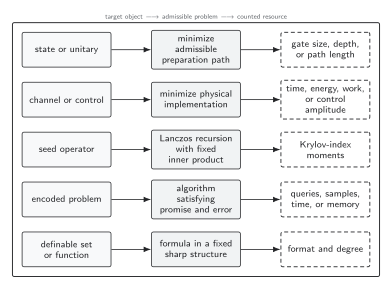
A complexity value is defined only after the target object selects an admissible family of paths or descriptions. Circuit length, physical control cost, Krylov spread, algorithmic resources, and sharp o-minimal format or degree answer different questions. The diagram is schematic and not to scale.
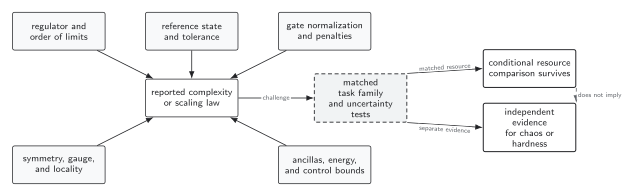
Reference sensitivity, gate nonuniqueness, regulator dependence, symmetry constraints, and unbounded controls are distinct failure modes. A link from complexity growth to chaos or computational hardness requires separate evidence after those controls. The diagram is schematic.
References
Section titled “References”- Avdoshkin, Alexander, Anatoly Dymarsky, and Michael Smolkin. “Krylov Complexity in Quantum Field Theory, and Beyond.” Journal of High Energy Physics 06 (2024): 066; corrected arXiv version 2025. DOI. Open PDF.
- Parker, Daniel E., Xiangyu Cao, Alexander Avdoshkin, Thomas Scaffidi, and Ehud Altman. “A Universal Operator Growth Hypothesis.” Physical Review X 9 (2019): 041017. DOI. Open PDF.
Original QFT.org content:CC BY 4.0, unless an item supplies different terms. Third-party material retains its own terms.