

Entropy and Rényi Estimation Protocols
Entropy and Rényi quantities can be estimated from direct multicopy observables, randomized-measurement statistics, reconstructed models, or numerical partition-function ratios. Each route has a different finite-sample bias, resource scaling, and continuum ceiling. The estimator must be chosen for the target order, state family, accessible copies, and physical region—not because “entropy” appears in every formula.
Required background. From Field Data to Information Claims supplies calibration and claim ceilings. Replica and entropy calculation checks supplies regulator and cross-method checks.
Targets and nonlinear bias
Section titled “Targets and nonlinear bias”For a regulated regional state ,
An unbiased estimator does not make unbiased. At finite sample size, use a likelihood, bootstrap, jackknife, or analytic correction appropriate to the dependence structure, and propagate the nonlinear transformation inside the procedure. Near small , intervals become asymmetric and Gaussian error propagation can fail.
Von Neumann entropy is not obtained from a few Rényi orders without a spectral model or a controlled analytic continuation. Treat as an inference problem and report the prior or model class that supplies the continuation.
Four estimation routes
Section titled “Four estimation routes”Multicopy permutation. Measure the cyclic permutation on matched copies to obtain directly. Daley and collaborators derive this route for bosonic lattice systems Daley et al. 2012, pp. 1–3. Resources grow with copy number and region size; copy drift is a primary systematic.
Randomized measurements. Apply a calibrated unitary ensemble and correlate outcome probabilities. This can estimate purity or other functionals without simultaneous copies but may have large variance governed by the ensemble and state; Brydges and collaborators demonstrate the corresponding second-Rényi inference in a controlled many-body setting Brydges et al. 2019, pp. 260–263.
Model-based reconstruction. Infer a Gaussian covariance or a low-rank density model and calculate entropy. It can be sample efficient when the model is correct and badly biased when it is not.
Numerical replica ratios. Estimate partition-function or free-energy differences with thermodynamic integration. This is a computational QFT method; autocorrelation, overlap, branch geometry, and continuum extrapolation enter its error budget.
Gaussian benchmark with finite samples
Section titled “Gaussian benchmark with finite samples”Generate a known multimode Gaussian state and compare:
- covariance reconstruction and symplectic-spectrum entropy;
- a randomized purity estimator for ;
- a simulated two-copy swap measurement;
- an exact regulated calculation.
Freeze train/validation splits before tuning. At each sample size, repeat the complete pipeline and measure bias, interval coverage, and root-mean-square error. Add a small non-Gaussian mixture that preserves the covariance approximately. The covariance estimator should then reveal model bias through disagreement with direct , provided the direct method has adequate power.
Continuum statement
Section titled “Continuum statement”Regional entropies generally contain regulator-dependent terms. An estimator that converges statistically at fixed lattice spacing has not measured a universal continuum entropy. Specify whether the target is a regulated operational entropy, a difference or mutual information with controlled cancellations, or a fitted universal coefficient. Hold the physical region fixed and vary spacing, volume, local truncation, and estimator resources together.
Exercises
Section titled “Exercises”Log bias. If is unbiased and has small variance , estimate the leading bias of .
Solution
A second-order expansion gives . Therefore inherits a bias whose sign also contains .
Rényi continuation. Why do accurate and not determine ?
Solution
Many spectra share the same second and third power sums but have different . Additional spectral assumptions, more moments, or direct reconstruction are needed.
Inference and failure-control maps
Section titled “Inference and failure-control maps”The first diagram traces the complete path from raw records to a bounded information claim; inspect the assumption attached to every arrow. The second maps shared and method-specific failure channels to held-out tests, regulator variation, replication, and correction.
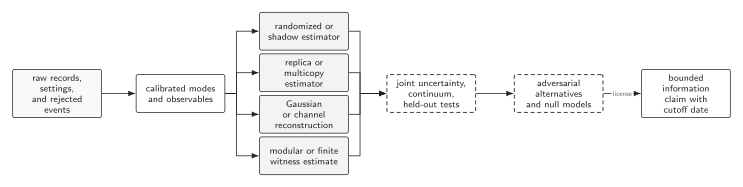
Entropy, tomography, witness, and recovery methods enter at the estimator stage, but all share calibration, uncertainty, continuum, and alternative-model tests. The final statement is no stronger than the least validated arrow. The diagram is schematic and not to scale.
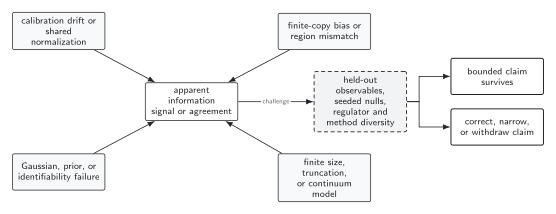
Different estimators can share the same calibration or normalization bias, so numerical agreement is not automatically independent replication. Adversarial nulls, held-out observables, regulator variation, and genuinely independent implementations set the claim ceiling and trigger correction when needed. The diagram is schematic.
References
Section titled “References”- Brydges, Tiff, Andreas Elben, Petar Jurcevic, Benoît Vermersch, Christine Maier, Ben P. Lanyon, Peter Zoller, Rainer Blatt, and Christian F. Roos. “Probing Rényi Entanglement Entropy via Randomized Measurements.” Science 364 (2019): 260–263. DOI. Open PDF.
- Daley, Andrew J., Hannes Pichler, Johannes Schachenmayer, and Peter Zoller. “Measuring Entanglement Growth in Quench Dynamics of Bosons in an Optical Lattice.” Physical Review Letters 109 (2012): 020505. DOI. Open PDF.
Original QFT.org content:CC BY 4.0, unless an item supplies different terms. Third-party material retains its own terms.