

Choosing a Continuum Subsystem: Algebra, Split, or Regulator
There is no universally correct “subsystem of a field.” The appropriate choice depends on the task: a sharp local algebra for intrinsic comparison, a split inclusion for separated operations, a regulator for density-matrix entropy, selected modes for communication, or a detector algebra for an explicit protocol. State the approximation and the strongest conclusion it supports.
Required background. Review factorization failure and the split property. Helpful background. Haag duality and additivity identifies missing boundary or sector observables.
A task-first decision rule
Section titled “A task-first decision rule”Start with the physical question, then select the smallest algebra that contains every admissible operation and observable needed to answer it.
| Task | Subsystem | Extra data | Licensed claim |
|---|---|---|---|
| Compare two continuum states locally | Represented local algebra | Region, representation, normality/support | Intrinsic expectation values, relative or modular comparison |
| Prepare or act independently in separated regions | Commuting algebras plus split inclusion | Collar, type-I interpolant or theorem, operation class | Normal product states or controlled local channels |
| Compute von Neumann or Rényi entropy | Type-I regulator | Cutoff, boundary/center choice, limit and subtraction | Regulated entropy and explicitly controlled continuum combination |
| Transmit information with wavepackets | Finite mode algebra | Mode functions, bandwidth, energy and localization error | Mode-channel performance, not all observables in a region |
| Model an experiment | Probe or detector algebra | Coupling support, switching, smearing, readout | Protocol-specific probabilities and disturbance |
Gauge theories add an algebra and center choice before the table can be applied. A charge-resolved quantity may require sector projectors or a reference frame; that construction is not supplied by geometry alone.
The structural map places Choosing a Continuum Subsystem: Algebra, Split, or Regulator among sharp local algebras, split inclusions, and regulated or operational substitutes.
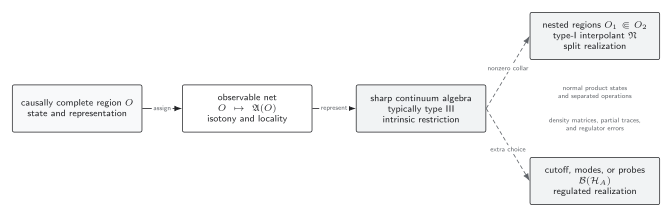
A causally complete region determines a sharp local algebra, usually type III. A nonzero split collar or an explicit cutoff, mode selection, or probe model can instead supply a type-I realization; these alternatives enable ordinary density matrices but retain different physical approximations. Schematic, not to scale.
Information needed to interpret the result
Section titled “Information needed to interpret the result”A reproducible claim should carry
where is the region or mode support, the algebra, the representation, the state, the operation class, regulator/energy data, an error tolerance, and the ordered limits. Not every task uses every entry, but an omitted entry must be immaterial rather than merely unstated.
Three benchmark decisions
Section titled “Three benchmark decisions”Vacuum entropy. A sharp continuum algebra has no density matrix. Choose a lattice, heat-kernel, or split regulator; quote the regulated , then identify a universal coefficient or regulator-independent combination before exporting a continuum claim.
Charge-resolved information. First select the gauge-invariant accessible algebra and its center or edge extension. Only then define sector weights and within-sector entropies. Results from inequivalent center choices are different observables.
Detector communication. Use the detector/probe algebra and a causal system–probe coupling. A wavepacket decomposition can approximate the channel, but a mode entanglement value alone does not establish a localized communication protocol.
Adversarial convention swap
Section titled “Adversarial convention swap”Change one subsystem choice while keeping the physical words unchanged. Replacing a sharp algebra by a lattice factor enables a partial trace; replacing an electric-center algebra by an extended algebra changes edge contributions; replacing localized probes by global modes changes causal support. If the answer does not change its definition, error estimate, or domain of validity, the original statement was underspecified.
Before applying this result, use the validity map to keep the algebra, state, operation class, resources, and approximation fixed.
For a side-by-side statement of the chapter’s subsystem choices, use the subsystem comparison table.
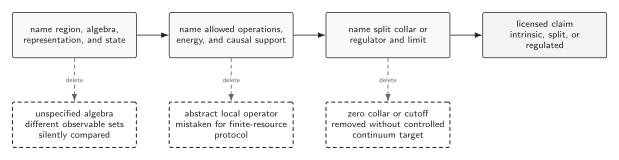
Every local-information claim must specify the represented algebra and state, the allowed operations and resource support, and any split collar or regulator. The dashed lower boxes show what fails when the algebra, protocol, or limiting prescription is left implicit. Schematic.
Further reading
Section titled “Further reading”Original QFT.org content:CC BY 4.0, unless an item supplies different terms. Third-party material retains its own terms.