

Continuum Subsystems and Local Algebras
Continuum QFT does not begin with a tensor product of spatial cells. It begins with observables assigned to spacetime regions and states restricted to those observable algebras. This chapter develops that replacement carefully, then explains when a regulator or a split inclusion recovers tensor-product tools without turning an approximation into an intrinsic continuum statement.
Helpful background. Operator algebras and positive functionals supply the algebraic language; microcausality fixes the locality input; direct sums and tensor products distinguish algebraic constructions; vacua, states, and representations fix the represented state; spacelike compatibility supplies the local-observable consequence; and locally convex, nuclear, and rigged Hilbert spaces supply the phase-space setting used later.
From regions to information-theoretic subsystems
Section titled “From regions to information-theoretic subsystems”For a causally complete region , write for its represented von Neumann algebra. Isotony, locality, covariance, and the time-slice property make the assignment physically usable, following the algebraic framework of Haag and Kastler 1964, pp. 848–861. A global state determines a restricted state ; no partial trace is required. The central distinction of the chapter is therefore
The second description is indispensable on a lattice and useful for separated regions, selected modes, and detector protocols. It is not automatic at a sharp continuum boundary, because physically relevant local algebras are generally type III, already exhibited for free fields by Araki 1964, pp. 956–965. This is why relative state comparison and modular theory survive even when an intrinsic local von Neumann entropy does not.
The diagram below is the chapter’s structural dictionary. Follow the solid arrows for the intrinsic construction and the dashed alternatives only after their extra assumptions have been stated.
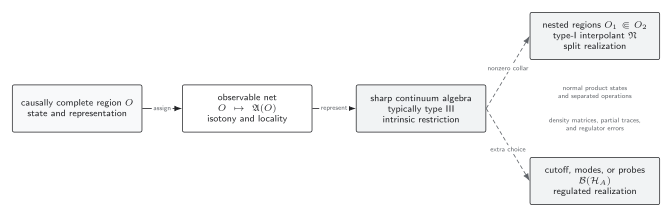
A causally complete region determines a sharp local algebra, usually type III. A nonzero split collar or an explicit cutoff, mode selection, or probe model can instead supply a type-I realization; these alternatives enable ordinary density matrices but retain different physical approximations. Schematic, not to scale.
What this chapter establishes
Section titled “What this chapter establishes”The first five pages build the algebraic language: local nets, restricted states, failure of sharp factorization, type-III factors, and standard form. The next five pages explain the controlled replacements and their hypotheses: split inclusions, nuclearity, Haag duality, independent preparation, and the Reeh–Schlieder property. The final two pages turn the framework into choices for information tasks and distinguish algebraic separability or distillability from a finite-resource laboratory protocol.
The chapter does not rederive the Haag–Kastler framework from Wightman fields, classify all type-III factors, construct gauge-theory edge algebras, or prove nuclearity for interacting models. It also does not assign an unregulated von Neumann entropy to a sharp type-III region. Those boundaries are substantive: removing them changes the mathematical object being discussed.
| Information task | Declared subsystem | Licensed conclusion | Essential limitation |
|---|---|---|---|
| Compare continuum states locally | 𝔄(O) with normal functionals | Agreement, distinguishability, relative entropy, and modular data on the chosen algebra | No intrinsic trace or reduced density matrix is implied |
| Prepare separated regions independently | 𝔄(O₁) ⊂ 𝔑 ⊂ 𝔄(O₂) with a split collar | Normal product states and type-I tensor-product methods | The collar, reference representation, and phase-space assumptions remain part of the result |
| Compute a regulated entropy | Lattice, cutoff, or mode algebra | A density matrix and its Rényi or von Neumann entropy | Cutoff dependence and the continuum limiting prescription must be reported |
| Analyze a communication or detector protocol | Selected modes or a probe-generated operation algebra | Channel, noise, success probability, and resource claims for that protocol | The selected operations need not exhaust the sharp local algebra |
A guided route through the chapter
Section titled “A guided route through the chapter”Start with Regions, Causal Complements, and Nets of Observables to see what a local subsystem contains. Then read Restricted States and Subregion Observables before using any reduced-state language. Why Continuum QFT Does Not Factorize Naively isolates the sharp-boundary obstruction, and Von Neumann Factors and Type-III Local Algebras identifies its operator-algebraic form. Standard Form, Cyclic and Separating Vectors supplies the state–algebra hypotheses later needed for modular theory.
For controlled tensor products, continue to The Split Property and Approximate Tensor Products and then Nuclearity, Phase-Space Bounds, and Split Distance. Read Additivity, Haag Duality, and Information Completeness whenever complements, disconnected regions, or omitted observables matter. Local Preparation, State Dependence, and Operational Independence translates algebraic separation into preparation claims, while Reeh–Schlieder Property and Limits of Localization explains why dense local state preparation does not imply cheap remote control or signaling.
End with Choosing a Continuum Subsystem: Algebra, Split, or Regulator for a decision procedure and Local Operations, Separability, and Distillability in QFT for bipartite resource questions. Readers interested only in regulated entropy may take the first three pages and the subsystem-choice page before entering Regulated Entropy and Replica Methods.
Conditions on local-information claims
Section titled “Conditions on local-information claims”Most errors in this subject come from silently changing one of four ingredients: the region, its algebra, the admissible operations, or the limiting prescription. The next figure turns those ingredients into a compact check. The upper row describes what must be fixed before a conclusion is drawn; the lower row shows the corresponding overclaims.
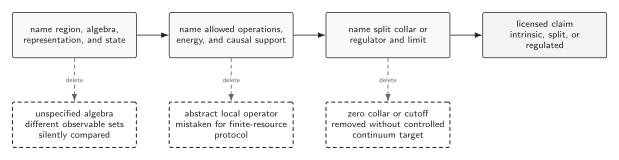
Every local-information claim must specify the represented algebra and state, the allowed operations and resource support, and any split collar or regulator. The dashed lower boxes show what fails when the algebra, protocol, or limiting prescription is left implicit. Schematic.
For example, Reeh–Schlieder cyclicity states that is dense. It does not bound the norm, energy, success probability, or spacetime support needed by an approximating operation. Likewise, the split inclusions characterized in Doplicher and Longo 1984, pp. 493–536, with phase-space control exemplified by Buchholz and Wichmann 1986, pp. 321–344, permit product-state constructions at nonzero separation; they do not convert the sharp algebra into . These distinctions will recur throughout the volume.
Check your preparation
Section titled “Check your preparation”You are ready to continue if you can answer the following without replacing an algebraic statement by a tensor-factor picture:
- Given , distinguish isotony from Haag duality and state which commutant relation the latter asserts.
- Explain why always makes sense but may not.
- State the extra geometry and operator-algebra hypothesis that license a split tensor product.
- For a proposed entanglement or preparation result, list the algebra, state class, allowed local operations, resource bound, and regulator or split distance.
A satisfactory answer should identify the precise continuum object first, then state the extra assumptions behind any density matrix or operational protocol. If one of those items is missing, return to the corresponding page before using the result downstream.
References
Section titled “References”- Araki, Huzihiro. “Type of von Neumann Algebra Associated with Free Field.” Progress of Theoretical Physics 32 (1964): 956–965. DOI.
- Buchholz, Detlev, and Eyvind H. Wichmann. “Causal Independence and the Energy-Level Density of States in Local Quantum Field Theory.” Communications in Mathematical Physics 106 (1986): 321–344. DOI.
- Doplicher, Sergio, and Roberto Longo. “Standard and Split Inclusions of von Neumann Algebras.” Inventiones Mathematicae 75 (1984): 493–536. DOI.
- Haag, Rudolf, and Daniel Kastler. “An Algebraic Approach to Quantum Field Theory.” Journal of Mathematical Physics 5 (1964): 848–861. DOI.
Original QFT.org content:CC BY 4.0, unless an item supplies different terms. Third-party material retains its own terms.