

Rényi Entropies and Replica Analytic Continuation
Integer replica moments determine the von Neumann entropy only after they have been embedded in an analytic function with sufficient domain, branch, and growth control. The physical density matrix supplies such a function when its spectrum is known; a finite list of path-integral values does not. Continuation uncertainty is therefore part of a replica result, not a cosmetic numerical detail.
Required background. Use branches, sheets, continuation, and monodromy, spectra and projectors, and the integer replica construction.
The spectral continuation
Section titled “The spectral continuation”For a regulated density matrix with eigenvalues and , define
For finite rank, is analytic for after choosing the real logarithm of each positive eigenvalue. In infinite dimension, the half-plane is restricted by trace convergence. Where the derivative can be exchanged with the sum,
This spectral expression also supplies nontrivial checks. Writing gives
Thus is convex on its real convergence interval, , and is nonincreasing in . A proposed interpolation that violates these constraints cannot come from a positive normalized density matrix.
The structural map places Rényi Entropies and Replica Analytic Continuation on the route from a regulated subsystem to integer moments, spectral checks, analytic continuation, and a continuum claim.
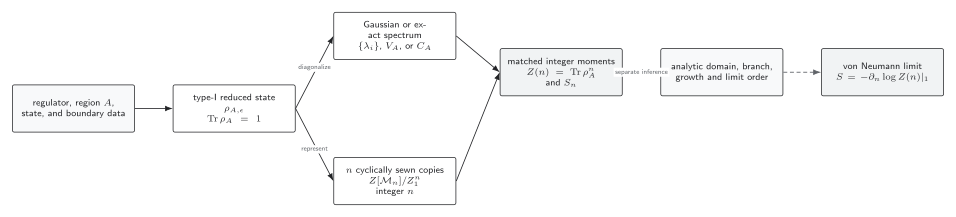
The spectral and replica routes must agree on matched integer moments at fixed regulator. Continuation from those moments to is logically separate and must state its analytic domain, branch, growth conditions, and order of limits. Schematic.
Why integer samples are insufficient
Section titled “Why integer samples are insufficient”Suppose fits every computed integer replica. Then
fits the same integer values for any analytic , yet generally has a different derivative at . Uniqueness theorems can eliminate this freedom only after a domain and a sufficiently strong growth bound are established. A calculation should state which theorem or physical spectral representation supplies those hypotheses. Merely observing a smooth fit over is not enough.
Branch points or zeros of can obstruct a chosen logarithm. A thermodynamic or large-parameter limit can also exchange dominant saddles, making continuation and the limit nonuniform. The integer geometries may remain individually well defined while the derivative at becomes sensitive to which branch is followed.
CFT interval example
Section titled “CFT interval example”For one interval of length in the vacuum of a two-dimensional CFT, the geometric result of Holzhey, Larsen, and Wilczek 1994, pp. 443–467 and its replica formulation in Calabrese and Cardy 2004, § 3 give
If is analytic near one and normalized by , differentiation gives the universal logarithm
The additive term is regulator and normalization dependent. When testing an interpolation scheme, first generate exact values of the known analytic expression at selected integers, hide the formula, and compare extrapolated derivatives with the exact result. Repeat after changing the fit family and the maximum integer. The spread is a continuation uncertainty; agreement from one ansatz is not an independent check.
Reporting a continuation
Section titled “Reporting a continuation”A usable result specifies the sampled replica numbers, their covariance, the analytic variable and branch, imposed positivity or convexity constraints, the fit family, singularities excluded from the domain, and sensitivity to alternative admissible fits. If a nearby singularity or saddle exchange produces unstable derivatives, report Rényi data at the computed integers rather than an unjustifiably precise von Neumann entropy. Analytic Continuation: Uniqueness and Failure Modes develops these diagnostics.
Before exporting this calculation, use the validity map to check normalization, infrared data, spectral or continuation control, and matched continuum scaling independently.
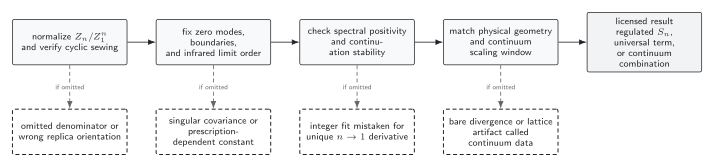
Normalization and sewing establish the intended integer moment; zero-mode and boundary control establish the infrared state; spectral and continuation checks control ; geometry matching and a scaling window establish the continuum target. Omitting any stage licenses only a weaker conclusion. Schematic.
References
Section titled “References”- Calabrese, Pasquale, and John Cardy. “Entanglement Entropy and Quantum Field Theory.” Journal of Statistical Mechanics: Theory and Experiment 2004 (2004): P06002. arXiv; DOI.
- Holzhey, Christoph, Finn Larsen, and Frank Wilczek. “Geometric and Renormalized Entropy in Conformal Field Theory.” Nuclear Physics B 424 (1994): 443–467. arXiv; DOI.
Original QFT.org content:CC BY 4.0, unless an item supplies different terms. Third-party material retains its own terms.