

Rindler Wedges and the Bisognano–Wichmann Theorem
The Bisognano–Wichmann theorem identifies the modular group of a vacuum wedge algebra with the Lorentz boosts preserving that wedge. The statement is exact for the Wightman-field theories covered by the theorem, and in other algebraic formulations only when the Bisognano–Wichmann property has been established separately. Poincaré covariance and a vacuum vector alone do not imply it.
Required background. Microcausality supplies the spacelike commutation relation used at the analytic boundary, stress-tensor charges identify a boost charge when a stress tensor exists, and Tomita–Takesaki flow supplies the intrinsic modular group of a standard algebra–vacuum pair.
Helpful background. Thermal KMS states explain the Unruh-temperature interpretation, while local region algebras distinguish an algebraic restriction from a Hilbert-space tensor factor.
The chapter’s route from standard pairs to geometric flow separates the intrinsic theorem from its geometric input. Compare the wedge row in the representative-flow table, then use the claim-licensing checklist before exporting the result to another state, region, or regulator.
Wedge geometry fixes the normalization
Section titled “Wedge geometry fixes the normalization”In Minkowski coordinates with the site’s metric, take
The boost of rapidity in the plane is
It preserves . Fix the covariance convention
and the modular convention
Then the Bisognano–Wichmann relation is
Thus positive modular time moves points with rapidity in this convention. Defining the flow with reverses the direction, but it cannot change the magnitude . In the equivalent convention used in many theorem statements,
The shared wedge–ball diagram makes the geometric relationship visible: inspect how wedge boost orbits become diamond-preserving ball trajectories while the entangling boundaries remain fixed.
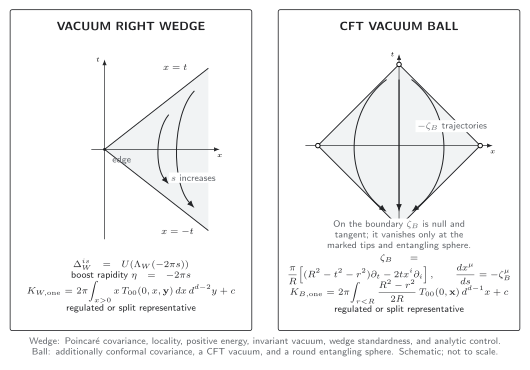
For the wedge, the geometric identification uses Poincaré covariance, locality, positive energy, an invariant vacuum, wedge standardness, and the analytic field control of the Bisognano–Wichmann theorem. For the ball it additionally uses conformal covariance, a CFT vacuum, and a round entangling sphere. The displayed stress-tensor charges are one-sided regulated or split representatives; the intrinsic continuum objects are the modular operators. With , positive follows in the wedge and in the ball. Schematic; not to scale.
The original scalar-field theorem and its extension to finite-component boson and fermion fields establish this boost–modular identification through complex Lorentz analyticity and the Tomita polar decomposition Bisognano and Wichmann 1975, Theorem 1 and pp. 985–1007; Bisognano and Wichmann 1976, §III, pp. 306–309 and Theorem 1, p. 310.
What the theorem assumes
Section titled “What the theorem assumes”The 1975 theorem treats a Hermitian scalar Wightman field. The 1976 extension allows a collection of finite-component, local or relatively local boson and fermion fields. Its working hypotheses include:
- a strongly continuous unitary representation of the proper orthochronous Poincaré group;
- the spectrum condition for translations and a unique invariant vacuum;
- fields that are operator-valued tempered distributions on a common invariant dense domain;
- Poincaré covariance and the appropriate Bose or Fermi locality relations;
- the field-domain and complex-boost analyticity used to identify the Tomita operator.
For the resulting wedge algebra, cyclicity follows from the Reeh–Schlieder argument, and locality together with cyclicity for the opposite wedge gives separation. It is therefore misleading to list “cyclic and separating” as an unrelated physical axiom: it is the standardness conclusion needed before modular theory can be applied.
An abstract Haag–Kastler net may satisfy covariance, locality, positive energy, and vacuum uniqueness without the equality above having been proved. In that setting the displayed equality is called the Bisognano–Wichmann property. The safe logical order is: establish a standard wedge pair, prove or assume the property for the specified model, and only then identify modular time with rapidity.
The local boost representative and Unruh scale
Section titled “The local boost representative and Unruh scale”When a conserved stress tensor is available, the right-half-space adjoint action on the surface has the one-sided representative
The weight has length dimension one and vanishes linearly at the entangling plane. The constant only fixes a regulated type-I normalization and drops from the adjoint action. In a split or tensor-factor representative, the standard modular generator is “right minus left”; in the continuum, the global boost implements the same automorphism on without requiring a trace-class reduced density matrix.
The uniformly accelerated orbit
has rapidity . Since along the modular trajectory,
This is the temperature entering accelerated-detector response and wedge KMS correlators, not a claim that the Minkowski vacuum is a global Gibbs density matrix Unruh 1976, §III, especially Eq. (3.10), pp. 883–885.
Worked free-field check of the
Section titled “Worked free-field check of the 2π2\pi2π”Consider the massless real scalar field in four dimensions, normalized by
Point fields are distributional shorthand here; the algebraic statement is obtained by smearing both insertions with test functions supported in the wedge. Along the orbit above, introduce the analytic function
Its upper boundary is the ordered Wightman function,
whereas its lower boundary is
The identity uses ; the change from to records the reversed operator order. Under , this proper-time strip becomes exactly . Therefore the correlator checks both the sign and the magnitude .
This check is reproducible without a fit. Fix any , exclude a small coincidence window , and compare the two regulated boundary values with the same . Normalize the dimension-two correlator as . The dimensionless analytic residual
is identically zero; a numerical implementation should therefore report only floating-point error. The controls and prevent a coincidence singularity from being mistaken for a normalization failure.
Adversarial state check
Section titled “Adversarial state check”The vacuum boost cannot be the modular flow of a state that is not invariant under that boost. A transparent diagnostic uses a coherent excitation. In a large-box normalization, take a right-moving massless mode with classical field
Along the accelerated orbit,
Applying the vacuum modular trajectory gives the stationarity residual
For and , . The nonzero one-point residual proves that this boost is not the coherent state’s modular group. A normalizable wavepacket replaces the box mode by a narrow frequency band; one must then report the bandwidth , box size or envelope scale, and the change in under refinement. What survives is the vacuum theorem and a useful comparison flow—not geometric modular flow for the excited state. This diagnostic does not compute the excited state’s actual modular Hamiltonian.
Common pitfalls
Section titled “Common pitfalls”Dropping the . A boost preserves the wedge for every rapidity. Only the Tomita/KMS boundary condition fixes the modular parametrization.
Treating a theorem for Wightman fields as an axiom of every net. In an abstract net, name the argument that establishes the Bisognano–Wichmann property. Covariance alone is not that argument.
Using the one-sided integral as a continuum density matrix. The integral is a local representative of the adjoint action. The intrinsic object is the modular operator of the wedge algebra and vacuum.
Exercises
Section titled “Exercises”1. Rapidity, sign, and dimensions
Section titled “1. Rapidity, sign, and dimensions”Show that the orbit , stays in . Starting from , find for . Finally verify that is dimensionless in spacetime dimensions.
Solution
The orbit obeys and , so . Its rapidity is . The theorem gives , hence . In natural units , , and , so the integral has dimension .
2. Boundary order in the free-field strip
Section titled “2. Boundary order in the free-field strip”For , evaluate its two boundaries in the strip . Explain why the equality is a KMS ordering relation rather than ordinary periodicity of a nonsingular function.
Solution
At the upper boundary, gives . At the lower boundary, approach from inside with . Then
so the squared denominator gives with the opposite . The poles lie on the boundaries. Ignoring the side from which a boundary is approached erases the operator ordering and turns a distributional KMS statement into the false claim that the two ordered distributions are identical.
3. Failure of vacuum boost stationarity
Section titled “3. Failure of vacuum boost stationarity”For the coherent-mode diagnostic, evaluate at and . Which conclusion follows from , and which conclusion does not?
Solution
Since ,
Every faithful state is stationary under its own modular flow. Therefore the vacuum boost automorphism cannot be the modular flow of this coherent excitation. The calculation does not determine the coherent state’s modular generator; that requires new modular data, for example a relative-modular or cocycle analysis. A wavepacket calculation must additionally check stability under bandwidth and volume refinement.
References
Section titled “References”- Bisognano, Joseph J., and Eyvind H. Wichmann. “On the Duality Condition for a Hermitian Scalar Field.” Journal of Mathematical Physics 16 (1975): 985–1007. DOI.
- Bisognano, Joseph J., and Eyvind H. Wichmann. “On the Duality Condition for Quantum Fields.” Journal of Mathematical Physics 17 (1976): 303–321. DOI; Open PDF.
- Unruh, William G. “Notes on Black-Hole Evaporation.” Physical Review D 14 (1976): 870–892. DOI.
Original QFT.org content:CC BY 4.0, unless an item supplies different terms. Third-party material retains its own terms.