

Causal Channels and Relativistic Communication
Relativistic communication begins with an intervention, not with a correlator. A sender chooses a localized operation, a field carries whatever influence the dynamics permits, and a receiver attempts to distinguish the resulting states or records. This chapter builds that operational chain and keeps three questions separate: whether two records are correlated, whether changing one operation can influence the other region, and how reliably information can be transmitted under stated energy, bandwidth, localization, and error constraints. The main setting is QFT in globally hyperbolic spacetime, with detector models used as regulated examples rather than as universal definitions of local field subsystems.
Helpful background. Causal quantum channels supplies localized completely positive maps, data processing supplies operational distinguishability bounds, and Lindblad field dynamics supplies a useful comparison with ordinary open-system noise. The measurement–correlator claim contract is helpful when a protocol is connected to experimental evidence.
Enter this chapter
Section titled “Enter this chapter”Start with signaling and causal composition, which defines influence by interventions rather than correlations. Algebraically localized operations turns that definition into a representation-independent action criterion. Channel–state methods in infinite dimensions explains why a finite-dimensional maximally entangled Choi vector cannot simply be imported into a type-III local algebra.
Then construct an actual field communication channel from sender and receiver couplings. The next routes distinguish quantum communication and entanglement distribution, entanglement harvesting, and pre-existing correlation from causal exchange. Finish with energy-constrained capacities, wavepackets, modes, and frames, Bell nonlocality in fields, and the dated protocol status comparison.
The figure gives the common architecture. Read the upper line from left to right, then follow only the lower branch corresponding to the task being claimed. The same apparatus can support several analyses, but their success criteria are not interchangeable.
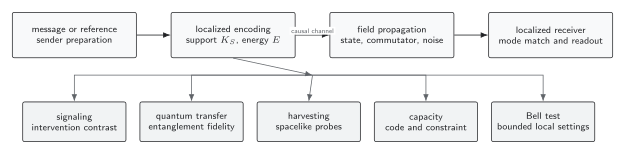
One field-mediated setup supports several inequivalent tasks. Signaling asks whether the receiver changes under a sender intervention; harvesting asks whether two probes acquire entanglement; capacity adds coding, constraints, and an asymptotic error criterion; a Bell test concerns a joint conditional distribution while retaining no-signaling marginals. The diagram is schematic and not to scale.
From localized operations to receiver statistics
Section titled “From localized operations to receiver statistics”Choose sender and receiver regions and . A message label selects a sender encoding, the sender and receiver couple locally to the field, and a receiver POVM produces the classical record . In a regulated detector model with sender state , field state , receiver ready state , and coupling unitaries and , the induced receiver channel is
and the observed conditional distribution is
This formula is a construction, not a complete definition of locality in continuum QFT. It presupposes a tensor-product regulator and explicitly introduced probes. In the algebraic description, a nonselective operation localized in is a normal unital completely positive map on observables that acts trivially on observables spacelike to ; Fewster and Verch 2020, §§ 3–5 give a covariant measurement framework that does not require the field algebra to split into local Hilbert-space factors.
The distinction matters because a channel is defined by more than a propagator. One must state the sender alphabet or input system, the preparation, both localized couplings, the field state, the receiver observable or decoder, and every admissible constraint. Changing any of these data can change the channel.
Correlation, influence, and communication
Section titled “Correlation, influence, and communication”Let and be two sender choices. Operational signaling to a receiver is present precisely when there is an admissible receiver outcome for which
with the preparation and receiver procedure held fixed and any uncommunicated sender outcomes averaged. For a type-I detector or regulator, this is equivalent to nonzero trace distance between the two receiver density operators. For a general local algebra, use one half of the norm distance between the two restricted normal states. This is a counterfactual statement: it compares what the receiver would see under two interventions.
By contrast, a nonzero connected two-point function
can reflect correlations already present in the field state. For spacelike-separated test functions, microcausality gives
while need not vanish. The commutator controls linear causal response; the symmetric or connected correlation controls a different part of the joint detector statistics.
A short Kraus-operator argument makes no-signaling concrete. Let the sender’s nonselective operation have Kraus operators with , and let be a receiver effect spacelike to every . Then
Thus the receiver marginal is independent of , even if the joint state has strong correlations. Selectively conditioning on a sender outcome can change a conditional receiver state, but the receiver cannot access that conditioning label before it is sent through an ordinary causal channel.
These observations produce a useful hierarchy:
- Correlation: a joint distribution, connected correlator, mutual information, or entanglement witness is nonzero.
- Causal influence: changing a localized intervention changes an accessible receiver statistic.
- Communication performance: a specified code transmits classical or quantum information with a declared error while obeying energy, bandwidth, localization, and timing constraints.
Each step needs additional information. None follows merely from the preceding quantity being nonzero.
A benchmark with an exact zero control
Section titled “A benchmark with an exact zero control”An exactly solvable rapid-interaction detector model makes the distinction quantitative. For the effective binary channel studied by Tjoa and Gallock-Yoshimura 2022, §§ IV–VI, the optimized unassisted classical capacity can be written
where , is a receiver-noise visibility, and is the smeared field commutator associated with the two couplings. If the supports are spacelike, and the two entropy terms cancel exactly: even though the field can remain correlated across the regions.
For a numerical check, take . At a causal geometry and coupling for which ,
This is a benchmark for that declared model, not a capacity of the quantum field in general. Delta-like switching, the chosen encoding, receiver noise, and the permitted coupling strengths are part of the channel definition. The model’s unassisted quantum capacity is zero because the resulting channel is entanglement breaking, so a positive classical capacity also does not imply coherent quantum transmission.
Comparing protocols without conflating their claims
Section titled “Comparing protocols without conflating their claims”The following comparison records the data needed to interpret six common protocol families. A dash in the capacity column means that the protocol does not define a communication capacity; it does not mean that the correlations are uninteresting.
| Protocol | Sender support | Receiver support | Channel definition | Resource state | Energy budget | Signaling condition | Capacity metric | Localization error | Evidence status |
|---|---|---|---|---|---|---|---|---|---|
| Spacelike harvesting | Compact switching and smearing for probe A | Strictly spacelike switching and smearing for probe B | Joint probe output map; no sender-to-receiver channel claimed | Usually vacuum or a stated quasifree field state | Probe gaps, switching work, and perturbative coupling order | Every receiver marginal is invariant under the other probe's choice | —; report negativity or another entanglement witness | Tail or support-overlap bound must be below the claimed effect | Analytic and numerical detector-model results; highly profile dependent |
| Timelike classical transmission | Localized message-dependent preparation or coupling | Readout inside the sender's causal future | Conditional distribution p(y | a) or a classical–quantum channel | Specified field and receiver ready states | Alphabet cost, switching work, duration, and mean or peak energy | At least one receiver effect distinguishes two sender choices | One-shot error or constrained classical capacity C(E) | Bound the difference between ideal and localized operations | Exact and perturbative model calculations; not a universal field capacity |
| Quantum or entanglement transmission | Coherent encoder acting on an input and a localized carrier | Localized decoder and retained quantum output | CPTP map from input code space to receiver output | Field state plus any declared preshared entanglement or reference frame | Block energy, bandwidth, duration, and success-probability accounting | All encoder-to-decoder influence lies in causal order | Entanglement fidelity, coherent information, or constrained Q(E) | Encoder and decoder tail norms enter the error budget | Theoretical protocols and bounds; detector-channel details can make Q vanish |
| Bosonic wavepacket coding | Normalized finite-energy packet or packet code | Matched accessible receiver modes | Lossy or noisy bosonic channel after mode selection | Vacuum, thermal, squeezed, or other stated environment | Mean or peak excitation energy and bandwidth | Receiver response follows retarded support, not plane-wave overlap alone | Constraint-specific classical, quantum, or entanglement-assisted rate | Report packet tails and mode-mismatch loss | Rigorous channel theory for ideal modes; spacetime implementation is model dependent |
| Spacelike Bell test | Random bounded setting and readout in region A | Random bounded setting and readout in spacelike region B | Joint distribution p(x, y | a, b), not a message channel | Specified field state and measurement instruments | Trial definition, detector efficiency, switching, and setting generation | Each marginal is independent of the remote setting | —; report CHSH value and statistical uncertainty | Close support overlap and postselection loopholes | AQFT theorems under stated region and state hypotheses; laboratory realization is separate |
| Relativistic broadcast channel | One localized sender encoding | Two or more localized receiver regions | One CPTP map with several receiver marginals | Specified field state and receiver ready states | Shared sender cost plus each receiver's local cost | Every marginal respects its own causal relation to the sender | Achievable rate region, not independent pairwise capacities alone | Bound each receiver's support tails and cross-talk | Nonperturbative model constructions exist; general operational rate regions remain open |
Failure controls that change the conclusion
Section titled “Failure controls that change the conclusion”The second figure is a diagnostic map. Its three columns add requirements from left to right: a state correlation, then a causal response, then a complete communication task. The lower boxes show common ways an apparently positive result can fail.
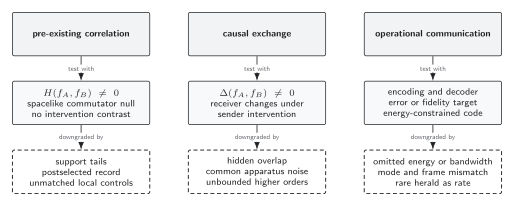
Correlation, causal exchange, and reliable communication require progressively more intervention data. A spacelike connected correlator can coexist with a zero commutator and zero signaling; a nonzero causal response still becomes a communication claim only after encoding, decoding, constraints, and accessible-record errors are fixed. The map is schematic.
Four controls are especially useful:
- Spacelike relocation. Move the receiver support outside the sender’s causal future while preserving the local apparatus parameters. A genuine sender-to-receiver contrast must vanish, up to the declared support-tail error.
- Sender-choice erasure. Average over or replace the message-dependent operation while leaving common causes unchanged. Correlations may survive; message distinguishability must not.
- Resource removal. Replace the field state or preshared entanglement by a control state while keeping the causal response channel fixed. This separates state-assisted performance from propagation alone.
- Accounting closure. Include switching work, detector gaps, rare heralding probabilities, mode mismatch, and discarded trials. A postselected high fidelity or a low conditional error need not imply a useful unconditional rate.
The same care applies to energy. In an infinite-dimensional input space, an unconstrained supremum can be infinite or discontinuous. A capacity such as or is meaningful only after the Hamiltonian, allowed states, and whether is a mean, peak, per-use, or block constraint are fixed. Barcellos and Landulfo 2021, §§ III–VI provide an explicit field-channel analysis in which channel performance and energy accounting are evaluated together; conclusions about a vanishing communication contribution to the energy are specific to their channel and receiver preparation, not a universal free-energy theorem.
Localization introduces another approximation. An exactly positive-frequency, exactly band-limited mode cannot also have compact spacetime support. A realistic protocol therefore reports a packet-tail norm, a receiver mode-overlap, or an operational trace-distance error. A plane wave is a useful basis vector, but it is not by itself a localized message.
Bell correlations and no signaling
Section titled “Bell correlations and no signaling”Bell nonlocality does not sit above signaling on a single scale. A CHSH experiment uses two setting choices and two outcomes to test whether the joint distribution admits a local hidden-variable factorization. Relativistic causality instead requires
independent of the remote setting. Quantum theory can violate the CHSH bound while satisfying both equalities.
In AQFT, Summers and Werner 1987, Theorems 3.1 and 4.1, pp. 252–257 prove maximal Bell violation for complementary wedge algebras under their stated assumptions, with an extension for injective wedge algebras. That is a strong structural theorem, but it is not automatically a claim about arbitrary compact laboratories, finite-duration detector hardware, or loophole-free data. A physical proposal must still supply bounded observables, region and state hypotheses, random setting selection, trial accounting, detection efficiency, and spacelike support.
Exercises
Section titled “Exercises”1. Prove the spacelike no-signaling identity
Section titled “1. Prove the spacelike no-signaling identity”A sender chooses one of two trace-preserving operations with Kraus operators . A receiver effect commutes with every . Show that the probability of is independent of . Which assumption fails if one conditions on a particular sender outcome?
Solution
In the Heisenberg picture,
Therefore for every initial state and every choice . The last equality uses trace preservation, which makes the dual map unital. Conditioning on one outcome retains only one Kraus operator (or one subset), so the corresponding selective map is not generally unital. Its conditional receiver state may change, but accessing the conditioning label requires a separate causal classical message.
2. Check the exact capacity control
Section titled “2. Check the exact capacity control”For the rapid-interaction channel above, take . Evaluate for (a) spacelike support, , and (b) . Explain why the second answer does not establish a universal field capacity.
Solution
For spacelike support, , so the two binary entropies are identical and . In case (b), the first entropy is , while
Hence
The value belongs to the stated detector channel, encoding, coupling, and noise parameter. Different switching, smearing, field states, energy restrictions, or receiver operations define different channels and can give different capacities.
3. Separate harvesting from causal exchange
Section titled “3. Separate harvesting from causal exchange”Two identical probes begin in a product ground state. At leading nontrivial order their local noise and nonlocal coherence are and . For the symmetric two-probe state, use
to find the negativity. What additional check is needed before calling the result harvesting from pre-existing field correlations?
Solution
The leading negativity is
Positive detector entanglement alone does not identify its source. To attribute it to pre-existing field correlations, the complete switching and smearing supports must be spacelike so that the smeared commutator vanishes, and any noncompact tails must be bounded below the reported effect. If the probes are in causal contact, field-mediated exchange can contribute and the more cautious description is entanglement generation or extraction in a causally connected protocol. Pozas-Kerstjens and Martín-Martínez 2015, §§ II–IV derive the perturbative witness, while Tjoa and Martín-Martínez 2021, §§ II–IV analyze the harvesting-versus-exchange distinction.
Review the chapter
Section titled “Review the chapter”After these routes you should be able to specify a relativistic communication protocol as localized operations plus an input, field state, receiver, constraint, and error criterion; prove spacelike no-signaling without assuming vanishing vacuum correlations; distinguish state correlations, causal exchange, classical communication, coherent transmission, harvesting, and Bell violation; compute a model capacity without overgeneralizing it; and identify which localization, energy, frame, postselection, and evidence checks can change the conclusion.
References
Section titled “References”- Barcellos, I. B., and Landulfo, A. G. S. (2021). “Relativistic Quantum Communication: Energy Cost and Channel Capacities.” Physical Review D 104, 105018. DOI. Open PDF.
- Cliche, M., and Kempf, A. (2010). “The Relativistic Quantum Channel of Communication through Field Quanta.” Physical Review A 81, 012330. DOI. Open PDF.
- Fewster, C. J., and Verch, R. (2020). “Quantum Fields and Local Measurements.” Communications in Mathematical Physics 378, 851–889. DOI. Open PDF.
- Pozas-Kerstjens, A., and Martín-Martínez, E. (2015). “Harvesting Correlations from the Quantum Vacuum.” Physical Review D 92, 064042. DOI. Open PDF.
- Summers, S. J., and Werner, R. (1987). “Maximal Violation of Bell’s Inequalities Is Generic in Quantum Field Theory.” Communications in Mathematical Physics 110, 247–259. DOI.
- Tjoa, E., and Gallock-Yoshimura, K. (2022). “Channel Capacity of Relativistic Quantum Communication with Rapid Interaction.” Physical Review D 105, 085011. DOI. Open PDF.
- Tjoa, E., and Martín-Martínez, E. (2021). “When Entanglement Harvesting Is Not Really Harvesting.” Physical Review D 104, 125005. DOI. Open PDF.
Original QFT.org content:CC BY 4.0, unless an item supplies different terms. Third-party material retains its own terms.