

Symmetry, Superselection, and Information Resources
Symmetry does more than label states: it restricts which observables, operations, ancillas, and communication protocols are physically available. The same density operator can therefore carry several inequivalent quantities—uncertainty in a charge sector, entanglement within a sector, coherence relative to a missing reference frame, gauge-edge data, or information recoverable by a covariant decoder. None of these quantities is an operational resource until the subsystem algebra and the allowed task have been declared.
This chapter builds a working dictionary for those declarations. It emphasizes finite regulators and exactly checkable models before taking a continuum limit, separates global symmetries from gauge redundancies, and keeps emerging soft-sector and generalized-symmetry diagnostics within their present evidence boundaries.
Helpful background. Factorization failure and local algebras supplies the continuum subsystem boundary; symmetry of a QFT supplies global action data; edge modes and subregion factorization supplies the gauge-boundary language; topological entanglement diagnostics supplies a downstream material application.
Enter this chapter
Section titled “Enter this chapter”Start with symmetry-constrained operations, because “free” has meaning only relative to an operation class. Superselection and accessible entanglement then separates charge-label uncertainty from entanglement usable under charge-preserving local operations. Fermionic graded subsystems explains why an ordinary qubit tensor product does not faithfully represent odd operators without the corresponding Jordan–Wigner algebra map.
The reference and resolution branch continues through reference frames and asymmetry, charge-resolved entanglement, and entanglement-asymmetry restoration. These pages distinguish coherence supplied by a finite frame, conditional entropies reconstructed from charged moments, and local symmetry restoration under a stated order of limits.
The gauge branch fixes a regional algebra in gauge subregions and centers, matches continuum bulk and edge terms in gauge-field edge contributions, and isolates the part usable under gauge-invariant local operations in centers, edges, and distillable entanglement.
Finally, soft-sector information makes finite detector resolution part of the question, generalized-symmetry information treats defect-conditioned observables without reclassifying generalized symmetries, and covariant channels and recovery asks what a symmetry-respecting decoder can actually reconstruct.
From task specification to an information resource
Section titled “From task specification to an information resource”The chapter’s first diagram is deliberately a branching dictionary rather than a causal chain. A block-diagonal sector state, a pre-twirled asymmetric state, and a gauge algebra with a center are different inputs; one should not feed one formula into another merely because all of them contain a charge label.
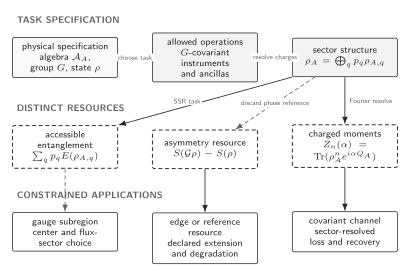
Symmetry–information dictionary. Sector entanglement, asymmetry, charged or defect moments, gauge or soft data, and covariant recovery are parallel outputs of a declared task. A reference frame, edge system, regulator, or detector response is an input to that task, not an invisible background. Schematic and not to scale.
Read the diagram from top to bottom:
- Fix the subsystem. Name the regional algebra, including its center or fermionic grading, rather than assuming a Hilbert-space factorization.
- Fix the symmetry data and state. Specify the group action, charge or defect labels, and whether the state is already invariant or still has coherence between sectors.
- Fix the operational resources. State the admissible maps, physical ancillas, reference or edge systems, regulator, and sector or detector resolution.
- Only then choose a quantity. Accessible entanglement, asymmetry, charged moments, soft distinguishability, and recovery error answer different questions even when calculated from the same regulated state.
This ordering prevents a common category error: if a state already has the Abelian form , then it has no off-diagonal charge coherence to be removed by the same twirl. Its sector entropy can still be nonzero, but its relative entropy of asymmetry is zero.
Sector blocks, coherence, and edge data
Section titled “Sector blocks, coherence, and edge data”For a normalized state that commutes with an Abelian regional charge,
and the direct-sum entropy identity is
This identity is kinematic. For the standard pure-state, fixed-total-charge task with local charge-preserving operations, the within-sector average gives the accessible entanglement, while the Shannon term is not itself a one-copy Bell-pair yield. Collective copies and a supplied reference can change the resource theory, so the task must accompany the formula. The particle-number construction is given in Wiseman and Vaccaro 2003, Eqs. (1)–(4).
If instead has coherence between charge sectors, the subsystem twirl removes that coherence. For a compact-group twirl in a finite or suitably regulated system,
This asymmetry measures distinguishability from the twirled state, not entanglement. A finite reference can make some relational coherence usable, but its state, localization, and degradation belong in the accounting Bartlett, Rudolph, and Spekkens 2007, §§ II.B–III.
Charge-resolved entropies use yet another object,
whose Fourier coefficients give unnormalized sector moments. The sector probability and the normalization of the conditional density matrix must be restored before taking an entropy. The construction is introduced in Goldstein and Sela 2018, Eqs. (1)–(6).
Gauge theories add an algebraic choice rather than merely another global charge. Gauss law can place boundary flux in the center of a regional gauge-invariant algebra. Electric-center, magnetic-center, and extended-Hilbert-space prescriptions need not assign the same formal entropy; the correct comparison first matches the algebra, edge system, measure, and regulator. The finite-lattice algebra classification is Casini, Huerta, and Rosabal 2014, §§ 2–4, and the gauge-invariant distillation rate is Van Acoleyen et al. 2016, Eq. (7) and the direct/converse proof on pp. 3–4.
Fermion-parity grading changes tensor-product conventions; negativity calculations additionally require a specified fermionic partial-transpose or partial-time-reversal convention Shapourian, Shiozaki, and Ryu 2017, § II. Generalized symmetries instead use topological defects acting on extended operators rather than ordinary pointlike charge generators Gaiotto et al. 2015, § 2.
Comparison table
Section titled “Comparison table”The table linearizes the chapter’s shared distinctions. “Allowed operations” means allowed for the named task, not dynamically costless, and “reference” means a physical system or side information whose preparation and reuse are part of the protocol.
| Framework | Algebra or center | Sectors | Allowed operations | Reference resource | Edge extension | Resolved observable | Accessible or distillable content | Recovery or validity boundary |
|---|---|---|---|---|---|---|---|---|
| Global charge superselection | Invariant local algebra | Local charge q with weights pq | Locally charge-preserving instruments and classical communication | No phase reference unless budgeted | None | Charge projectors and full-counting statistics | Within-sector average for the standard pure-state task | Collective activation or a supplied reference changes the task |
| Fermion parity grading | ℤ₂-graded CAR field algebra; even observable subalgebra | Even and odd parity blocks | Parity-preserving physical maps and ancillas | No parity-violating reservoir in the declared theory | None | Restricted covariance spectrum and a specified fermionic partial transpose or partial time reversal | Ordering-independent results after the algebra map | A naive qubit cut can represent a different subsystem |
| Finite reference and asymmetry | Selected algebra with a group action | Coherence modes between representation sectors | Covariant joint operations on target and reference | Finite token state, localization, and reuse tracked | None | Twirl and relative entropy of asymmetry | Relational coherence for the stated protocol | A perfect or reset reference overstates performance |
| Charge-resolved entanglement | Symmetric reduced algebra and regional charge | Probabilities and conditional states for each charge | Charge resolution with a declared Fourier grid | Distinct from a phase reference | None | Charged and projected moments | Conditional Rényi or von Neumann entropy | Normalization, continuation, tails, and aliasing must be controlled |
| Local symmetry restoration | Fixed subsystem algebra and twirl | Off-diagonal charge blocks | Symmetric dynamics with a fixed order of limits | Initial asymmetry and any frame stated | None | Subsystem asymmetry, commutator, and charged observables | Local restoration diagnostic | Recurrences and conserved modes forbid a universal decay claim |
| Gauge subregion and edge data | Gauge-invariant regional algebra with a named center | Boundary irreducible representations or fluxes | Gauge-invariant local operations | Physical boundary charges counted if supplied | Electric, magnetic, or extended-space prescription named | Flux projectors and matched bulk-plus-edge determinants | Conditional multiplicity-space entanglement; other terms are task dependent | Gauss law, edge measure, zero modes, and regulator must match |
| Soft infrared information | Dressed or inclusive measured algebra | Soft-charge or radiation labels at finite resolution | Finite-time detector operations | Dressing and boundary data declared | None unless a physical boundary system is introduced | Soft-cloud overlaps and inclusive distinguishability | Only distinctions resolved by the detector | The dressing, bandwidth, regulator, and order of limits matter |
| Generalized symmetry | Extended-operator and defect algebra | Charge or fusion labels only when defined | Operations compatible with the declared defect data | Inserted topological defect is part of the observable | Defect support and contact prescription stated | Twisted moments and linked-region correlations | A geometry- and task-dependent diagnostic | Identity normalization, deformation, and explicit-breaking controls are required |
| Covariant channel and recovery | Input and output algebras with group actions | Sector populations, coherences, and mode errors | Covariant decoder plus any locality constraint | Finite reference and correlated side information counted | Gauge center respected when present | Entanglement fidelity and relative-entropy loss | Performance achievable under the restriction | Decoder twirling preserves performance only for a symmetric task; erased labels require correlated side information |
Three gates before an operational claim
Section titled “Three gates before an operational claim”A formal entropy, overlap, or recovery fidelity becomes an operational statement only after three independent gates pass. The second diagram is the chapter’s stop rule.
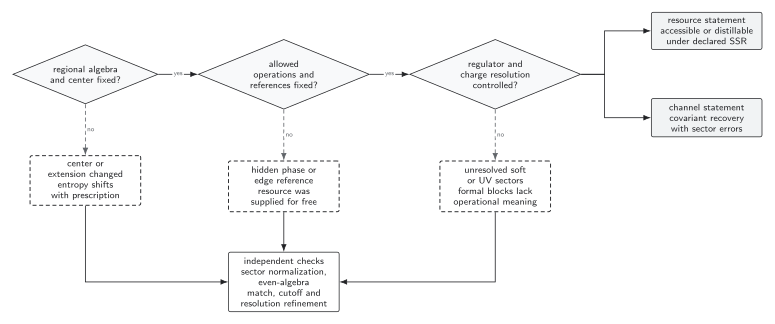
Validity and failure map. Passing all three gates licenses a resource, channel, or diagnostic statement only for the declared task. Changing the subsystem prescription, supplying an undeclared phase or edge ancilla, or leaving ultraviolet, infrared, or sector data unresolved changes the question rather than merely its numerical answer. Schematic and not to scale.
The gates are logically independent. A perfectly normalized charge distribution does not repair an unphysical tensor product; a valid gauge algebra does not make an undeclared edge reference free; and a covariant channel does not become local merely because the group average exists. Independent controls should therefore test sector normalization, the even-algebra map, reference degradation, regulator refinement, and detector resolution separately.
The unrestricted recovery theorem also has a precise scope. For a reference state , a channel , and states supported in , a universal averaged rotated-Petz map obeys the one-map fidelity bound in Junge et al. 2018, Remark 2.2, Eqs. (20)–(21). Symmetry covariance, gauge compatibility, locality, and reference cost are additional properties that must be proved for the QFT task; the theorem does not supply them automatically.
Check your route
Section titled “Check your route”1. A pure fixed-charge state has and one-dimensional conditional states. Find its reduced entropy and its accessible entanglement for the standard one-copy local charge-superselection task.
Solution
The direct-sum entropy is bit because both conditional entropies vanish. The accessible entanglement is . The missing bit is charge-label uncertainty for this task; collective copies or a supplied reference define a different task.
2. A state already commutes with . What are and ?
Solution
The twirl leaves the state unchanged: . Therefore . Sector uncertainty can remain nonzero, showing explicitly that asymmetry and the Shannon entropy of sector weights are different quantities.
3. A decoder reconstructs charge coherence only when an undeclared phase-locked ancilla is attached. Which validity gate fails, and what is the strongest surviving statement?
Solution
The operation-and-reference gate fails. The surviving statement is conditional: the protocol is reference-assisted, and its performance must be reported together with the ancilla state, localization, correlations, and degradation. It is not a no-reference covariant recovery protocol.
References
Section titled “References”- Bartlett, Stephen D., Terry Rudolph, and Robert W. Spekkens. “Reference Frames, Superselection Rules, and Quantum Information.” Reviews of Modern Physics 79 (2007): 555–609. DOI.
- Casini, Horacio, Marina Huerta, and José Alejandro Rosabal. “Remarks on Entanglement Entropy for Gauge Fields.” Physical Review D 89 (2014): 085012. DOI.
- Gaiotto, Davide, Anton Kapustin, Nathan Seiberg, and Brian Willett. “Generalized Global Symmetries.” Journal of High Energy Physics 2015, no. 2 (2015): 172. DOI.
- Goldstein, Moshe, and Eran Sela. “Symmetry-Resolved Entanglement in Many-Body Systems.” Physical Review Letters 120 (2018): 200602. DOI.
- Junge, Marius, Renato Renner, David Sutter, Mark M. Wilde, and Andreas Winter. “Universal Recovery Maps and Approximate Sufficiency of Quantum Relative Entropy.” Annales Henri Poincaré 19 (2018): 2955–2978. DOI.
- Shapourian, Hassan, Ken Shiozaki, and Shinsei Ryu. “Partial Time-Reversal Transformation and Entanglement Negativity in Fermionic Systems.” Physical Review B 95 (2017): 165101. DOI.
- Van Acoleyen, Karel, Nick Bultinck, Jutho Haegeman, Michael Mariën, Volkher B. Scholz, and Frank Verstraete. “The Entanglement of Distillation for Gauge Theories.” Physical Review Letters 117 (2016): 131602. DOI.
- Wiseman, Howard M., and John A. Vaccaro. “Entanglement of Indistinguishable Particles Shared between Two Parties.” Physical Review Letters 91 (2003): 097902. DOI.
Original QFT.org content:CC BY 4.0, unless an item supplies different terms. Third-party material retains its own terms.