

Restricted States and Subregion Observables
Restricting a QFT state to a region means restricting its expectation-value functional to the region’s represented observable algebra. It is not, in general, a partial trace. A density operator describes the restriction only when a suitable type-I representation or regulator has supplied a tensor factor and a trace.
Required background. Use the definitions of normal states and operator algebras, observable matrix elements, and the local net. Helpful background. Hilbert-space completion and duality clarify which topology is being used.
Restriction is an algebraic operation
Section titled “Restriction is an algebraic operation”A state on a unital -algebra is a positive normalized linear functional . For an inclusion , its restriction is simply
No Hilbert-space decomposition is needed. The restriction preserves positivity and normalization, and it contains exactly the statistics of measurements drawn from .
In a representation , normality is additional structure: is normal when it is continuous under monotone increasing limits of positive operators, equivalently when it lies in the predual . A trace-class operator on defines a normal functional by , but the same functional need not be represented by a density matrix inside .
For a genuine factorization with , restriction is equivalent to
This familiar formula is a special representation theorem, not the definition of restriction.
The structural map places Restricted States and Subregion Observables among sharp local algebras, split inclusions, and regulated or operational substitutes.
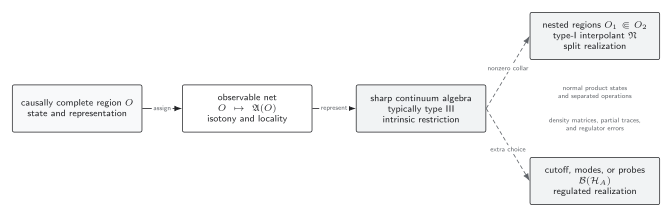
A causally complete region determines a sharp local algebra, usually type III. A nonzero split collar or an explicit cutoff, mode selection, or probe model can instead supply a type-I realization; these alternatives enable ordinary density matrices but retain different physical approximations. Schematic, not to scale.
A regulated interval and its continuum target
Section titled “A regulated interval and its continuum target”Consider a scalar field regulated as a finite harmonic chain. For sites in an interval , the canonical variables generate , and the vacuum or one-particle density matrix can be partially traced to . Local expectation values computed from agree with the global state restricted to operators supported on those sites.
As the lattice spacing tends to zero at fixed physical interval, the local continuum algebra is generally type III. The sequence remains useful for regulated entropies and correlators, but there need not be a limiting trace-class operator belonging to the continuum local algebra. The stable comparison is instead
for a controlled family of observables approximating . The observable family, state convergence, and topology must all be stated.
Local indistinguishability
Section titled “Local indistinguishability”If two global states and satisfy , no measurement whose effects lie in distinguishes them. Conversely, any with is a local witness. This makes the choice of algebra part of every distinguishability claim.
A common error is to enlarge the observable set during tomography. Reconstructing a regulated covariance matrix, for example, licenses claims about the regulated mode algebra that was measured; it does not automatically determine the state on a sharper continuum algebra.
Before applying this result, use the validity map to keep the algebra, state, operation class, resources, and approximation fixed.
For a side-by-side statement of the chapter’s subsystem choices, use the subsystem comparison table.
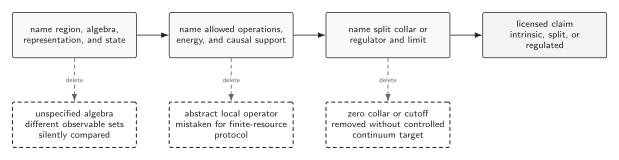
Every local-information claim must specify the represented algebra and state, the allowed operations and resource support, and any split collar or regulator. The dashed lower boxes show what fails when the algebra, protocol, or limiting prescription is left implicit. Schematic.
Further reading
Section titled “Further reading”Original QFT.org content:CC BY 4.0, unless an item supplies different terms. Third-party material retains its own terms.