

Conformal Boundaries and Defects
A planar conformal defect is specified first by geometry and symmetry, and only then by spectra and OPE coefficients. For a -dimensional support in dimensions, codimension determines the transverse rotation group, the allowed one-point functions, and the number of independent cross-ratios. This page derives the preserved subgroup, separates ambient from intrinsic local data, and fixes the free half-space scalar used to check the rest of the chapter.
Required background. Support, codimension, and operator data define the support and normal bundle. The conformal algebra and its generators provide the commutators used to identify the preserved subalgebra.
Helpful background. Boundaries, interfaces, and domain walls distinguish one-sided boundaries from two-sided interfaces before conformal symmetry is imposed.
The subgroup preserving a plane
Section titled “The subgroup preserving a plane”Use Euclidean coordinates and put the defect at . Translations , rotations , dilatations , and special conformal transformations preserve the plane. They close into . Normal rotations close into a commuting :
The broken generators are , , and mixed rotations . To check , use
When and , the transformed normal coordinate remains zero. For , it does not. The same conclusion follows directly from the conformal-algebra commutators Billò et al. 2016, §§1–2.
A boundary has . Its connected preserved group is , with no nontrivial continuous factor. A two-sided interface may also be invariant under an orientation-reversing , and a codimension-two defect may preserve or break reflection in its normal plane. Such discrete symmetries impose selection rules, but they must be stated separately.
Plane, sphere, and global qualifications
Section titled “Plane, sphere, and global qualifications”A sphere is locally conformally equivalent to a plane by inversion about a point on the sphere. Consequently, local flat- and spherical-defect correlators are related by the primary-field Weyl factors. Three qualifications matter:
- the inversion point is removed, so the equivalence is between conformal patches;
- orientation and normal-frame conventions transform with the map;
- a renormalized defect partition function can acquire an anomaly or scheme-dependent local term even when separated-point correlators map covariantly.
The plane-to-sphere map therefore transfers local representation theory and OPE data, not automatically a numerical free energy. Boundary and defect anomaly terms are treated separately in Boundary and defect Weyl anomalies.
Ambient and intrinsic local data
Section titled “Ambient and intrinsic local data”The ordinary bulk OPE is unchanged as a local operator identity away from the support:
What changes is the state created by the defect. A bulk scalar may have
subject to internal, parity, and transverse-tensor selection rules. In addition, the support carries defect primaries
where is a representation of parallel rotations and denotes an representation. Their correlators obey -dimensional conformal covariance, while transverse rotations act as a global symmetry from the intrinsic viewpoint.
A complete local specification therefore contains:
| Data | Meaning | Normalization needed for comparison |
|---|---|---|
| and | Ambient bulk spectrum and OPE | Bulk two-point basis |
| Bulk one-point coefficient | Bulk operator and distance | |
| Defect spectrum | Parallel and transverse representation conventions | |
| Bulk-to-defect coupling | Bulk and defect two-point bases | |
| Intrinsic defect OPE | Defect two-point basis | |
| Displacement two-point coefficient | Localized Ward-identity convention |
Intrinsic locality does not imply a separately conserved defect stress tensor. Such a tensor exists only if the support contains an autonomous local sector with the required conservation law. The displacement operator is different: it is forced by broken transverse translations and exists even when no intrinsic stress tensor does Billò et al. 2016, §5.
Exact half-space scalar
Section titled “Exact half-space scalar”Take , , and
With
the canonical full-space propagator satisfies
For , the method of images gives
At , the Dirichlet expression vanishes and the normal derivative of the Neumann expression vanishes. These are distributional identities with separated boundary insertions; contact terms at coincidence are fixed by the bulk delta-function normalization. The half-space solution assumes decay at infinity. On a compact domain, the Neumann Laplacian has a constant zero mode and its Green function requires a zero-average source, zero-mode projection, or another infrared prescription.
Two exact boundary primaries are exposed by the boundary limit:
They obey unit-normalized two-point functions on the boundary. The renormalized composite one-point function,
is the image term after subtracting the full-space coincident singularity. Thus Neumann and Dirichlet have the same preserved group but different defect data. Liendo, Rastelli, and van Rees recover precisely these two solutions from boundary crossing in Liendo, Rastelli, and van Rees 2013, §3.1, pp. 10–12.
The figure below follows the path from codimension to preserved symmetry, transverse labels, and the two OPE channels. Inspect where removes the angular cross-ratio and where the free image sign enters as dynamical data.
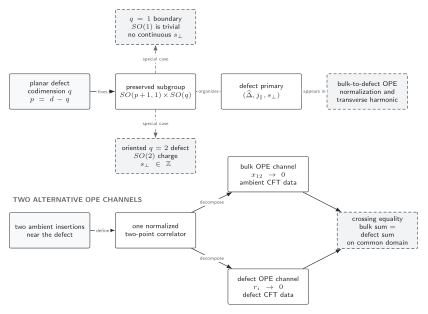
Schematic relation among a planar codimension- defect, its symmetry, transverse-spin sectors, and bulk-versus-defect channel variables. The boundary degeneration has one cross-ratio; the image sign distinguishes the Dirichlet and Neumann scalar data without changing the subgroup.
The same information in structured form is:
| Geometric input | Preserved structure | Operator consequence | Correlator consequence | Failure if omitted |
|---|---|---|---|---|
| General plane | Parallel and transverse representation labels | Two scalar cross-ratios for generic | Transverse sectors are mixed | |
| Boundary, | No continuous transverse spin | One scalar cross-ratio | A nonexistent angular variable is retained | |
| Oriented defect | Integer transverse charge | Angular Fourier sectors | and are identified without a reflection symmetry | |
| Free scalar, | Same boundary subgroup | Neumann value or Dirichlet normal derivative | Image term has sign | Boundary conditions and OPE data disagree |
Checks that prevent false identifications
Section titled “Checks that prevent false identifications”Codimension check. Recompute before importing a formula. A boundary block, a line-defect block, and a generic-codimension block solve different Casimir problems.
Orientation check. Specify whether reflection of the normal frame is a symmetry. Otherwise parity-odd structures or the distinction between and can be lost.
Normalization check. Test a proposed convention against the delta-function Green equation and one boundary limit. A missing factor of , , or propagates into every OPE coefficient.
Global check. A local plane-to-sphere map does not fix partition-function counterterms or zero modes. Those require a separate regulator and global prescription.
The representation labels are constructed next in Defect representations, transverse spin, and tensor structures; the corresponding near-support expansion begins at Bulk-to-defect expansion and defect operators.
References
Section titled “References”- Billò, Marco, Vasco Gonçalves, Edoardo Lauria, and Marco Meineri. “Defects in Conformal Field Theory.” Journal of High Energy Physics 04 (2016): 091. DOI. Open PDF
- Liendo, Pedro, Leonardo Rastelli, and Balt C. van Rees. “The Bootstrap Program for Boundary CFT.” Journal of High Energy Physics 07 (2013): 113. DOI. Open PDF
Original QFT.org content:CC BY 4.0, unless an item supplies different terms. Third-party material retains its own terms.