

Complex Coordinates and Local Conformal Symmetry
In two Euclidean dimensions, the conformal Killing equation reduces locally to the Cauchy–Riemann equations. Its solutions are therefore arbitrary holomorphic and antiholomorphic functions, which explains the infinite-dimensional local symmetry. Global invertibility is much more restrictive: on the Riemann sphere, the orientation-preserving conformal automorphisms are only Möbius maps. This page derives that distinction and fixes the analytic domain needed for primary-field transformations.
Required background. Conformal maps and compactification provide the geometric action of finite conformal transformations, while branches, sheets, continuation, and monodromy provide the analytic control needed for fractional powers.
Helpful background. Smooth manifolds, tangent spaces, and tensors explain coordinate charts and tensorial versus anomalous transformation laws.
Holomorphic solutions of the conformal Killing equation
Section titled “Holomorphic solutions of the conformal Killing equation”Let and in an oriented Euclidean patch with . An infinitesimal vector field
is conformal when . The and components give
Thus and locally. For a real Euclidean vector field, on the physical slice. In a complexified correlator calculation the two functions may be continued independently, but that does not turn them into two independent real spacetime symmetries.
A finite orientation-preserving map is locally
and rescales the metric by . Antiholomorphic maps reverse orientation and form a disconnected extension; they are not generated by the holomorphic conformal Killing fields above. These local statements, including the nonvanishing-Jacobian qualification, are developed in Di Francesco, Mathieu, and Sénéchal 1997, §§5.1–5.2 and Ginsparg 1990, §§2.1–2.2.
Expanding on an annulus gives
with Witt brackets
The Laurent series is local data: a pole at is allowed only because the contour lies in a punctured domain. It is not evidence that the corresponding flow is regular everywhere.
Why only Möbius transformations are global
Section titled “Why only Möbius transformations are global”On the compactified plane , a globally defined conformal symmetry must be one-to-one and holomorphic, including at infinity. Every such automorphism is
with identified under a common nonzero rescaling. The group is . Infinitesimally, only , , and are regular global vector fields. Higher positive modes are singular at infinity; modes below are singular at the origin.
This is the decisive local/global distinction. For example, is holomorphic, but its derivative vanishes at and it is two-to-one on the sphere. It is a useful branched covering map, not a global conformal automorphism. Likewise is conformal only after choosing a simply connected branch domain; going around the origin shifts it by .
The plane–cylinder map makes this hierarchy concrete. Inspect the figure from left to right: the exponential is locally conformal but not one-to-one without the cylinder identification, and later algebraic and modular steps require additional data beyond the coordinate map.
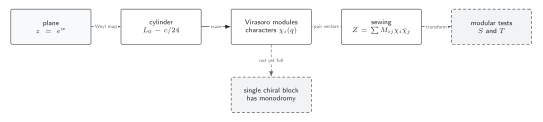
From to modular consistency: the diagram is schematic and separates a local chiral block, which may have monodromy, from the paired and sewn full-CFT data tested by modular and transformations.
The relationships in the figure are equivalently:
| Stage | Mathematical input | Domain or identification | What is not yet established |
|---|---|---|---|
| Plane–cylinder map | , so the image is | The points and require asymptotic states | |
| Virasoro module | Local stress-tensor modes | A punctured coordinate disk | A left–right local field spectrum |
| Chiral block | A chosen module and fusion channel | A branch on configuration space | Single-valuedness under monodromy |
| Sewing | Paired chiral and antichiral states | Plumbing region | Consistency in every degeneration channel |
| Modular test | Complete torus sectors | and | Higher-genus consistency by itself |
Primary and quasiprimary fields
Section titled “Primary and quasiprimary fields”A primary field transforms under a finite conformal map, on a domain where all fractional powers have fixed branches, as
Equivalently, infinitesimally,
The sign here corresponds to an active transformation with coordinates held fixed. Switching to a passive coordinate convention reverses the displayed variation; mixing the two is a common source of sign errors.
A quasiprimary transforms covariantly only under the global Möbius subgroup. Descendants of primaries are generally quasiprimary only after taking appropriate linear combinations. The stress tensor is more exceptional still: its central-charge-dependent Schwarzian term means it is not a primary when .
Under a rotation, a field gains . Ordinary single-valued bosonic fields therefore have . Fermionic fields may acquire a sign and require a spin structure. Chiral fields with fractional spin can exist as components of a chiral algebra or as nonlocal objects, but a full local correlator must pair monodromies so that its declared physical continuation is single-valued.
A two-point covariance check
Section titled “A two-point covariance check”Translation, rotation, and scale covariance give
Under inversion , choose a branch for and transform both insertions before sending one point from infinity. The phases cancel for a mutually local full field, leaving the same power law. A chiral factor alone can acquire monodromy around the origin; this is why chiral covariance does not by itself establish locality.
Common pitfalls
Section titled “Common pitfalls”Equating holomorphic with globally invertible. Holomorphy is local. Check zeros of , poles, behavior at infinity, and injectivity on the stated domain.
Treating and as permanently independent. That device is useful for analytic continuation. A Euclidean correlator must ultimately obey its reality condition, while a Lorentzian continuation needs its own ordering and prescription.
Calling every conformal covariant a primary. Quasiprimaries need only Möbius covariance, and the stress tensor has a Schwarzian anomaly. The transformation law, not the scaling dimension alone, decides the class.
Exercises
Section titled “Exercises”Show directly that only , , and are regular at both and .
Solution
Near the origin, is regular only for . Set near infinity. Since ,
which is regular at only for . Both conditions hold precisely for .
References
Section titled “References”- Di Francesco, Philippe, Pierre Mathieu, and David Sénéchal. Conformal Field Theory. Graduate Texts in Contemporary Physics. New York: Springer, 1997. DOI.
- Ginsparg, Paul. “Applied Conformal Field Theory.” In Fields, Strings and Critical Phenomena, Les Houches Session XLIX, edited by Édouard Brézin and Jean Zinn-Justin, 1–168. Amsterdam: North-Holland, 1990. arXiv.
Original QFT.org content:CC BY 4.0, unless an item supplies different terms. Third-party material retains its own terms.