

Perturbative CFT Data near Free Fixed Points
A weakly coupled fixed point turns renormalized perturbation theory into CFT data: fixed-point anomalous dimensions become scaling dimensions, renormalized three-point functions become OPE coefficients, and equations of motion determine multiplet recombination. The conversion is reliable only after operator mixing, scheme dependence, evanescent structures, and the asymptotic character of the expansion have been controlled.
Required background. Free and generalized-free theories supplies the zeroth-order operator basis and Wick contractions. Beta functions, running masses, and field anomalous dimensions supplies the RG definitions. Helpful background. Operator mixing and renormalization matrices develops the matrix problem, and Gaussian and Wilson–Fisher fixed points gives the RG setting.
From renormalized operators to conformal eigenoperators
Section titled “From renormalized operators to conformal eigenoperators”Let denote dimensionless renormalized couplings and let a finite set of operators with identical quantum numbers obey
This sign convention makes the fixed-point dilatation matrix
The scaling dimensions are its eigenvalues. When the zeroth-order dimensions are degenerate, diagonalizing only the diagonal entries of is wrong: one must include every operator that mixes, including total derivatives and equation-of-motion operators, and then pass to conformal primaries or the appropriate quotient. In a unitary fixed point, the two-point matrix gives the inner product with respect to which the physical dilatation operator is self-adjoint; a nonsymmetric matrix in a convenient renormalization basis need not signal complex dimensions.
An OPE coefficient requires one more step. Renormalized two- and three-point functions contain normalization matrices and scheme-dependent finite pieces. Transform all operators to eigenoperators, normalize their separated-point two-point functions to the declared convention, and only then read the coefficient of the conformal three-point structure. This procedure makes fixed-point dimensions and normalized OPE coefficients invariant under analytic redefinitions of couplings and nonsingular changes of operator basis, order by order to the accuracy retained.
Wilson–Fisher data as a normalization test
Section titled “Wilson–Fisher data as a normalization test”Consider the Euclidean model in ,
With this definition of , minimal subtraction gives
The first dimensions are
The absence of an anomalous part in and the shift of the singlet scalar are useful convention checks. The field equation
also shows why the free primary becomes a descendant of at the interacting fixed point. This is conformal multiplet recombination, not the deletion of an operator. Its use in deriving Wilson–Fisher CFT data without evaluating every Feynman integral is explained in Rychkov and Tan 2015, §§1–4; the fixed-point expansion originates with Wilson and Fisher 1972, pp. 240–243.
Substituting into these first terms does not by itself produce a precision prediction for three dimensions. For example, at the displayed expressions give and , but omitted terms are not parametrically small at . Resummation choices and independent bootstrap, Monte Carlo, or experimental comparisons are part of a quantitative conclusion.
What is universal at finite order
Section titled “What is universal at finite order”A coupling redefinition changes beta-function coefficients away from a fixed point and changes the coordinate value of . At an isolated fixed point, however, the eigenvalues of
are invariant under a nonsingular reparameterization. So are properly normalized scaling dimensions and OPE coefficients. A truncated calculation preserves that invariance only up to the first omitted order: retaining a higher-order fixed-point root inside a lower-order anomalous dimension manufactures spurious precision.
Dimensional regularization introduces additional care for spinning and composite sectors. Tensor identities valid at an integer dimension do not hold in generic , and evanescent operators can mix into physical operators through poles. The safe procedure is to work in a basis complete in generic , renormalize, take the required quotient, and only then approach the target dimension. Degenerate operators require degenerate perturbation theory; near-degeneracies can make an apparently small off-diagonal term produce an order-one rotation of eigenvectors.
The schematic map below locates the Wilson–Fisher expansion among controlled higher-dimensional limits. Inspect the independent small parameter in each branch and the distinct way control can fail.
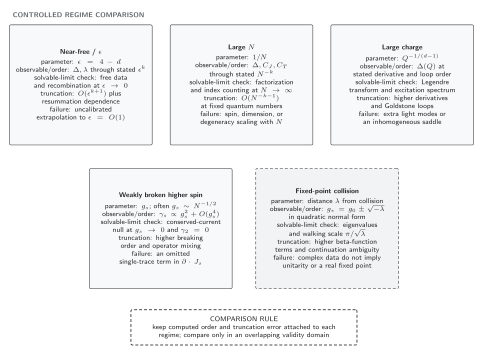
Controlled higher-dimensional CFT limits. The diagram is schematic and not to scale: proximity to a free point controls powers of or a weak coupling, whereas large , large charge, and fixed-point collision use different expansions and different error tests.
The same information is available without the diagram:
| Regime | Expansion parameter | Direct observable | Representative computed order | Error or remainder | Independent check | Leading loss of control |
|---|---|---|---|---|---|---|
| Near Wilson–Fisher | dimensions and OPE coefficients near the free basis | declared power of after fixed-point substitution | omitted powers and resummation dependence | multiplet recombination and an overlapping fixed-dimension method | evaluation at without calibration | |
| Weak gauge or Yukawa fixed point | loop-counting combinations of all | mixed-operator spectrum and normalized correlators | declared loop order | omitted loops and competing roots | nonsingular scheme change | strong coupling or an unstable truncation |
| Large | factorized spectrum and connected corrections | declared order in | higher orders and nonuniform limits | index counting and crossing | spin or dimension scaling with | |
| Large charge | lowest dimension in a fixed-charge sector | declared derivative and Goldstone-loop order | higher derivatives and extra light modes | Legendre transform and excitation spectrum | a change of homogeneous ground state | |
| Fixed-point collision | distance from the collision | walking time and complex-conjugate data after continuation | local normal form through stated nonlinear order | higher beta-function terms and continuation ambiguity | scheme-invariant eigenvalues and multi-observable drift | mistaking slow real flow for a real fixed point |
Error and failure tests
Section titled “Error and failure tests”Fixed-point substitution. Check to one order beyond the accuracy quoted where the available calculation permits. State which root is connected continuously to the free theory.
Scheme test. Perform an allowed finite redefinition and verify that fixed-point observables change only beyond the retained order. Couplings and individual matrix entries need not pass this test.
Mixing test. Enlarge the basis by redundant and evanescent operators, then verify that physical eigenvalues and normalized separated-point correlators are unchanged after the quotient.
Asymptotic test. Compare successive orders, vary admissible resummations, and test against an independent observable or method. A short asymptotic series supplies an estimate with assumptions, not a rigorous remainder bound.
A bounded calculation can be used for varying truncation order and comparing resummations once its executable implementation is available; no result on this page depends on that calculation having run.
Exercises
Section titled “Exercises”Using the displayed beta function, verify and compute the correction-to-scaling exponent through first order in .
Solution
The nonzero root is . Differentiating gives , hence .
Why must be substituted before diagonalizing the dilatation matrix?
Solution
Away from a fixed point, scale transformations also move the couplings, so the anomalous-dimension matrix alone is not the CFT dilatation operator. At the coupling flow vanishes and its eigenoperators have definite fixed-point scaling dimensions.
References
Section titled “References”- Rychkov, S., and Tan, Z. M. (2015), “The -expansion from conformal field theory,” Journal of Physics A: Mathematical and Theoretical 48, 29FT01. doi:10.1088/1751-8113/48/29/29FT01. Open PDF
- Wilson, K. G., and Fisher, M. E. (1972), “Critical exponents in 3.99 dimensions,” Physical Review Letters 28, 240–243. doi:10.1103/PhysRevLett.28.240
Original QFT.org content:CC BY 4.0, unless an item supplies different terms. Third-party material retains its own terms.