

Defect Lorentzian Inversion and Lightcone Expansions
A flat conformal defect turns an ambient two-point function into a two-variable bootstrap problem. Its bulk-channel discontinuity determines defect dimensions and bulk-to-defect coefficients above a transverse-spin threshold, while the bulk lightcone limit forces universal trajectories near the transverse-derivative spectrum. The result is exact only after the ordering, contour, growth bound, and low-spin terms have all been specified.
Required background. Defect crossing supplies the two OPE channels and their normalizations. The Lorentzian inversion formula supplies the contour-deformation logic and explains why data below a spin threshold need separate input.
Evidence cutoff. Research-sensitive inversion, trajectory, and defect-interface statements below reflect primary sources available through 2026-08-09. Later threshold estimates or extensions to new defect sectors require a renewed source check.
Two channels for an ambient two-point function
Section titled “Two channels for an ambient two-point function”Let a planar, spacelike defect have dimension and codimension . For identical ambient scalars normalized by
we choose the standard defect cross-ratios so that the bulk lightcone limit is at fixed . The same function has two expansions,
Here is the defect one-point coefficient of a bulk primary, is a bulk-to-defect coefficient, is transverse spin, and is transverse twist. The displayed prefactor fixes the bulk identity block to one. Different block conventions move powers of between the prefactor and the blocks, so formulas from another source must first be checked against this identity normalization.
The bulk and defect decompositions, their normalizations, and the preserved representation labels are developed in Billò et al. 2016, §§2–3. The defect OPE converges in the useful wedge
In that wedge the bulk identity dominates, yet no single fixed- defect block reproduces its singularity. A nonuniform sum over large transverse spin must do so. For the trivial defect, the required operators are transverse derivatives of ,
Thus a general defect contains, under the stated convergence and boundedness assumptions, trajectories approaching these values as .
A crossed bulk primary shifts the leading trajectory
Section titled “A crossed bulk primary shifts the leading trajectory”Suppose the lowest nonidentity term relevant in the bulk lightcone limit is a single primary with dimension , spin , and twist . Matching its logarithm to the leading defect trajectory gives
with, in the normalization above,
The exponent and coefficient follow from matching the bulk collinear block to the large-transverse-spin defect sum Lemos et al. 2018, §2.1, eqs. (2.17)–(2.22). The exponent is universal; the sign is not. It depends on the product , whose sign is not fixed by ordinary four-point-function positivity. Degenerate minimal-twist operators must be summed before interpreting the coefficient, and a zero or singular gamma-function factor signals that the naive leading matching needs refinement.
The defect inversion integral
Section titled “The defect inversion integral”Introduce radial variables and . Integer labels an harmonic in the Euclidean defect OPE; the Lorentzian contour produces its analytic continuation in transverse spin. Let be the radial partial wave, the transverse-spin solution selected by the contour deformation, and the corresponding normalization. For the conventions of Lemos, Liendo, Meineri, and Sarkar, the Lorentzian inversion function is
Poles in give defect dimensions; their residues give squared bulk-to-defect coefficients after the stated block normalization is restored. On the integration segment , use . This is an ordinary discontinuity around the bulk-channel cut, not the four-point double discontinuity, and it has no general pointwise positivity property. Reversing the orientation reverses the displayed formula’s overall discontinuity sign. The contour and the exact codimension- formula are derived in Lemos et al. 2018, §3, especially eq. (3.42).
The contour arcs vanish only if the correlator obeys a transverse Regge bound. If
the Lorentzian integral agrees with Euclidean inversion at integer . Analyticity in then organizes the corresponding defect operators into trajectories. The formula does not determine : light defect primaries that obstruct the deformation must be subtracted or supplied independently. No theory-independent universal value of is known. A complementary Lorentzian formula inverts the defect-channel discontinuity to recover bulk-channel data; it has different kernels and convergence conditions and should not be substituted into the displayed formula Liendo, Linke, and Schomerus 2020, §§3–4.
The following diagram locates this inversion step among several distinct defect-CFT constraints. Inspect in particular that a displacement Ward identity, a folding argument, an RG statement, and a Lorentzian reconstruction are separate inputs rather than interchangeable evidence.
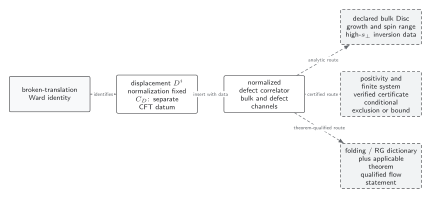
Schematic flow of defect constraints. Lorentzian inversion reconstructs high-transverse-spin defect data from a declared bulk-channel discontinuity; it does not by itself establish displacement normalization, an RG monotonicity theorem, or a numerical certificate.
The same distinction can be read without the diagram:
| Input | Mathematical object | Supported conclusion | Missing without an extra check |
|---|---|---|---|
| Broken-translation Ward identity | Displacement operator and its normalization | Response to transverse motion of the defect | High-spin spectrum |
| Folding | Boundary condition in the product theory | Interface-to-boundary reformulation | Reflection positivity unless separately shown |
| Defect RG data | Perturbing defect operator and endpoint assumptions | Flow statement within its theorem’s domain | Lorentzian analyticity |
| Bulk discontinuity plus growth bound | for | Analytic high-spin trajectories and residues | Low-spin defect primaries |
| Numerical crossing certificate | Truncated primal/dual data with residual checks | Conditional exclusion or bound | Exact inversion outside the certified setup |
Solvable checks and the low-spin obstruction
Section titled “Solvable checks and the low-spin obstruction”For the trivial defect, inversion of the bulk identity reproduces the transverse-derivative tower. A free bulk scalar gives an especially sharp limitation: its equations of motion allow the leading tower , while additional solutions can occur only at bounded spin. In a simple nontrivial free-defect correlator,
the constant defect-identity term has zero bulk discontinuity. The inversion integral therefore cannot see it, and the small- behavior gives ; the absent term sits precisely at the excluded spin. This is a consistency check, not a failure of crossing.
A reproducible calculation should use free three-dimensional Dirichlet and Neumann boundary correlators to compare both channels and stage an inversion panel. It should use declared inputs and explicit checks.
Limits of the conclusion
Section titled “Limits of the conclusion”- The large- lightcone expansion is asymptotic; it does not justify evaluating its first term at or .
- The inversion formula requires the actual Lorentzian ordering and discontinuity. A Euclidean branch jump inserted by hand is not a substitute.
- Codimension one has no nontrivial transverse-spin tower, so the large- argument must be replaced by boundary-specific methods.
- A pole of the inversion function is candidate defect data only after shadow poles, normalization factors, and possible cancellations among bulk exchanges are handled.
- Current benchmark values and disputed applications require dated evidence; the durable statement here is the conditional reconstruction theorem and its explicit threshold.
Exercises
Section titled “Exercises”Assume one crossed bulk scalar of twist shifts the leading defect trajectory. If its coefficient product is doubled while all dimensions are held fixed, determine the large- change in . Then explain why the answer gives no prediction for .
Solution
The coefficient is linear in , so the leading shift doubles and retains the power . The derivation used the contour deformation and lightcone expansion only for . Low-spin terms can have zero discontinuity and must be added independently, so analytic continuation of the asymptotic formula does not determine them.
References
Section titled “References”- Billò, Marco, Vasco Gonçalves, Edoardo Lauria, and Marco Meineri. “Defects in Conformal Field Theory.” Journal of High Energy Physics 2016, no. 4 (2016): 091. doi:10.1007/JHEP04(2016)091.
- Lemos, Madalena, Pedro Liendo, Marco Meineri, and Sourav Sarkar. “Universality at Large Transverse Spin in Defect CFT.” Journal of High Energy Physics 2018, no. 9 (2018): 091. doi:10.1007/JHEP09(2018)091.
- Liendo, Pedro, Yannick Linke, and Volker Schomerus. “A Lorentzian Inversion Formula for Defect CFT.” Journal of High Energy Physics 2020, no. 8 (2020): 163. doi:10.1007/JHEP08(2020)163.
Original QFT.org content:CC BY 4.0, unless an item supplies different terms. Third-party material retains its own terms.