

Celestial and Cosmological Correlators: Axiom and Handoff Audit
Celestial amplitudes and late-time cosmological correlators transform conformally, but conformal covariance alone does not make either object an ordinary reflection-positive Euclidean CFT correlator. Before importing a block expansion, positivity bound, inversion formula, or dispersion relation, one must identify the spectrum, inner product, ordering, distributional support, factorization rule, and map to the physical observable.
Required background. Lorentzian correlators and causal orderings fixes what a sheet and discontinuity mean in an ordinary CFT. Celestial amplitudes defines the transform and scattering observable; this page uses that interface without rederiving it.
Helpful background. Multipoint correlators and multilightcone limits helps separate global conformal kinematics from OPE convergence and positivity.
Evidence cutoff. Research-sensitive celestial and cosmological interface statements below reflect primary sources available through 2026-08-09. Later observable maps, infrared prescriptions, or bootstrap theorems require a renewed source check.
Celestial covariance comes from the Lorentz group
Section titled “Celestial covariance comes from the Lorentz group”For a massless four-dimensional momentum, write
A celestial transform of an -particle amplitude is schematically
with the momentum-conserving distribution and the infrared prescription retained. The Lorentz group acts by Möbius transformations on , and boost eigenstates on the principal series have
for the standard massless normalizable basis. This proves global two-dimensional conformal covariance of the transformed scattering states Pasterski, Shao, and Strominger 2017, §§2–4.
It does not prove a discrete spectrum bounded below, a Euclidean vacuum state–operator correspondence, or reflection positivity. Momentum conservation makes low-point celestial objects distributions; for four massless particles, physical kinematics restricts the complex cross-ratio to a real locus in the appropriate signature and channel. Soft and collinear singularities, loop-level infrared divergences, and the choice of dressed or inclusive states can also alter the function space. Ordinary block or inversion formulas may be used only after these features have been incorporated into their domain.
Celestial “crossing” begins with scattering crossing and permutation of incoming and outgoing legs. It can induce relations among celestial channel representations, but the analytic continuation in energies and the Mellin contours are part of that operation. It is not automatically the equality of two absolutely convergent Euclidean OPEs with positive squared coefficients.
Cosmological boundary data depend on state and observable
Section titled “Cosmological boundary data depend on state and observable”Approximate de Sitter isometries act as Euclidean conformal transformations on a late-time spatial slice. A bulk field of mass has late-time weights
or above the principal-series threshold. Complex weights and oscillatory squeezed-limit signals are compatible with unitary time evolution in the bulk; they do not furnish reflection-positive Euclidean boundary data.
Three commonly conflated objects are:
- a coefficient in the late-time wavefunction ;
- an in-in expectation value in a specified initial state;
- a proposed boundary correlator in a dS/CFT dictionary.
Even at tree level, the in-in correlator is obtained from and includes inverse quadratic kernels and contractions of lower wavefunction coefficients. Therefore a singularity or sign of need not transfer unchanged to an observable. The Bunch–Davies prescription, initial-state choice, gauge-invariant variable, boundary counterterms, and treatment of late-time logarithms must be declared Maldacena 2003, §§2–4.
The cosmological bootstrap can constrain wavefunction coefficients from spatial conformal symmetry, singularities, and factorization. Those are powerful inputs, but their positivity and locality structures are cosmological ones; see Arkani-Hamed et al. 2018, §§2–4. An ordinary CFT unitarity bound cannot be applied to a complex late-time weight without a separate dictionary and inner-product theorem.
Compatibility table
Section titled “Compatibility table”| Ordinary CFT input | Ordinary Euclidean CFT | Celestial transform | Cosmological late-time object | Safe conclusion |
|---|---|---|---|---|
| Global conformal covariance | Generated by on local operators | Follows from the four-dimensional Lorentz group for boost eigenstates | Follows from exact or approximate de Sitter isometries on a spatial slice | Conformal tensor structures and Ward identities appropriate to the object |
| Spectrum | Local dimensions, usually discrete on the cylinder and bounded by unitarity | Principal-series boost weights are continuous; soft sectors may add distributions | Complementary or principal-series weights; time dependence and mixing may remain | Use the actual measure; do not assume a discrete positive OPE |
| State–operator correspondence | Radial quantization identifies local insertions with Hilbert-space states | Scattering states live at null infinity; the Mellin basis is not a proved Euclidean radial Hilbert space | Boundary data encode a wavefunction or in-in observable, not generally cylinder states | No imported norm bound without a new inner-product construction |
| Reflection positivity | Gives nonnegative identical-scalar OPE squares in a Euclidean ordering | Not supplied by Lorentz covariance; the scattering inner product is different | Not supplied by late-time conformal covariance; complex weights can occur | Positivity methods require an object-specific proof |
| Local OPE and convergence | Convergent inside radial domains away from singularities | Celestial OPEs can encode collinear factorization and soft currents, often distributionally | Boundary expansions encode bulk factorization and late-time limits | Match factorization residues before claiming CFT OPE completeness |
| Crossing | Associativity of local OPEs in overlapping domains | Scattering crossing plus energy and Mellin continuation | Exchange symmetry, factorization, and wavefunction/in-in relations | Write the exact channel equation before applying a bootstrap functional |
| Distributional support | Correlators are distributions but Euclidean separated-point functions are ordinary functions | Momentum conservation can restrict cross-ratios to lower-dimensional support | Momentum conservation gives a spatial delta function; trimmed correlators remain state dependent | Keep delta functions and support conditions through transforms |
| Observable map | Correlator itself is the specified observable | Inverse Mellin transform returns a scattering amplitude with an infrared prescription | and in-in rules convert wavefunction data to expectation values | Check the round trip to the physical observable |
| Lorentzian inversion or dispersion | Requires a declared sheet, growth bound, and appropriate discontinuity | Requires a celestial analytic domain compatible with scattering support and Mellin contours | Requires the wavefunction or in-in analytic structure and its boundary terms | Transfer only the theorem whose hypotheses have been re-established |
Where the analytic machinery can connect
Section titled “Where the analytic machinery can connect”The diagram places recoupling and multipoint methods before the cross-domain interface. Inspect the final arrows: they are conditional on the compatibility table rather than automatic consequences of conformal covariance.
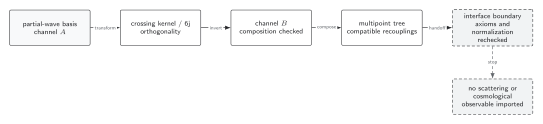
Schematic method interface. Crossing kernels and multilightcone limits transfer only after the target object’s spectrum, ordering, distributional support, factorization, and observable map satisfy the hypotheses of the selected theorem.
A celestial partial-wave expansion can legitimately use harmonic analysis on its continuous spectrum. That does not make its coefficients positive OPE squares. A cosmological wavefunction coefficient can legitimately obey conformal Ward identities and factorization on partial-energy poles. That does not make it a Euclidean Schwinger function. In both cases, dispersion reasoning may survive in a modified form because analyticity and discontinuities remain meaningful, but its contour, growth, and subtraction data must be derived for the physical object.
Two minimal checks
Section titled “Two minimal checks”Celestial check. Apply a Lorentz transformation to . The Mellin transform converts the energy rescaling into the primary factor with and . This verifies covariance. The surviving momentum delta function shows immediately why covariance alone does not prove an ordinary separated-point correlator.
Cosmological check. A conformally covariant scalar two-point kernel has trimmed momentum dependence
For , this is , an oscillatory phase rather than a positive Euclidean spectral density. The transformation law is correct, but an ordinary reflection-positivity argument is unavailable without additional structure.
Exact handoffs
Section titled “Exact handoffs”- The energy Mellin transform, incoming/outgoing prescription, infrared-safe scattering observable, and inverse transform remain with celestial amplitudes.
- Cosmological backgrounds, initial states, in-in contours, gauge-invariant perturbations, and observables continue in quantum fields in cosmology, especially vacuum choice and initial-state effects.
- A proposed dS/CFT dictionary or bulk interpretation continues with late-time wavefunctions and boundary data. Celestial holographic completeness questions continue with the celestial CFT and scattering interface.
This page’s conclusion is deliberately narrower: conformal kinematics may be transferred object by object, while positivity, locality, spectral discreteness, and inversion domains must be proved again.
Exercises
Section titled “Exercises”A celestial four-point transform is covariant and supported on . Which ordinary scalar-CFT inputs have been established, and which remain missing before applying a positive double-discontinuity functional?
Solution
Global conformal covariance and the distributional support are established. One still needs a suitable local OPE with convergence on the support or its regulated extension, an inner product giving nonnegative coefficients, a precise channel continuation, and growth conditions that permit swapping and discard the arc. Scattering unitarity does not supply these ingredients in the ordinary Euclidean-CFT form without a derivation.
References
Section titled “References”- Arkani-Hamed, Nima, Daniel Baumann, Hayden Lee, and Guilherme L. Pimentel. “The Cosmological Bootstrap: Inflationary Correlators from Symmetries and Singularities.” arXiv:1811.00024 [hep-th] (2018). arXiv:1811.00024.
- Maldacena, Juan. “Non-Gaussian Features of Primordial Fluctuations in Single Field Inflationary Models.” Journal of High Energy Physics 2003, no. 5 (2003): 013. doi:10.1088/1126-6708/2003/05/013.
- Pasterski, Sabrina, Shu-Heng Shao, and Andrew Strominger. “Flat Space Amplitudes and Conformal Symmetry of the Celestial Sphere.” Physical Review D 96, no. 6 (2017): 065026. doi:10.1103/PhysRevD.96.065026.
Original QFT.org content:CC BY 4.0, unless an item supplies different terms. Third-party material retains its own terms.