

Quantum Fields in Cosmology
Quantum fields in an expanding universe are time-dependent oscillators constrained by covariance, canonical normalization, state admissibility, and local renormalization. A mode basis can define a useful particle diagnostic without defining a unique vacuum; a finite power spectrum does not replace a renormalized stress tensor; and a relic abundance is predictive only after the expansion history, matching, dilution, and backreaction are controlled.
Helpful background. Particle creation in time-dependent backgrounds supplies Bogoliubov evolution; adiabatic states supplies ultraviolet control; stress-tensor subtraction schemes supplies local renormalization; and cosmological backreaction benchmarks supplies self-consistency tests.
The FLRW calculation contract
Section titled “The FLRW calculation contract”On spatially flat FLRW,
The last sign follows the site’s Riemann convention. For , set in four dimensions. Its normalized modes satisfy
Thus the site conformal coupling is ; for the curvature potential vanishes. These formulas fix the mode dynamics and symplectic normalization. They do not select positive frequency at every time.
The separation between canonical mode evolution and asymptotic particle interpretation is developed explicitly by Parker 1969, §§II–IV, pp. 1059–1067. The observable-specific adiabatic construction of a conserved homogeneous stress tensor is given by Parker and Fulling 1974, §§II–IV, pp. 344–352.
Every calculation in the chapter should name:
- the scale factor and differentiability class;
- field spin, mass, curvature or background coupling, and canonical variable;
- initial state or density matrix and its ultraviolet order;
- observable—particle diagnostic, correlator, local composite, abundance, or mean stress;
- subtraction and finite local gravitational couplings;
- matching history, physical cutoff hierarchy, and numerical error;
- the first hierarchy that is no longer controlled.
The structure map should be read from modes and state through an explicitly chosen observable, then through subtraction or late-time transfer, and only afterward into relic or backreaction conclusions.

Cosmological QFT separates mode evolution, state choice, basis-dependent particles, local renormalization, relic transfer, and mean backreaction. Schematic; not to scale.
Routes through the chapter
Section titled “Routes through the chapter”- FLRW fields and mode quantization derives the scalar oscillator and Wronskian.
- Conformal and minimally coupled scalars isolates curvature coupling and expansion history.
- Spinor and gauge fields preserves tetrad, gauge, and polarization constraints.
- Adiabatic particle number treats a controlled but basis-dependent diagnostic.
- Adiabatic subtraction renormalizes local observables to the required order.
- Vacuum choice and initial-state effects separates ultraviolet admissibility from infrared preparation.
- Initial density matrices and boundary EFT encodes mixed and excited states with boundary counterterms.
- Bunch–Davies, Euclidean, and alpha states tests de Sitter analyticity and singularities.
- Trans-Planckian initial-state sensitivity states the EFT ceiling.
- Gravitational production of massive relics converts late-time modes into abundance.
- Mode matching across cosmological eras preserves canonical data through transitions.
- Renormalized stress and FLRW backreaction solves the constrained mean system.
Domain and failure conditions
Section titled “Domain and failure conditions”This is the canonical comparison table for the chapter.
| Task | Required data | Quantity computed | Controlled statement | Decisive check | Failure or handoff |
|---|---|---|---|---|---|
| Scalar modes | , canonical variable | Normalized | Field algebra and two-point function | Wronskian | A time-dependent basis is not a preferred particle notion |
| Conformal comparison | Spin/coupling and conformal state | Rescaled mode equation | No production for massless conformally invariant free fields | Flat oscillator after rescaling | Anomaly or interactions can leave local stress |
| Spinor/gauge modes | Tetrad, spin structure, gauge, constraints | Physical mode functions | Fermionic or transverse field algebra | Anti/commutator and constraint propagation | Gauge/tetrad artifacts do not define production |
| Adiabatic particles | WKB order and asymptotic regime | Late-time occupation with a remainder estimate | Stability across orders | Intermediate-time number is basis dependent | |
| Local subtraction | State, modes, observable, finite couplings | or | Local covariant observable | Second order for , fourth for in 4D; conservation | Subtraction is not state preparation |
| Gaussian state | Initial mode covariance and UV asymptotics | Power/correlation/stress differences | Admissible family of states | Hadamard or sufficient adiabatic order | UV regularity does not fix infrared data |
| Boundary EFT | Initial slice, density kernel, cutoff, operators | Modified propagator/correlator | Expansion in physical scales over | Positivity and boundary RG | Unbounded density matrix or unsuppressed operators |
| de Sitter state | Patch, analytic continuation, mass/coupling | Two-point function | BD/Euclidean equivalence in its domain | Hadamard wavefront and loop counterterms | Formal alpha states add singularities |
| Trans-Planckian effect | UV completion encoded by boundary coefficients | EFT correction with error | Model-dependent suppressed sensitivity | Slice independence after running; stress bound | No generic prediction above the cutoff |
| Relic production | Smooth history, late adiabatic basis, entropy history | , , or yield | Model abundance with matching error | Smooth-transition and WKB convergence | A discontinuity-dominated yield is unphysical |
| Era matching | Canonical data and junction regularity | Symplectic transfer matrix | Preserved Wronskian and phase | Smooth-family convergence | Artificial junction particles |
| Backreaction | Renormalized , state–geometry data, couplings | Coupled and modes | Mean semiclassical solution | Friedmann constraint and conservation | Scheme, state, truncation, or numerical error dominates |
The failure map emphasizes four category errors: treating particle number as local stress, changing the state while claiming a subtraction change, promoting cutoff sensitivity to a UV prediction, and inserting a nonconserved stress into the Friedmann equation.
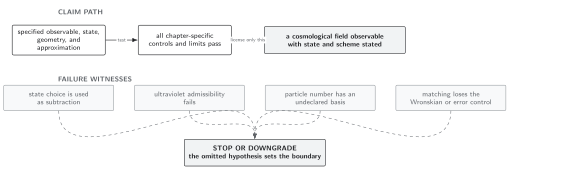
Each cosmological conclusion has a distinct failure test; passing mode normalization alone does not license a particle, relic, or backreaction claim. Schematic; not to scale.
References
Section titled “References”- Parker, L., “Quantized Fields and Particle Creation in Expanding Universes. I,” Physical Review 183, 1057–1068 (1969), doi:10.1103/PhysRev.183.1057.
- Parker, L., and S. A. Fulling, “Adiabatic Regularization of the Energy-Momentum Tensor of a Quantized Field in Homogeneous Spaces,” Physical Review D 9, 341–354 (1974), doi:10.1103/PhysRevD.9.341.
Original QFT.org content:CC BY 4.0, unless an item supplies different terms. Third-party material retains its own terms.