

Ground, KMS, and Symmetry-Selected States
Ground and thermal equilibrium states are defined relative to a specified time-evolution automorphism. A stationary Killing field can supply that evolution, but its normalization, domain, and spectral properties matter. Ground-state positivity and the Kubo–Martin–Schwinger condition can distinguish useful states when the flow is well behaved; neither provides a geometry-independent vacuum prescription.
Required background. Quasifree States and Two-Point Functions supplies the scalar state conditions. Vacuum Ambiguity, Time Flow, and Observer Dependence explains why a time flow is extra structure. Thermal Density Operators and the KMS Condition supplies the finite-system comparison.
Helpful background. Infinite-Volume KMS States explains why a density matrix need not exist. Local Covariance, Isometric Embeddings, and Boundaries supplies the geometric scope. Internal, Spacetime, Discrete, and Antiunitary Symmetries clarifies which transformations act linearly or antiunitarily.
A declared dynamical system
Section titled “A declared dynamical system”Let be an observable algebra with a strongly continuous one-parameter group of star automorphisms. A state is invariant if . In its GNS representation, invariance gives a unitary group
It is a ground state for this flow if the implementing generator has nonnegative spectrum, . The zero of energy is fixed by leaving the cyclic vector invariant. This is a statement about the chosen , not about all observers.
A state is KMS at inverse temperature if, for suitable , there is a bounded function analytic in , continuous on the boundary, and satisfying
This analytic boundary condition remains meaningful in infinite systems where is not trace class Haag, Hugenholtz, and Winnink 1967, § 2, pp. 219–224. A KMS state is invariant, but invariance alone does not imply KMS analyticity.
First application: one ultrastatic generator
Section titled “First application: one ultrastatic generator”On an ultrastatic spacetime, let the positive spatial operator be and put . Assume zero modes are absent or treated separately. For one spectral mode of frequency , the ground-state occupation is zero, while the -KMS occupation is
Using the same normalized positive-frequency modes , the two-point functions have the schematic spectral forms
and
Both have the same antisymmetric part. At high frequency decays exponentially, so their difference is smooth under the standard spectral hypotheses; the ground and finite-temperature states are both Hadamard. The calculation compares two state selections for one fixed generator. It does not identify temperature without specifying how the Killing parameter relates to proper time.
Normalization and existence tests
Section titled “Normalization and existence tests”Rescale the generator by a positive constant, so that . The same KMS state then has
Therefore a quoted temperature is incomplete unless the time flow is normalized, for example by the proper time of a specified observer or by an asymptotic convention. Ground-state spectrum positivity survives a positive rescaling, but numerical energies do not.
Existence is also nontrivial. If the stationary generator becomes spacelike, if bosonic superradiant modes give negative conserved frequency, or if incompatible horizon regularity conditions are imposed, a globally regular invariant ground or KMS state may fail to exist. The Kay–Wald analysis of bifurcate Killing horizons shows how symmetry, regularity, and thermal properties interact under precise assumptions Kay and Wald 1991, §§ 5–7.
The adversarial test is to rescale an unnormalized Killing field and call the new numerical a new physical temperature, or to impose a Bose factor on a superradiant spectrum without checking positivity. The strongest surviving claim is equilibrium relative to a declared automorphism flow on the region where that flow and state exist.
Selection is not universality
Section titled “Selection is not universality”Symmetry can reduce ambiguity dramatically: an ultrastatic ground state may be unique within a stated regular quasifree class. Yet there is no nontrivial state choice natural on every spacetime under the standard locally covariant and dynamical-locality assumptions Fewster and Verch 2015, § 6. Stationarity, KMS analyticity, discrete symmetry, horizon regularity, and boundary conditions are separate requirements and may be mutually incompatible.
Domain and failure conditions
Section titled “Domain and failure conditions”Ground and KMS conditions occupy the rightmost selection box of the construction map. They apply only after a positive admissible state and a normalized automorphism flow have been specified; the flow is part of the hypothesis rather than a consequence of Hadamard form.

Spectrum positivity or KMS analyticity can select relative to one declared evolution, while Hadamard admissibility alone cannot. Schematic; not to scale.
The zero-mode and symmetry-versus-uniqueness witnesses are especially relevant here. A zero mode can obstruct a bosonic ground covariance, and invariance under a Killing flow does not establish uniqueness; superradiance or an unnormalized generator further narrows the thermal claim.
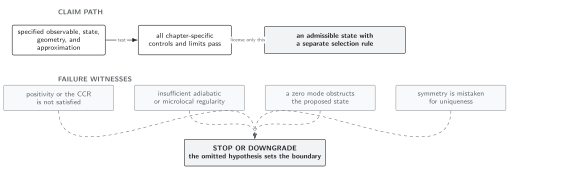
Existence, normalization, regularity, and uniqueness must be checked separately for the chosen dynamics. Schematic; not to scale.
The relation to other selectors is summarized in Domain and failure conditions.
Handoffs
Section titled “Handoffs”States of Low Energy and Smeared-Energy Selection replaces unavailable global stationarity with a sampled operational criterion. Instantaneous Vacua, Alpha Vacua, Sorkin–Johnston States, and Failure Tests compares selectors that can fail ultraviolet or auxiliary-choice tests. Proof-level KMS theory continues in C-Star Dynamical Systems and the KMS Condition, while the obstruction to a universal choice continues in No Natural States and Covariant State Spaces.
References
Section titled “References”- Fewster, Christopher J., and Rainer Verch. “Algebraic Quantum Field Theory in Curved Spacetimes.” In Advances in Algebraic Quantum Field Theory, edited by Romeo Brunetti et al., 125–189. Springer, 2015. arXiv:1504.00586.
- Haag, Rudolf, Nicolaas M. Hugenholtz, and Marinus Winnink. “On the Equilibrium States in Quantum Statistical Mechanics.” Communications in Mathematical Physics 5 (1967): 215–236. DOI.
- Kay, Bernard S., and Robert M. Wald. “Theorems on the Uniqueness and Thermal Properties of Stationary, Nonsingular, Quasifree States on Spacetimes with a Bifurcate Killing Horizon.” Physics Reports 207 (1991): 49–136. DOI.
Original QFT.org content:CC BY 4.0, unless an item supplies different terms. Third-party material retains its own terms.