

Horizon-Restricted Local Operations and Distillability
A horizon limits which local observables and operations a laboratory can access; it does not automatically supply an exact tensor factor or a partial trace. In continuum QFT the robust subsystem data are commuting local algebras. Entanglement witnesses and distillation tasks must therefore be formulated in terms of accessible algebras, with a split inclusion or another explicit subsystem construction whenever density matrices are used.
Required background. Local Field Algebras, Causality, and the Time-Slice Property supplies the net of local algebras. Causal Support, Signaling, and Global Geometry fixes horizon accessibility. Local Operations, Separability, and Distillability in QFT gives algebraic entanglement tasks.
Helpful background. Algebraic Quantum Channels and Localized Operations supplies local completely positive maps. Centers, Edge Extensions, and Distillable Entanglement treats nontrivial centers and gauge constraints. Selective Operations, Postselection, and State Update states the conditioning cost.
Accessible algebras across a horizon
Section titled “Accessible algebras across a horizon”Let and be causally complementary wedge-like regions, or finite subregions contained in the exterior domains available to two laboratories. Assign von Neumann algebras
in the GNS representation of a declared state . Microcausality gives when the regions are spacelike separated. The bipartite object is the commuting pair together with the restricted state
This restriction is always meaningful. What generally fails is the stronger identification
because local algebras of relativistic QFT are ordinarily type III. Consequently there need not be a density matrix for the sharp geometric region, even though is a perfectly good state.
The split property and a finite collar
Section titled “The split property and a finite collar”Choose nested regions separated by a nonzero collar. The split property supplies a type I factor such that
This intermediate algebra supports an ordinary subsystem representation and density matrices, but it depends on the collar and on the chosen split implementation. Shrinking the collar to zero can make entanglement and energy costs diverge. The mathematical structure of standard split inclusions is developed by Doplicher and Longo 1984, pp. 493–536; its use is therefore a theorem with hypotheses, not a decorative regulator.
For a horizon problem, take strictly inside the right accessible region and a slightly larger region still accessible to the right laboratory, with analogous left regions. A split inclusion on each side defines finite-resolution laboratory subsystems. The split distance is part of the protocol, as are detector bandwidth, operation time, and any energy needed to localize the controls.
Witnesses and distillation operations
Section titled “Witnesses and distillation operations”An algebraic CHSH witness uses self-adjoint contractions and :
A value rules out separability for the stated commuting-algebra pair. Vacuum sectors of AQFT can exhibit strong Bell correlations under appropriate hypotheses Summers and Werner 1987, pp. 2448–2456. This is a structural QFT result. It does not say that finite detectors can attain the optimum at bounded energy.
One-copy distillation can be formulated without an initial tensor factor: seek completely positive maps
such that the induced two-qubit functional
is entangled, with normalization and success probability stated for selective maps. Repetition, classical communication, and postselection define a specific distillation protocol. General algebraic criteria and partial-transpose tests for QFT systems are given by Verch and Werner 2005, §§ 3–5.
Two wedge laboratories with finite split distance
Section titled “Two wedge laboratories with finite split distance”Specify a bifurcate Killing horizon and a Hadamard state regular in the regions used. Choose compact laboratory regions on opposite sides of a finite buffer, not sharp half-spaces ending exactly at the horizon. The operational calculation proceeds as follows:
- Construct and from observables supported in the two laboratory worldtubes.
- Verify commutation during the measurement interval and establish the split inclusion for the chosen collars.
- Select smeared bounded functions of field observables or detector-induced POVMs that realize .
- Evaluate with uncertainties and compare with the classical bound.
- If claiming distillability, provide the maps , success probability, number of copies, communication allowed, and energy or localization bounds.
A horizon may prevent one laboratory from implementing an operation on the other side or from receiving its classical message. The witness can still diagnose correlations of the mathematical bipartite pair, while the declared distillation task may be impossible under those communication constraints. Correlation, extractability, and usable entanglement are distinct conclusions.
The formal-trace adversarial test
Section titled “The formal-trace adversarial test”Start from a calculation that writes solely because is “behind” a horizon. Ask which type I tensor factor defines that trace. If none is supplied, replace the density matrix by the restricted state and reformulate every observable claim algebraically. If a split factor is introduced, report its collar dependence and rerun the witness as the collar changes.
What survives may include KMS properties of the wedge restriction, expectation values of accessible observables, or an algebraic entanglement witness. A literal finite entropy, qubit count, or distillation rate does not survive without the subsystem and resource specification. Nor does failure of access establish global information destruction.
Domain, limits, and maps
Section titled “Domain, limits, and maps”See the canonical Domain and failure conditions. Split inclusions require phase-space or nuclearity conditions and separated regions; gauge theories and gravity can require centers, dressings, or edge extensions. The Reeh–Schlieder property supports strong correlation results but does not provide cost-free operational preparation.
The structure map emphasizes that restriction to an accessible algebra is a distinct map after propagation. Inspect that box before assigning entropy or channel noise to a horizon.

Accessible local algebras define the operational bipartition; a finite split collar can supply an approximate type I subsystem for specified measurements. Schematic; not to scale.
The failure map’s horizon witness asks for the missing algebra. If the answer is only a geometric label, density-matrix claims must be reformulated or withdrawn.
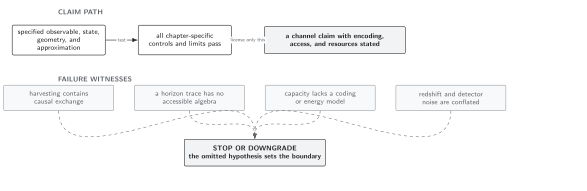
Sharp region restriction licenses accessible-observable statements; entropy and distillation claims require an explicit subsystem or commuting-algebra protocol. Schematic; not to scale.
Handoffs
Section titled “Handoffs”Entanglement Distribution and State Transfer Through Curved Fields defines complete receiver access for transfer tasks. Centers, Edge Extensions, and Distillable Entanglement treats constrained theories. Black-hole information questions require a separately defined global task and do not follow from this local restriction alone.
References
Section titled “References”- Doplicher, Sergio, and Roberto Longo. “Standard and Split Inclusions of von Neumann Algebras.” Inventiones Mathematicae 75 (1984): 493–536. DOI.
- Summers, Stephen J., and Reinhard Werner. “Bell’s Inequalities and Quantum Field Theory. II. Bell’s Inequalities Are Maximally Violated in the Vacuum.” Journal of Mathematical Physics 28 (1987): 2448–2456. DOI.
- Verch, Rainer, and Reinhard F. Werner. “Distillability and Positivity of Partial Transposes in General Quantum Field Systems.” Reviews in Mathematical Physics 17 (2005): 545–576. DOI. Open PDF.
Original QFT.org content:CC BY 4.0, unless an item supplies different terms. Third-party material retains its own terms.